Loading...
Done
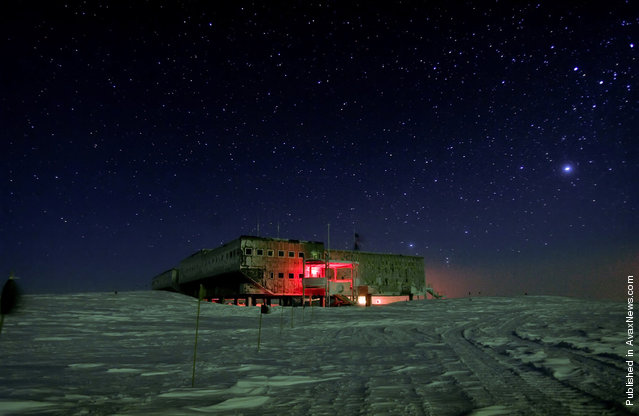
Amundsen-Scott South Pole Station experiences months of darkness. The sun dips below the horizon on March 21, after which follows several weeks of twilight before complete darkness results

Amundsen-Scott South Pole Station experiences months of darkness. The sun dips below the horizon on March 21, after which follows several weeks of twilight before complete darkness results. Photo taken on June 25, 2009. (National Science Foundation/Jeremy Johnson)
Details
08 Apr 2012 13:07:00
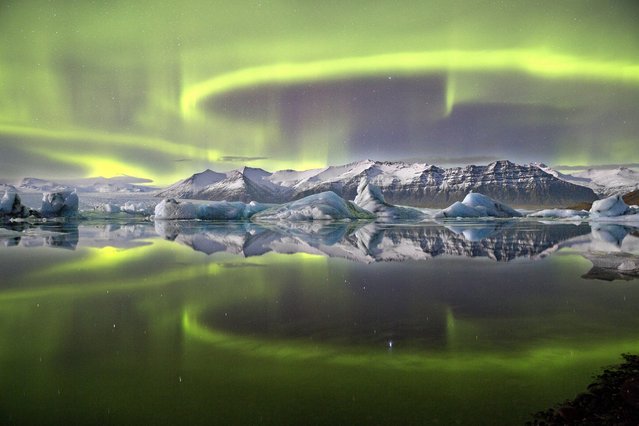
“Aurora over a glacier lagoon”. A vivid green overheaded aurrora pictured in Iceland's Vatnajokull National Park reflected almost symetrically in Jokulsrlon Glacier lagoon. A complete lack of wind and currrent combin in this sheltred lagoon scene to crete an arresting mirror effect giving the image a sensation of utter stillness. Despite theis there is motion on a suprising scale, as the loops and arcs of the aurora are shaped by the shifting forces of the Earth's magnetic field. (Photo by  James Woodend/The Astronomy Photographer of the Year 2014 Contest)

“Aurora over a glacier lagoon”. A vivid green overheaded aurrora pictured in Iceland's Vatnajokull National Park reflected almost symetrically in Jokulsrlon Glacier lagoon. A complete lack of wind and currrent combin in this sheltred lagoon scene to crete an arresting mirror effect giving the image a sensation of utter stillness. Despite theis there is motion on a suprising scale, as the loops and arcs of the aurora are shaped by the shifting forces of the Earth's magnetic field. James Woodend of Great Britain won the grand prize with the image, beating out more than 2,500 other entries. The Astronomy Photographer of the Year 2014 contest is judged by the Royal Observatory Greenwich and BBC Sky at Night magazine. (Photo by James Woodend/The Astronomy Photographer of the Year 2014 Contest)
Details
26 Sep 2014 13:39:00
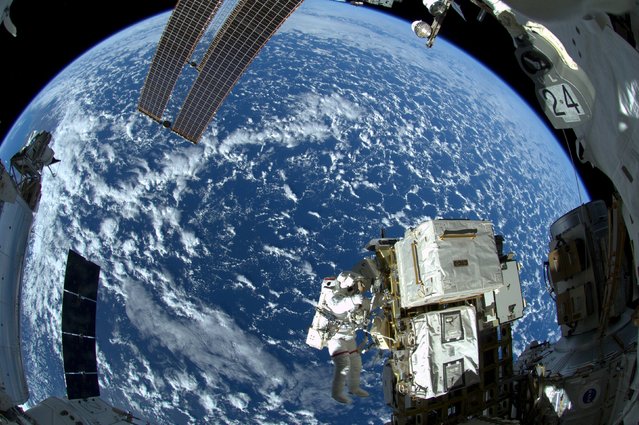
NASA astronaut Reid Wiseman and European Space Agency astronaut Alexander Gerst (not shown) works outside the space station's Quest airlock in the first of three spacewalks for the Expedition 41 crew aboard the International Space Station in this NASA image released October 8, 2014. (Photo by Reuters/NASA)

NASA astronaut Reid Wiseman and European Space Agency astronaut Alexander Gerst (not shown) works outside the space station's Quest airlock in the first of three spacewalks for the Expedition 41 crew aboard the International Space Station in this NASA image released October 8, 2014. (Photo by Reuters/NASA)
Details
05 Nov 2015 08:02:00
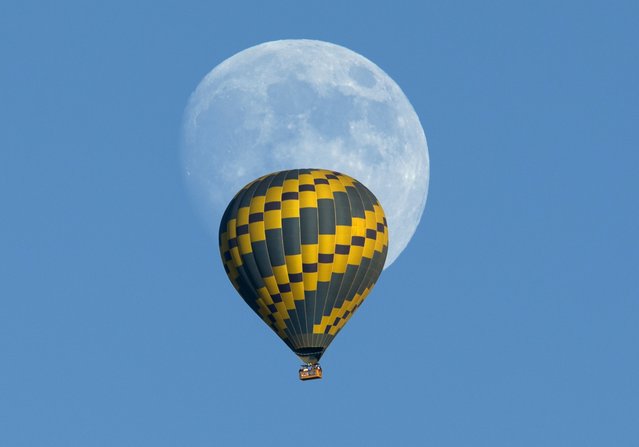
A hot air balloon floats past an almost full rising moon on a warm fall evening near Encinitas, California October 5, 2014. (Photo by Mike Blake/Reuters)

A hot air balloon floats past an almost full rising moon on a warm fall evening near Encinitas, California October 5, 2014. (Photo by Mike Blake/Reuters)
Details
09 Nov 2014 09:42:00
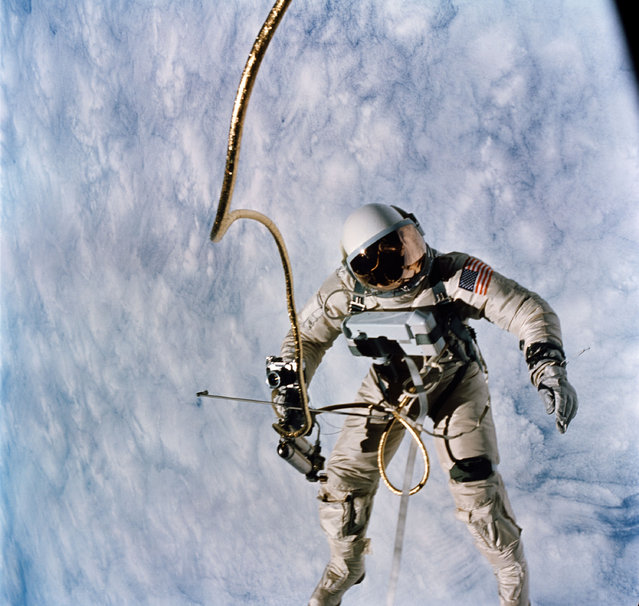
Astronaut Edward H. White II, pilot for the Gemini-Titan 4 (GT-4) spaceflight, floats in the zero-gravity of space during the third revolution of the GT-4 spacecraft on June 3, 1965. White wears a specially designed spacesuit. His face is shaded by a gold-plated visor to protect him from unfiltered rays of the sun. (Photo by NASA)

Astronaut Edward H. White II, pilot for the Gemini-Titan 4 (GT-4) spaceflight, floats in the zero-gravity of space during the third revolution of the GT-4 spacecraft on June 3, 1965. White wears a specially designed spacesuit. His face is shaded by a gold-plated visor to protect him from unfiltered rays of the sun. In his right hand he carries a Hand-Held Self-Maneuvering Unit (HHSMU) that gives him control over his movements in space. White also wears an emergency oxygen chest pack; and he carries a camera mounted on the HHSMU for taking pictures of the sky, Earth and the GT-4 spacecraft. He is secured to the spacecraft by a 25-feet umbilical line and a 23-feet tether line. Both lines are wrapped together in gold tape to form one cord. Astronaut James A. McDivitt, command pilot, remained inside the spacecraft during the extravehicular activity (EVA). Astronaut White died in the Apollo/Saturn 204 fire at Cape Kennedy on January 27, 1967. (Photo by NASA)

Details
22 Jul 2014 12:05:00
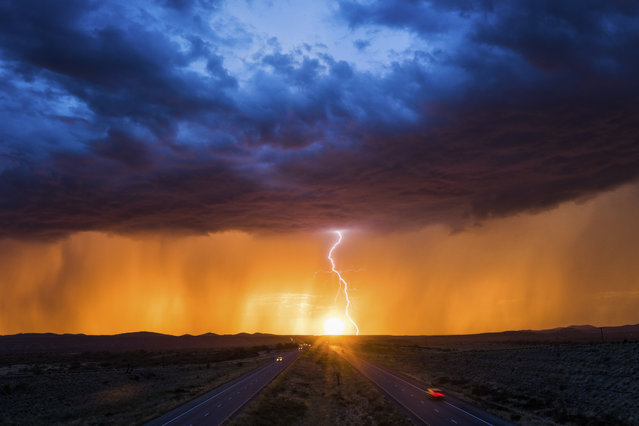
A stunning monsoon sunset coupled with intense lightning creating an amazing scene on August 26, 2017. (Photo by Mike Olbinski/Caters News Agency)

While most people head for cover at the first sign of a storm, this man runs straight toward it. Storm chaser and father of three Mike Olbinski is addicted to photographing extreme weather and regularly takes on tornadoes and supercell thunderstorms in a bid to capture extraordinary images. The photographer, from Phoenix, often travels hundreds of miles a day to reach the eye of a storm. He first became hooked on the unusual hobby almost a decade ago, following the birth of his daughter. Here: A stunning monsoon sunset coupled with intense lightning creating an amazing scene on August 26, 2017. (Photo by Mike Olbinski/Caters News Agency)
Details
06 Dec 2017 07:24:00
A boy bursts a soap-bubble at Gorky Park in Moscow on July 19, 2017. (Photo by Mladen Antonov/AFP Photo)

A boy bursts a soap-bubble at Gorky Park in Moscow on July 19, 2017. (Photo by Mladen Antonov/AFP Photo)
Details
13 Dec 2017 07:30:00
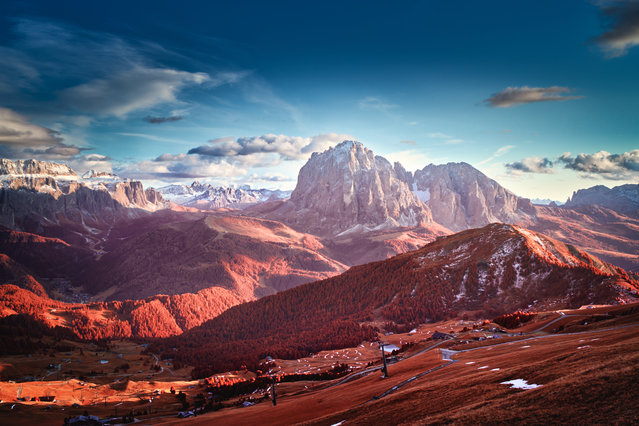
Lights and Shadows in the Dolomites, in the landscape infrared category. (Photo by Tomasz Grzyb/Kolari Vision)

A selection of winning images from the Life in Another Light photo contest 2020, from Kolari Vision. Here: Lights and Shadows in the Dolomites, in the landscape infrared category. (Photo by Tomasz Grzyb/Kolari Vision)
Details
29 Jan 2021 09:48:00