Loading...
Done
Baby Fennec Fox

The fennec fox or fennec (Vulpes zerda) is a small nocturnal fox found in the Sahara of North Africa.


Please Subscribe To: Our Youtube Channel
Details
10 Dec 2016 23:01:00
Norwegian Trolls By Ivar Rodningen Part 1

Ivar Rodningem is a professional illustrator, whose imaginative mind transports us into a parallel world where trolls roam the lands.

Please Subscribe To: Our Youtube Channel
Details
19 Dec 2016 23:59:00


PassCode – Bite the Bullet (Full Version) 【テレビ東京系ドラマ「フリンジマン」主題歌】
Details
26 Feb 2019 00:03:00


Masahiko Kondō, Nana Mizuki and Lalisa Manoban (近藤真彦, 水樹奈々 and LiSA) – Midnight Shuffle (ミッドナイト・シャッフル)
Details
21 Nov 2019 00:03:00


SOFI TUKKER – Swing (Official Music Video). Sofi Tukker is a German American musical duo based in New York consisting of Sophie Hawley-Weld (German) and Tucker Halpern (American). In December 2018 their album Treehouse was nominated for a Grammy for Best Dance/Electronic Album.
Details
30 Nov 2019 00:03:00


티아라 (T-ara) – 롤리폴리 (Roly Poly) Dance Cover by C.A.C’s Trainees Vietnam (K-pop in Public Challenge)
Details
05 Jun 2021 08:59:00
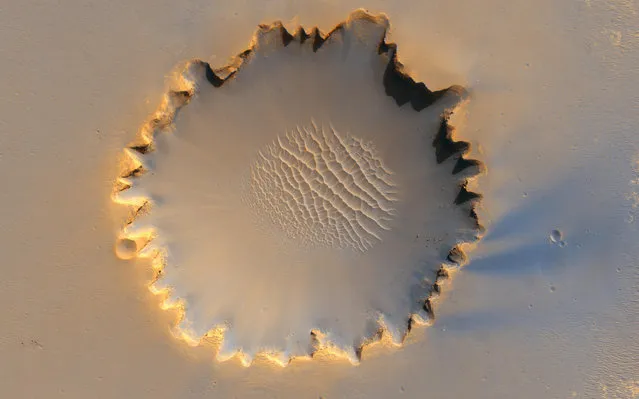
NASA's rover Opportunity visits Victoria Crater, viewed from orbit by the High Resolution Imaging Science Experiment on NASA's Mars Reconnaissance Orbiter in october of 2006. Opportunity is a small dot on the crater's lip, at top right. Opportunity first reached the crater's rim on September 27, 2006. (Photo by NASA/JPL-Caltech/University of Arizona/The Atlantic)

“NASA's Mars rover Opportunity just celebrated its ninth anniversary on Mars – a mission that was originally meant to last just 90 days...” – The Atlantic. Photo: NASA's rover Opportunity visits Victoria Crater, viewed from orbit by the High Resolution Imaging Science Experiment on NASA's Mars Reconnaissance Orbiter in october of 2006. Opportunity is a small dot on the crater's lip, at top right. Opportunity first reached the crater's rim on September 27, 2006. (Photo by NASA/JPL-Caltech/University of Arizona via The Atlantic)


Details
14 Feb 2013 10:58:00
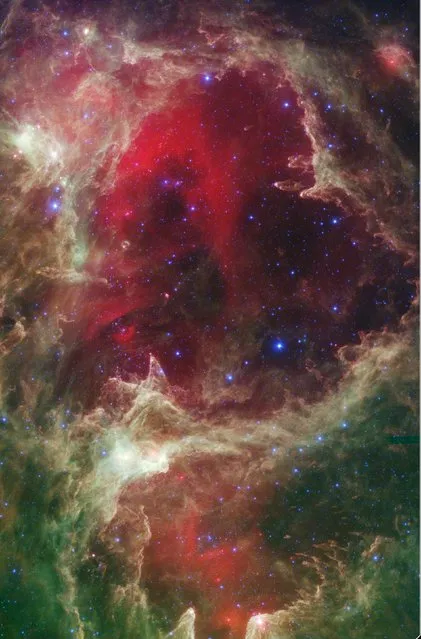
An infrared portrait from NASA's Spitzer Space Telescope which shows generations of stars is seen in this undated NASA handout image released February 14, 2013. In this wispy star-forming region, called W5, the oldest stars can be seen as blue dots in the centers of the two hollow cavities (other blue dots are background and foreground stars not associated with the region). Red shows heated dust that pervades the region's cavities, while green highlights dense clouds. (Photo by NASA/Reuters/JPL-Caltech/Harvard-Smithsonian/Handout)


An infrared portrait from NASA's Spitzer Space Telescope which shows generations of stars is seen in this undated NASA handout image released February 14, 2013. In this wispy star-forming region, called W5, the oldest stars can be seen as blue dots in the centers of the two hollow cavities (other blue dots are background and foreground stars not associated with the region). Red shows heated dust that pervades the region's cavities, while green highlights dense clouds. (Photo by NASA/Reuters/JPL-Caltech/Harvard-Smithsonian/Handout)

Details
03 Mar 2013 08:44:00