Loading...
Done
Developed for the British American Ambulance Corps, this new motorcycle ambulance is capable of speeding wounded soldiers 90 miles an hour from the front lines to field hospitals. Its springs are synchronized with the patient?s heartbeat to avoid increasing fever when traveling over various Terrain. Viewing it in New York  August 27, 1941, are left to right: constable Herbert Scott of England, driver; William E. Detlor, whose firm developed the vehicle; M. W. Stand, inspector-general of Civilian Defense, and Maj. Edward Riekert, also. (Photo by AP Photo)

Developed for the British American Ambulance Corps, this new motorcycle ambulance is capable of speeding wounded soldiers 90 miles an hour from the front lines to field hospitals. Its springs are synchronized with the patient's heartbeat to avoid increasing fever when traveling over various Terrain. Viewing it in New York August 27, 1941, are left to right: constable Herbert Scott of England, driver; William E. Detlor, whose firm developed the vehicle; M. W. Stand, inspector-general of Civilian Defense, and Maj. Edward Riekert, also. (Photo by AP Photo)
Details
28 Aug 2015 11:51:00
In this Sunday June 13, 1988 file photo West German police officers arrest an English soccer hooligan who sticks out his tongue. Rioting broke out between some 100 hooligans and the police in downtown Stuttgart, West Germany following the European Soccer Championships match between England and Ireland. England was defeated by Ireland 0-1. (Photo by Kraufmann/AP Photo/File)

In this Sunday June 13, 1988 file photo West German police officers arrest an English soccer hooligan who sticks out his tongue. Rioting broke out between some 100 hooligans and the police in downtown Stuttgart, West Germany following the European Soccer Championships match between England and Ireland. England was defeated by Ireland 0-1. (Photo by Kraufmann/AP Photo/File)
Details
05 Sep 2021 05:44:00
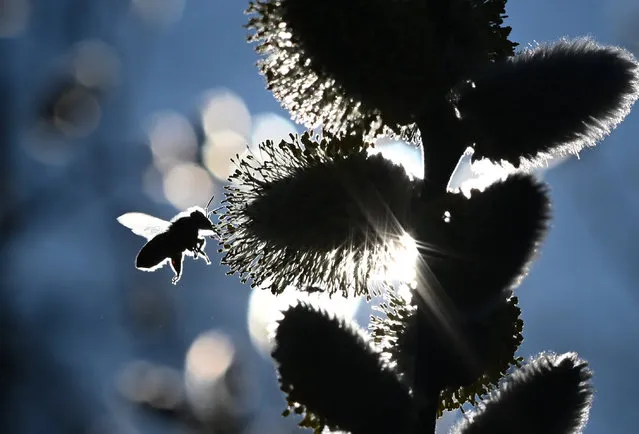
A bee approaching the flowers of a willow in Otzberg, Germany on February 28, 2021. Willow catkins are a protected species and one of the first sources of food for insects in early spring. (Photo by Arne Dedert/DPA)

A bee approaching the flowers of a willow in Otzberg, Germany on February 28, 2021. Willow catkins are a protected species and one of the first sources of food for insects in early spring. (Photo by Arne Dedert/DPA)
Details
10 Apr 2021 05:48:00
Kim Bui of Germany competes in the Women's Uneven Bars Final during the Artistic Gymnastics competition on day 4 of the European Championships Munich 2022 at Olympiapark on August 14, 2022 in Munich, Germany. (Photo by Kai Pfaffenbach/Reuters)

Kim Bui of Germany competes in the Women's Uneven Bars Final during the Artistic Gymnastics competition on day 4 of the European Championships Munich 2022 at Olympiapark on August 14, 2022 in Munich, Germany. (Photo by Kai Pfaffenbach/Reuters)
Details
20 Aug 2022 05:18:00
WWII: Women And The War Effort

These stunning color portraits, produced by the U.S. Office of War Information during World War II depict the role of women in the US war effort. All of the images were shot on 4x5 color transparency film by Howard R. Hollem and Alfred T. Palmer during 1942 and 1943 and were turned over to the Library of Congress Prints and Photographs Division in 1944. They are seen here with their original captions.
Details
18 Aug 2013 13:26:00
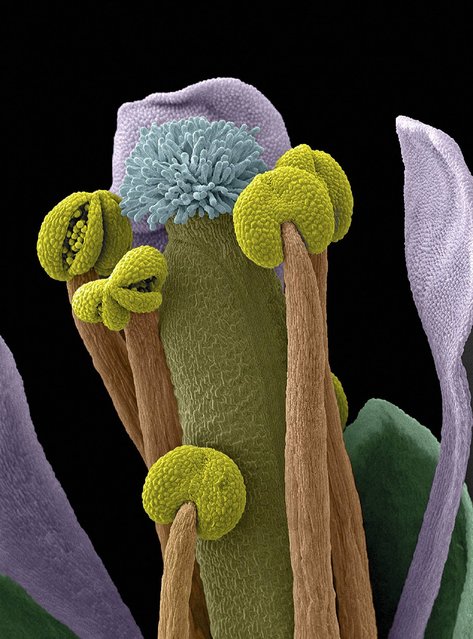
Scanning electron micrograph (SEM) of an Arabidopsis thaliana flower, also commonly known as thale cress. Some of the anthers are open, revealing pollen grains ready for dispersal. Arabidopsis was the first plant to have its entire genome sequenced and is widely used as a model organism in molecular and plant biology. Horizontal width of image is 1200 microns. Magnification 100x. (Photo by Stefan Eberhard/Wellcome Images)

Beautiful, strange and occasionally alarming pictures from the shortlist for this year’s Wellcome image awards – which celebrate the very best in science photography and imaging – from an x-ray of a bat to a micrograph of a kidney stone. The exhibition opens on 12 March at three science centres and the Museum of Science and Industry in Manchester. Photo: Scanning electron micrograph (SEM) of an Arabidopsis thaliana flower, also commonly known as thale cress. Some of the anthers are open, revealing pollen grains ready for dispersal. Arabidopsis was the first plant to have its entire genome sequenced and is widely used as a model organism in molecular and plant biology. Horizontal width of image is 1200 microns. Magnification 100x. (Photo by Stefan Eberhard/Wellcome Images)
Details
11 Mar 2014 05:58:00
Two female holidaymakers relax on an unidentified beach of England, September 21, 1940, as a soldier, eyes straight ahead, stands guard at a barrier built as a defense against possible invasion by Germany. (Photo by AP Photo)

Two female holidaymakers relax on an unidentified beach of England, September 21, 1940, as a soldier, eyes straight ahead, stands guard at a barrier built as a defense against possible invasion by Germany. (Photo by AP Photo)
Details
22 Sep 2015 10:37:00
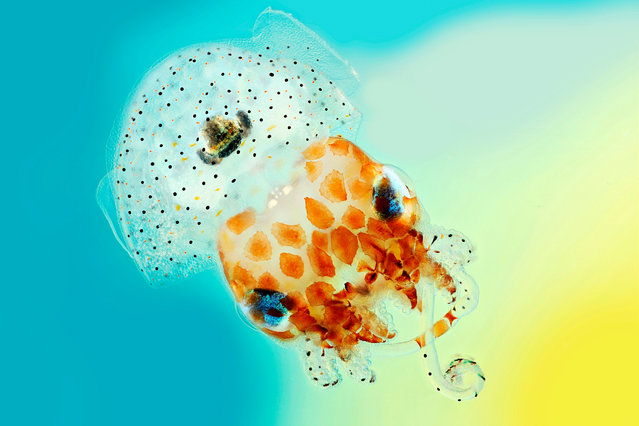
With its huge eyes, comical name and diminutive size, Mark R. Smith’s image of a baby Hawaiian bobtail squid can’t help but raise a smile. A curiously endearing creature, the cephalopod is just 1.5cm across, its mantle cavity bearing more than a passing resemblance to a rather natty shower cap. But it is also a beautiful example of symbiosis – nature’s version of “I’ll scratch your back if you scratch mine” – for on the underside of the squid is a light organ which houses bioluminescent bacteria. The squid offers the bacteria protection and food, while the bacteria emit a glow – a handy trait that the squid uses to offset its silhouette, helping it to evade predators in the depths below. Mark R. Smith’s entry combines several images of a Hawaiian bobtail squid with different focus lengths to create a final picture with greater depth of field than normal. (Photo by Mark R. Smith/Wellcome Images/Macroscopic Solutions)

With its huge eyes, comical name and diminutive size, Mark R. Smith’s image of a baby Hawaiian bobtail squid can’t help but raise a smile. A curiously endearing creature, the cephalopod is just 1.5cm across, its mantle cavity bearing more than a passing resemblance to a rather natty shower cap. But it is also a beautiful example of symbiosis – nature’s version of “I’ll scratch your back if you scratch mine” – for on the underside of the squid is a light organ which houses bioluminescent bacteria. The squid offers the bacteria protection and food, while the bacteria emit a glow – a handy trait that the squid uses to offset its silhouette, helping it to evade predators in the depths below. Mark R. Smith’s entry combines several images of a Hawaiian bobtail squid with different focus lengths to create a final picture with greater depth of field than normal. (Photo by Mark R. Smith/Wellcome Images/Macroscopic Solutions)
Details
08 Mar 2017 00:05:00