Loading...
Done
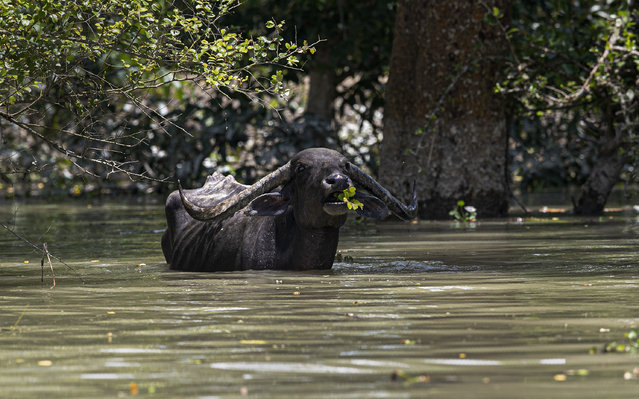
A wild water buffalo eats tree branches standing in flood water at the Pobitora wildlife sanctuary in Pobitora, Morigaon district, Assam, India, Thursday, July 16, 2020. (Photo by Anupam Nath/AP Photo)

A wild water buffalo eats tree branches standing in flood water at the Pobitora wildlife sanctuary in Pobitora, Morigaon district, Assam, India, Thursday, July 16, 2020. Floods and landslides triggered by heavy monsoon rains have killed dozens of people in this northeastern region. The floods also inundated most of Kaziranga National Park, home to an estimated 2,500 rare one-horned rhinos. (Photo by Anupam Nath/AP Photo)
Details
18 Jul 2020 00:01:00
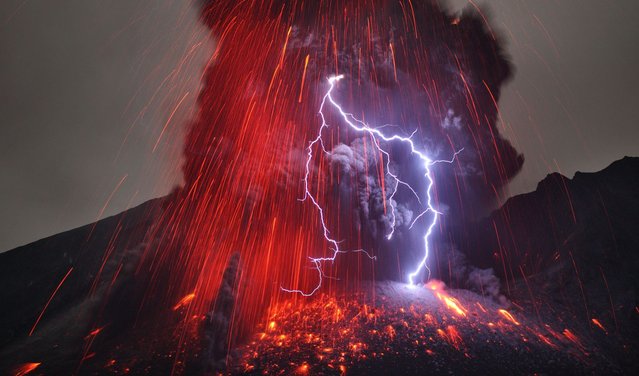
Lightning only ever strikes a volcanic eruption during heavy “vulcanian” or “plinian” explosions when the amount of red lava is very low. (Photo by Martin Rietze/Guzelian)

Martin Rietze is a “volcano-chaser”, a particular breed of photographer who takes big risks for big shots. He was able to capture destructive and beautiful forces of nature at work on a trip to Japan in February 2013. His photos show the Sakurajima Volcano, an active volcanic who's record-breaking 1914 eruption sent lava flows across the island. (Photo by Martin Rietze/Guzelian)
Details
08 Apr 2013 10:49:00


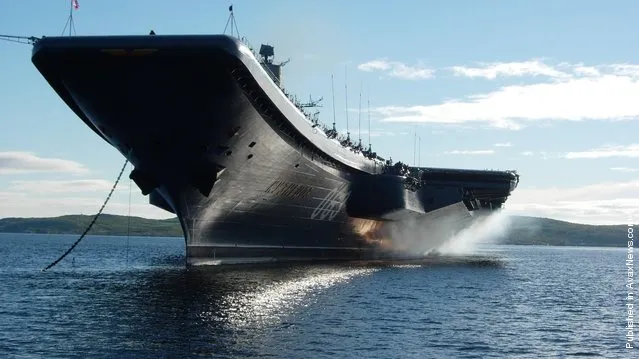
Admiral Flota Sovetskovo Soyuza Kuznetsov (Russian: Адмирал флота Советского Союза Кузнецов “Fleet Admiral of the Soviet Union Kuznetsov”), originally named Riga, renamed Leonid Brezhnev then Tbilisi) is an aircraft cruiser (heavy aircraft carrying missile cruiser (TAVKR) in Russian classification) serving as the flagship of the Russian Navy. She was originally commissioned in the Soviet Navy, and was intended to be the lead ship of her class, but the only other ship of her class, Varyag, was never commissioned and was sold to the People's Republic of China by Ukraine under the condition she would never be refitted for combat. Kuznetsov was named after the Admiral of the Fleet of the Soviet Union Nikolai Gerasimovich Kuznetsov.
Details
20 Nov 2011 03:51:00
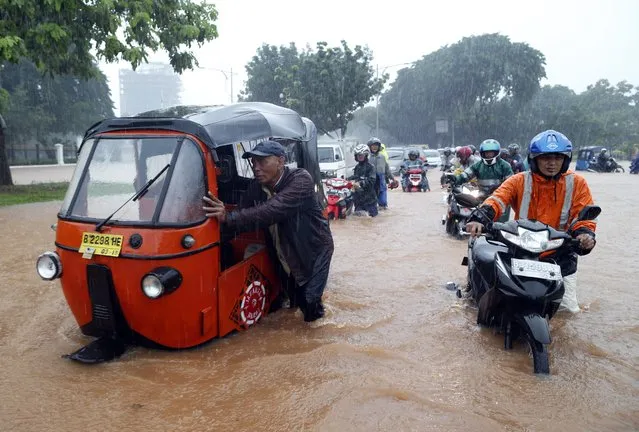
Indonesian motorists push their motorbikes as they wade through a flooded street outside the presidential palace in Jakarta, Indonesia, 09 February 2015. Incessant rain overnight  triggered widespread flooding in the Indonesian capital Jakarta, bringing traffic to a standstill. (Photo by Mast Irham/EPA)

Indonesian motorists push their motorbikes as they wade through a flooded street outside the presidential palace in Jakarta, Indonesia, 09 February 2015. Incessant rain overnight triggered widespread flooding in the Indonesian capital Jakarta, bringing traffic to a standstill. The city hall in central Jakarta and the front lawn of the presidential palace were inundated in up to 20 centimetres of water, television pictures showed, after heavy rain. (Photo by Mast Irham/EPA)
Details
11 Feb 2015 12:55:00
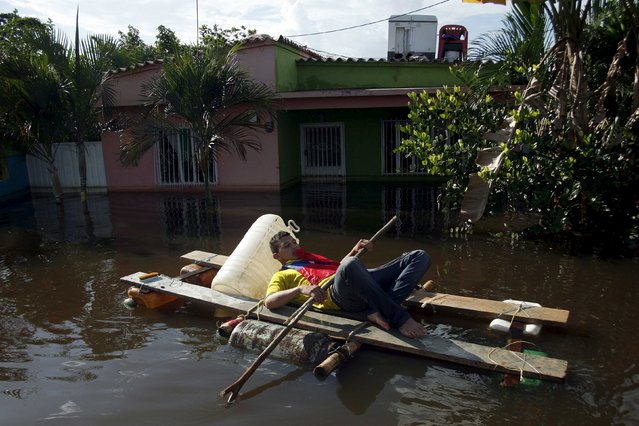
A man paddles a makeshift boat along a flooded street in Guasdualito, in the state of Apure, Venezuela, July 4, 2015. (Photo by Carlos Eduardo Ramirez/Reuters)

A man paddles a makeshift boat along a flooded street in Guasdualito, in the state of Apure, Venezuela, July 4, 2015. A total of 9,000 families have been affected by the overflowing of rivers Arauca and Sarare in Guasdualito, Apure state, because of the heavy rains in recent days in this area of the country, local media reported. (Photo by Carlos Eduardo Ramirez/Reuters)
Details
06 Jul 2015 10:22:00
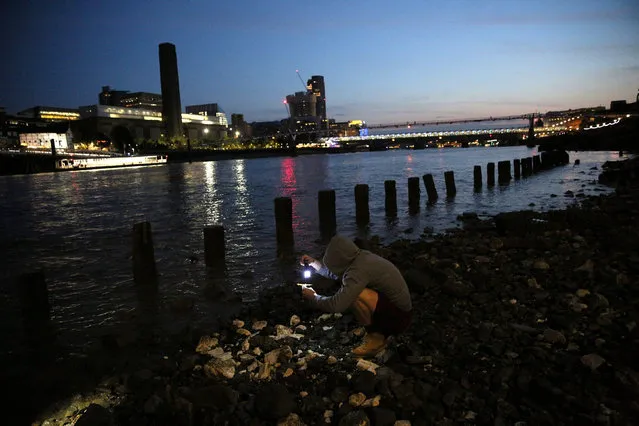
A mudlark uses a torch to look for items on the bank of the River Thames in London, Britain June 06, 2016. Mudlarking is believed to trace its origins to the 18th and 19th century, when scavengers searched the Thames' shores for items to sell. These days, history and archaeology fans are the ones hoping to find old relics such as coins, ceramics, artifacts or everyday items from across centuries. They wait for the low tide and then scour specific areas of exposed shores. "If you're in a field you could be out all day long, with the river you're restricted to about two or three hours," mudlark Nick Stevens said. While many just use the naked eye for their searches, others rely on metal detectors for which a permit from the Port of London Authority is needed. Digging also requires consent. (Photo by Neil Hall/Reuters)

A mudlark uses a torch to look for items on the bank of the River Thames in London, Britain June 06, 2016. Mudlarking is believed to trace its origins to the 18th and 19th century, when scavengers searched the Thames' shores for items to sell. These days, history and archaeology fans are the ones hoping to find old relics such as coins, ceramics, artifacts or everyday items from across centuries. their finds with the Portable Antiquities Scheme. Any item over 300 years old must be recorded. (Photo by Neil Hall/Reuters)
Details
27 Aug 2016 10:43:00
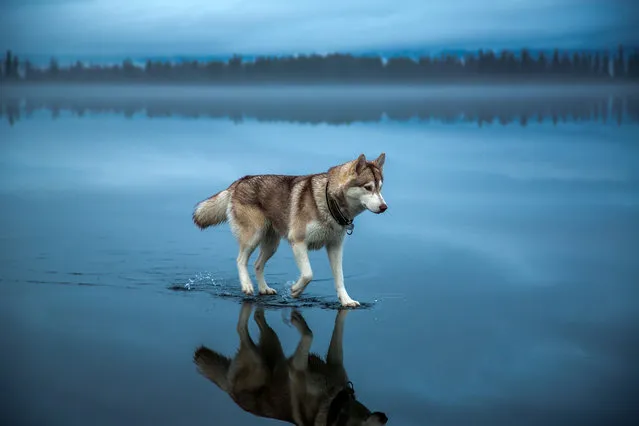
This graceful husky appears to be smarter than your average dog having apparently mastered the art of walking on water. The soft-footed canine was photographed while making its way across a lake in northern Russia. Photographer Fox Grom captured a remarkable set of images after heavy rain fell on a frozen lake to create the amazing illusion. Here: Husky dog Alaska walks on water in Northern Russia, January 2015. (Photo by Fox Grom/Visual Press Agency)

This graceful husky appears to be smarter than your average dog having apparently mastered the art of walking on water. The soft-footed canine was photographed while making its way across a lake in northern Russia. Photographer Fox Grom captured a remarkable set of images after heavy rain fell on a frozen lake to create the amazing illusion. The 40-year-old, who works as an all-terrain vehicle driver, regularly walks his pet dogs, Alaska and Blizzard, near the natural beauty spot. “I always take pictures of my dogs whilst walking them but on this occasion there was an extraordinary phenomenon“, he said. “The ice was already very thick when it rained heavily making for a spectacular scene”. Here: Husky dog Alaska walks on water in Northern Russia, January 2015. (Photo by Fox Grom/Visual Press Agency)
Details
20 Mar 2015 11:46:00
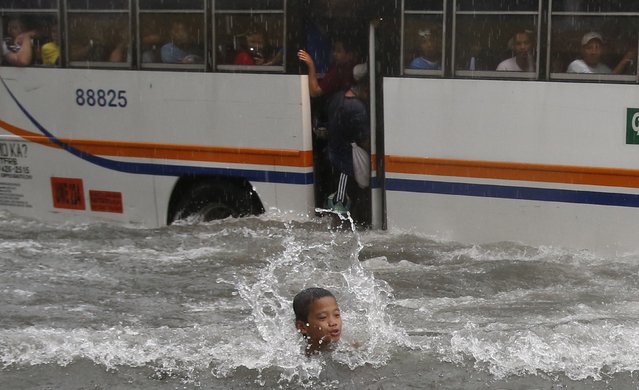
A boy plays at a flooded street in front of a passing bus as tropical storm Fung-Wong battered the Philippine capital Manila September 19, 2014. Heavy rain in the Philippine capital, Manila, caused flooding in many areas on Friday, shutting schools, government offices and financial markets as a tropical storm made landfall to the north. Thousands of residents in low-lying areas were moved to higher ground, officials said, as flood waters rose quickly after the equivalent of half a month's usual rain fell in six hours. (Photo by Erik De Castro/Reuters)

A boy plays at a flooded street in front of a passing bus as tropical storm Fung-Wong battered the Philippine capital Manila September 19, 2014. Heavy rain in the Philippine capital, Manila, caused flooding in many areas on Friday, shutting schools, government offices and financial markets as a tropical storm made landfall to the north. Thousands of residents in low-lying areas were moved to higher ground, officials said, as flood waters rose quickly after the equivalent of half a month's usual rain fell in six hours. (Photo by Erik De Castro/Reuters)
Details
19 Sep 2014 09:39:00