Loading...
Done
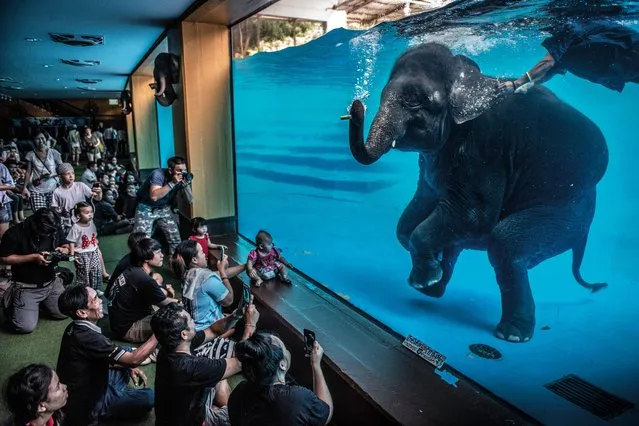
Winner, photojournalism. Elephant in the room, by Adam Oswell, Australia Zoo. Visitors watch a young elephant performing underwater. Oswell was disturbed by this scene, and organisations concerned with the welfare of captive elephants say performances like this encourage unnatural behaviour. In Thailand, there are now more elephants in captivity than in the wild. With the Covid pandemic causing tourism to collapse, elephant sanctuaries are becoming overwhelmed with animals that can no longer be looked after by their owners. (Photo by Adam Oswell/Wildlife Photographer of the Year 2021)

Winner, photojournalism. Elephant in the room, by Adam Oswell, Australia Zoo. Visitors watch a young elephant performing underwater. Oswell was disturbed by this scene, and organisations concerned with the welfare of captive elephants say performances like this encourage unnatural behaviour. In Thailand, there are now more elephants in captivity than in the wild. With the Covid pandemic causing tourism to collapse, elephant sanctuaries are becoming overwhelmed with animals that can no longer be looked after by their owners. (Photo by Adam Oswell/Wildlife Photographer of the Year 2021)
Details
30 Oct 2021 08:40:00
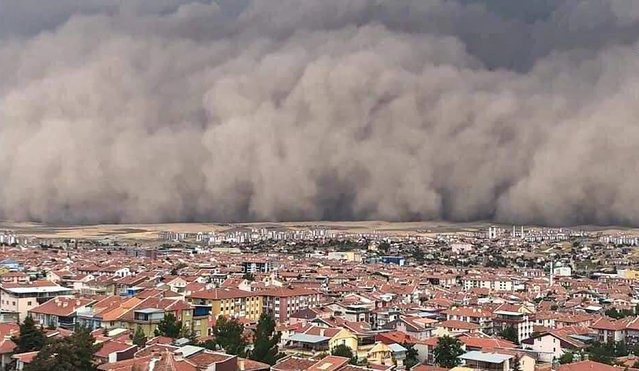
A handout TV grab made available by the Demiroren News Agency (DHA) on September 12, 2020, shows a freak sandstorm sweeping over Polatli, in Ankara, on September 12, 2020. A freak sandstorm hit Ankara on September 12, 2020, the Turkish capital's mayor said, as officials said six people were injured after strong winds. (Photo by Handout/DHA via AFP Photo)

A handout TV grab made available by the Demiroren News Agency (DHA) on September 12, 2020, shows a freak sandstorm sweeping over Polatli, in Ankara, on September 12, 2020. A freak sandstorm hit Ankara on September 12, 2020, the Turkish capital's mayor said, as officials said six people were injured after strong winds. (Photo by Handout/DHA via AFP Photo)
Details
24 Sep 2020 00:05:00
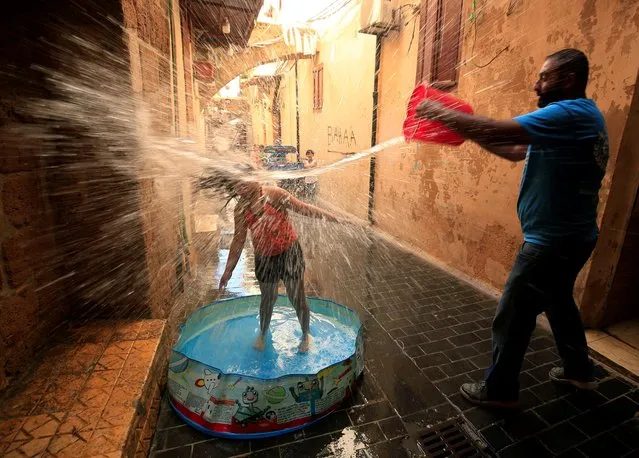
A man throws water on a girl playing in a pool, during a hot weather, amid concerns over the spread of coronavirus disease (COVID-19), in Sidon, southern Lebanon on May 21, 2020. (Photo by Ali Hashisho/Reuters)

A man throws water on a girl playing in a pool, during a hot weather, amid concerns over the spread of coronavirus disease (COVID-19), in Sidon, southern Lebanon on May 21, 2020. (Photo by Ali Hashisho/Reuters)
Details
24 May 2020 00:05:00
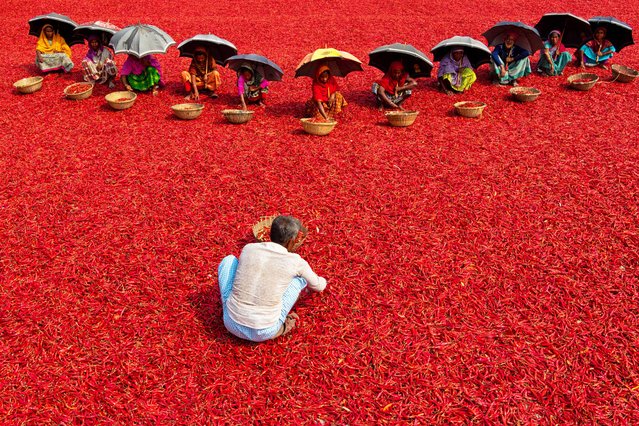
Rows of workers shelter under umbrellas from the scorching heat as they painstakingly sort through a red carpet of millions of chilli peppers in Bogra, Bangladesh on October 3, 2023. They sort the rotten and broken chilli peppers out to separate the poor quality ones which won't sell. In a line, the pickers who are paid less than £3 for a 10-hour shift slowly move forward with their baskets to separate the bad from the good after the chilies have been dried in the sun for a week. The dried & sorted chillies are then packaged and taken to the local market where they are brought mainly by companies to be made into chilli powder. The workers sort them in a warm environment, with temperatures reaching up to 45°C. More than 5,000 people work in almost 100 chilli farms in the Bogra district of Bangladesh to supply local spice companies with chillies for their recipes. Known as “Lal Morich” to the locals, chilli peppers are a major part of Bengali cuisine and are used as part of a combination of spices for various meat dishes, including chicken and beef. (Photo by Joy Saha/Rex Features/Shutterstock)

Rows of workers shelter under umbrellas from the scorching heat as they painstakingly sort through a red carpet of millions of chilli peppers in Bogra, Bangladesh on October 3, 2023. They sort the rotten and broken chilli peppers out to separate the poor quality ones which won't sell. In a line, the pickers who are paid less than £3 for a 10-hour shift slowly move forward with their baskets to separate the bad from the good after the chilies have been dried in the sun for a week. (Photo by Joy Saha/Rex Features/Shutterstock)
Details
21 Oct 2023 04:04:00
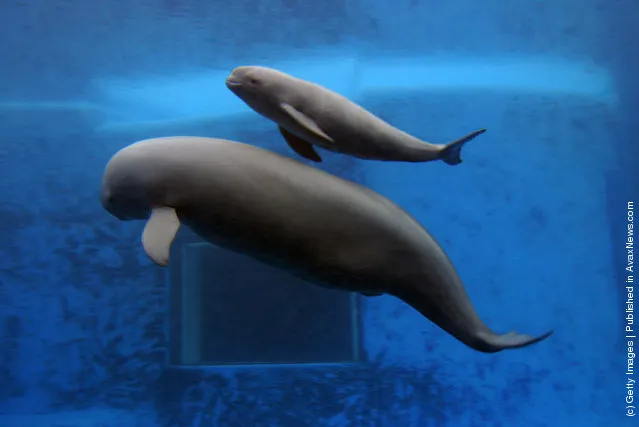
A newly born Yangtze finless porpoise (top) swims with his mother at the Hydrobiology Institute of the Chinese Academy of Sciences

“The finless porpoise (Neophocaena phocaenoides) is one of six porpoise species. In the waters around Japan, at the northern end of its range, it is known as the sunameri. A freshwater population found in the Yangtze River in China is known locally as the jiangzhu or «river pig»”. – Wikipedia

Photo: A newly born Yangtze finless porpoise (top) swims with his mother at the Hydrobiology Institute of the Chinese Academy of Sciences on June 3, 2007 in Wuhan of Hubei Province, China. (Photo by China Photos/Getty Images)
Details
20 Feb 2012 12:23:00
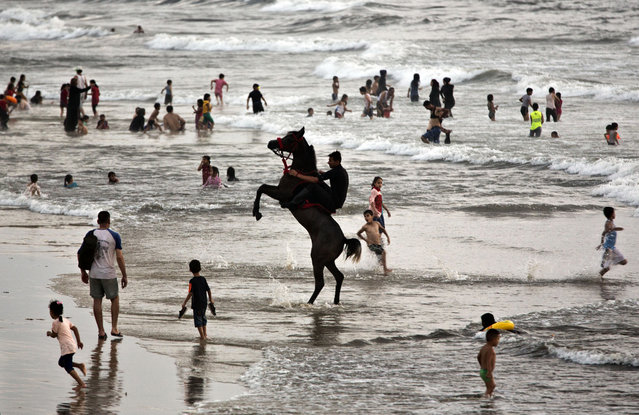
A man rides a horse while others swim on the beach of Gaza City, Friday, August 3, 2018. (Photo by Khalil Hamra/AP Photo)

A man rides a horse while others swim on the beach of Gaza City, Friday, August 3, 2018. (Photo by Khalil Hamra/AP Photo)
Details
05 Oct 2018 00:01:00
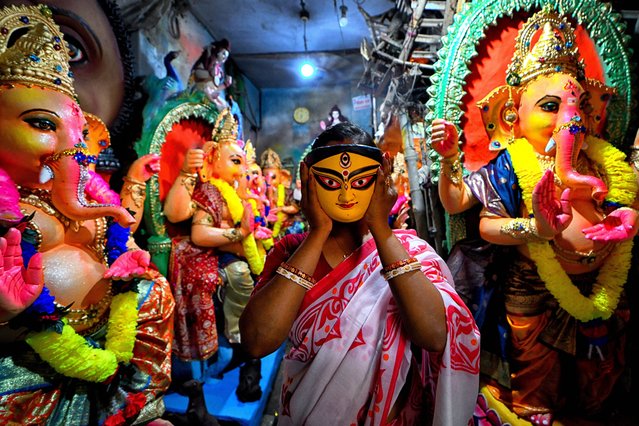
A model, Mousumi Das wearing a traditional Indian saree and holding a Clay face of the Durga idol poses for an Agomoni Concept photoshoot at the Artist hub Kumortuli in Kolkata on August 23, 2025. (Photo by ZUMAPRESS.com/The Mega Agency)

A model, Mousumi Das wearing a traditional Indian saree and holding a Clay face of the Durga idol poses for an Agomoni Concept photoshoot at the Artist hub Kumortuli in Kolkata on August 23, 2025. (Photo by ZUMAPRESS.com/The Mega Agency)
Details
18 Sep 2025 03:31:00
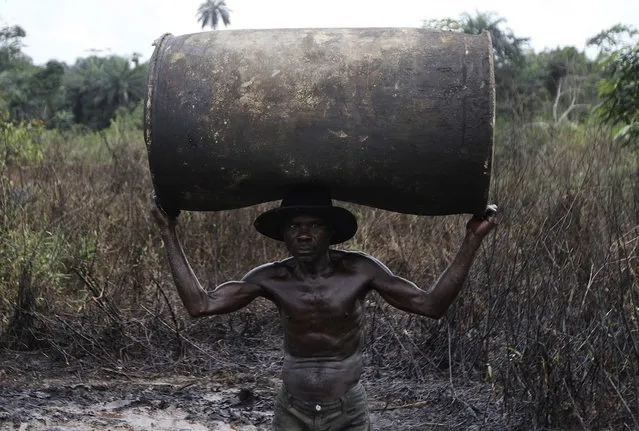
Ebiowei, 48, carries an empty oil container on his head to a place where it would be filled with refined fuel at an illegal refinery site near river Nun in Nigeria's oil state of Bayelsa November 27, 2012. (Photo by Akintunde Akinleye/Reuters)

Ebiowei, 48, carries an empty oil container on his head to a place where it would be filled with refined fuel at an illegal refinery site near river Nun in Nigeria's oil state of Bayelsa November 27, 2012. Locals in the industry say workers can earn $50 to $60 a day. Thousands of people in Nigeria engage in a practice known locally as “oil bunkering” – hacking into pipelines to steal crude then refining it or selling it abroad. The practice, which leaves oil spewing from pipelines for miles around, managed to lift around a fifth of Nigeria's two million barrel a day production last year according to the finance ministry. (Photo by Akintunde Akinleye/Reuters)
Details
18 Jan 2013 14:29:00