Loading...
Done
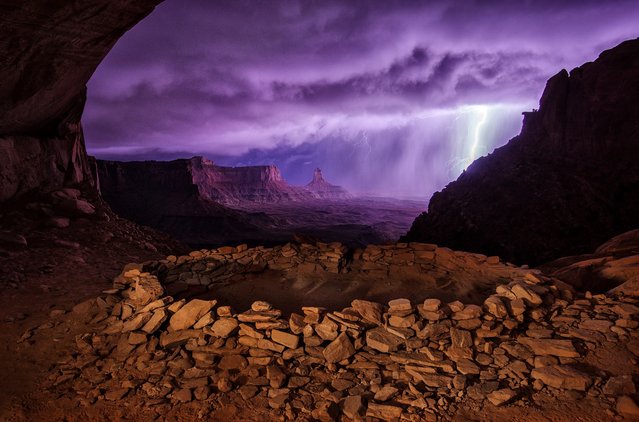
Second Place Winner: “Thunderstorm at False Kiva”. I hiked out to these ruins at night hoping to photograph them with the Milky Way, but instead a thunderstorm rolled through, creating this dramatic image. – Max Seigal. (Photo and caption by Max Seigal/National Geographic Traveler Photo Contest)

Second Place Winner: “Thunderstorm at False Kiva”. I hiked out to these ruins at night hoping to photograph them with the Milky Way, but instead a thunderstorm rolled through, creating this dramatic image. – Max Seigal. National Geographic Traveler Director of Photography Dan Westergren, one of this year's judges, shares his thoughts on the second place winner: “This photo combines two different scenes into one: the small kiva in a cliff dwelling and the grand vista of Canyonlands National Park across the valley. I really like the two different color palettes – warm inside and purple outside. This two-for-one scene was caused by the lightning storm outside the dwelling, which lit up the landscape like it was a huge electronic flash. Looking at this picture I can imagine what a wonderful sight it must have been for the ancient people who lived here. It doesn't seem too amazing now in our modern world, but might have been mind-blowing for the prehistoric residents”. Location: Utah. (Photo and caption by Max Seigal/National Geographic Traveler Photo Contest)
Details
02 Aug 2013 06:16:00
White Rainbow Or Fog Bow

A fog bow is a similar phenomenon to a rainbow; however, as its name suggests, it appears as a bow in fog rather than rain. Because of the very small size of water droplets that cause fog—smaller than 0.05 millimeters (0.0020 in)—the fog bow has only very weak colors, with a red outer edge and bluish inner edge.
Details
05 Oct 2013 11:09:00
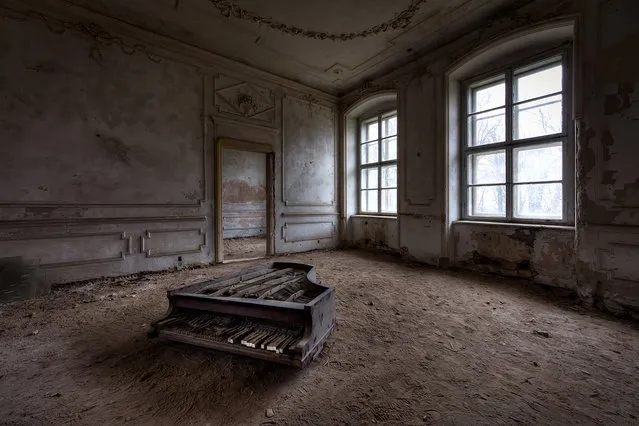
This piano was located in one of many rooms of a huge chateau in Poland. (Photo by Vincent Jansen)

Photographer Vincent Jansen travels throughout Europe, visiting beautiful abandoned places. He explores churches, factories, sanatoriums, mortuaries, villas and theaters, all quietly waiting for renovation or demolition. His photos show a unique perspective on what is happening behind the “no trespassing” signs: where nature is slowly gaining ground and the desolation, loneliness and decay leave their stunning traces. Photo: This piano was located in one of many rooms of a huge chateau in Poland. (Photo by Vincent Jansen)
Details
11 May 2014 12:10:00
A five-week-old orphaned Southern Sea Otter pup rests on a rubber mat after arriving at the Shedd Aquarium's Abbott Oceanarium in Chicago, Illinois October 28, 2014 in this handout photo provided to Reuters on November 5, 2014. The stranded pup was found on September 30 on Coastways Beach in California and was rescued the next day to be brought back to health at the Monterey Bay Aquarium. (Photo by Brenna Hernandez/Reuters/Shedd Aquarium)

A five-week-old orphaned Southern Sea Otter pup rests on a rubber mat after arriving at the Shedd Aquarium's Abbott Oceanarium in Chicago, Illinois October 28, 2014 in this handout photo provided to Reuters on November 5, 2014. The stranded pup was found on September 30 on Coastways Beach in California and was rescued the next day to be brought back to health at the Monterey Bay Aquarium. Southern sea otters were listed as “threatened” under the U.S. Endangered Species Act in 1977. (Photo by Brenna Hernandez/Reuters/Shedd Aquarium)
Details
08 Nov 2014 13:15:00
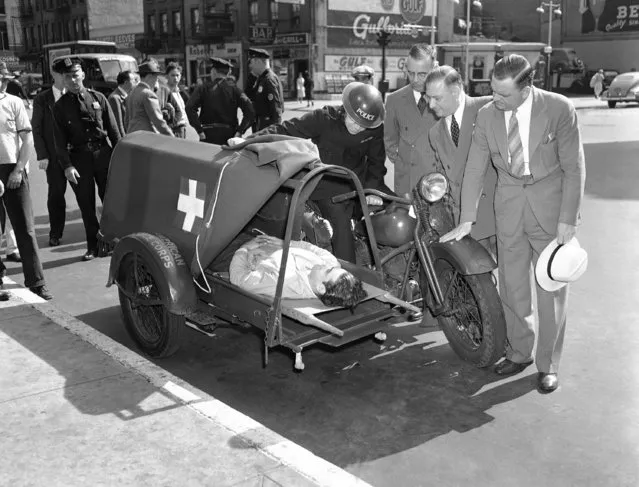
Developed for the British American Ambulance Corps, this new motorcycle ambulance is capable of speeding wounded soldiers 90 miles an hour from the front lines to field hospitals. Its springs are synchronized with the patient?s heartbeat to avoid increasing fever when traveling over various Terrain. Viewing it in New York  August 27, 1941, are left to right: constable Herbert Scott of England, driver; William E. Detlor, whose firm developed the vehicle; M. W. Stand, inspector-general of Civilian Defense, and Maj. Edward Riekert, also. (Photo by AP Photo)

Developed for the British American Ambulance Corps, this new motorcycle ambulance is capable of speeding wounded soldiers 90 miles an hour from the front lines to field hospitals. Its springs are synchronized with the patient's heartbeat to avoid increasing fever when traveling over various Terrain. Viewing it in New York August 27, 1941, are left to right: constable Herbert Scott of England, driver; William E. Detlor, whose firm developed the vehicle; M. W. Stand, inspector-general of Civilian Defense, and Maj. Edward Riekert, also. (Photo by AP Photo)
Details
28 Aug 2015 11:51:00
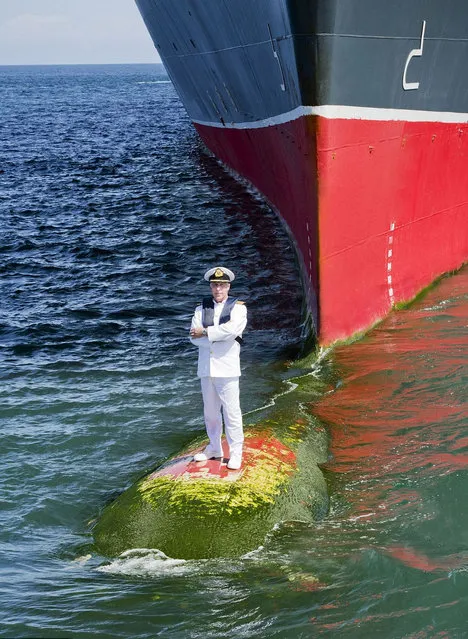
Queen Mary 2's Captain Perches On The Bow Of His Vast Ship

Daring Captain Kevin Oprey is seen standing beneath the soaring hull of Cunard’s flagship Queen Mary 2.
Details
30 Aug 2014 09:37:00
A visitor checks automatic gun during International Defence Exhibition and Seminar (IDEAS) 2022 at the Expo Centre in Karachi on November 16, 2022. (Photo by Rizwan Tabassum/AFP Photo)

A visitor checks automatic gun during International Defence Exhibition and Seminar (IDEAS) 2022 at the Expo Centre in Karachi on November 16, 2022. (Photo by Rizwan Tabassum/AFP Photo)
Details
16 Dec 2022 23:50:00
A gallery assistant poses for a photograph with an artwork entitled “John Perreault, 1972” by US artist Alice Neel during a press preview of “Alice Neel: Hot Off The Griddle” at the Barbican Art Gallery in London on February 15, 2023. (Photo by Justin Tallis/AFP Photo)

A gallery assistant poses for a photograph with an artwork entitled “John Perreault, 1972” by US artist Alice Neel during a press preview of “Alice Neel: Hot Off The Griddle” at the Barbican Art Gallery in London on February 15, 2023. (Photo by Justin Tallis/AFP Photo)
Details
16 Mar 2023 05:14:00