Loading...
Done
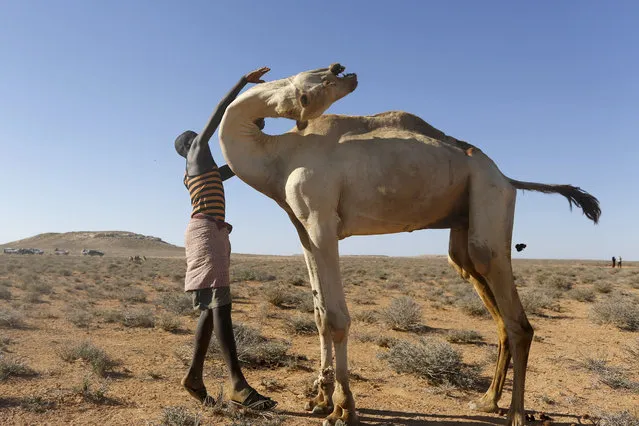
Ali Asair, who has left his family behind and traveled hundreds of kilometers in search for a pasture for his animals, attends to his camel in a pastoralists' settlement in the Bandarbeyla district in Somalia's semi-autonomous region of Puntland, Somalia, 24 March 2017. According to media reports, the United Nations says only 31 percent of 864 million US dollars appeal for a drought-hit Somalia is funded. The UN said the world is facing the largest humanitarian crisis since 1945, adding that more than 20 million people are facing the threat of famine in Somalia, Yemen, South Sudan and Nigeria and 1.4 million children could die from starvation this year. (Photo by Dai Kurokawa/EPA)

Ali Asair, who has left his family behind and traveled hundreds of kilometers in search for a pasture for his animals, attends to his camel in a pastoralists' settlement in the Bandarbeyla district in Somalia's semi-autonomous region of Puntland, Somalia, 24 March 2017. According to media reports, the United Nations says only 31 percent of 864 million US dollars appeal for a drought-hit Somalia is funded. The UN said the world is facing the largest humanitarian crisis since 1945, adding that more than 20 million people are facing the threat of famine in Somalia, Yemen, South Sudan and Nigeria and 1.4 million children could die from starvation this year. (Photo by Dai Kurokawa/EPA)
Details
28 Mar 2017 09:01:00
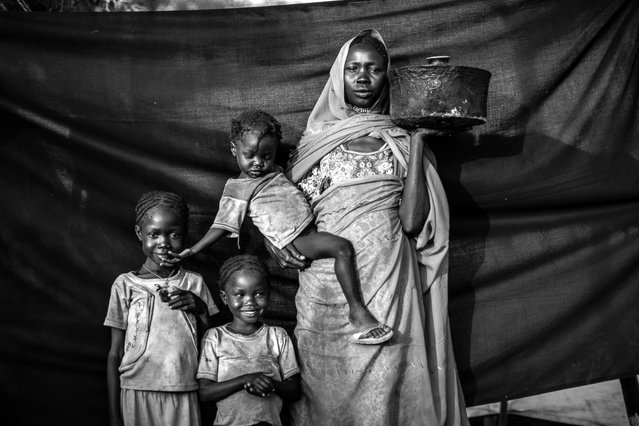
Magbola Alhadi, 20, and her three children pose for a portrait in Jamam refugee camp in Maban County, South Sudan on August 11th, 2012. Magboola and her family weathered aerial bombing raids for several months, but decided it was time to leave their village of Bofe the night that soldiers arrived and opened fire. (Photo by Brian Sokol/Panos Pictures)

Magbola Alhadi, 20, and her three children pose for a portrait in Jamam refugee camp in Maban County, South Sudan on August 11th, 2012. Magboola and her family weathered aerial bombing raids for several months, but decided it was time to leave their village of Bofe the night that soldiers arrived and opened fire. With her three children, she travelled for 12 days from Bofe to the town of El Fudj, on the South Sudanese border. The most important thing that Magboola was able to bring with her is the saucepan she holds in this photograph. It wasn't the largest pot that she had in Bofe, but it was small enough she could travel with it, yet big enough to cook sorghum for herself and her three daughters (from left: Aduna Omar, 6, Halima Omar, 4, and Arfa Omar, 2) during their journey. (Photo by Brian Sokol/Panos Pictures)
Details
18 Sep 2015 15:04:00
Artists perform during a “Yandu Story” Show performance, in Yancheng, Jiangsu province, China, 20 September 2022. The story dates back to some 100 years when – according to the organizers – two prominent local families, Gu and Ling, were committed to get out of a predicament, but parted due to different development concepts and ended in a turmoil. The large-scale immersive series of performances took more than a year of careful planning and consists of two parts: a daytime performance and a 90-minute night performance, they added. (Photo by Alex Plavevski/EPA/EFE/Rex Features/Shutterstock)

Artists perform during a “Yandu Story” Show performance, in Yancheng, Jiangsu province, China, 20 September 2022. The story dates back to some 100 years when – according to the organizers – two prominent local families, Gu and Ling, were committed to get out of a predicament, but parted due to different development concepts and ended in a turmoil. The large-scale immersive series of performances took more than a year of careful planning and consists of two parts: a daytime performance and a 90-minute night performance, they added. (Photo by Alex Plavevski/EPA/EFE/Rex Features/Shutterstock)
Details
29 Sep 2022 03:41:00
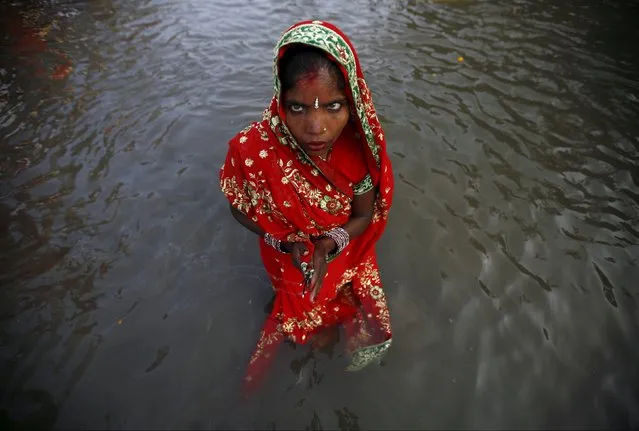
A devotee offers prayers to the setting sun during the "Chhat" festival at Bagmati river in Kathmandu, Nepal November 17, 2015. (Photo by Navesh Chitrakar/Reuters)

A devotee offers prayers to the setting sun during the "Chhat" festival at Bagmati river in Kathmandu, Nepal November 17, 2015. Hindus in Nepal celebrate "Chhat", a four-day festival that honours the sun god, by praying at sunrise and sunset, and seek blessings for one's family by giving offerings. (Photo by Navesh Chitrakar/Reuters)
Details
19 Nov 2015 08:01:00
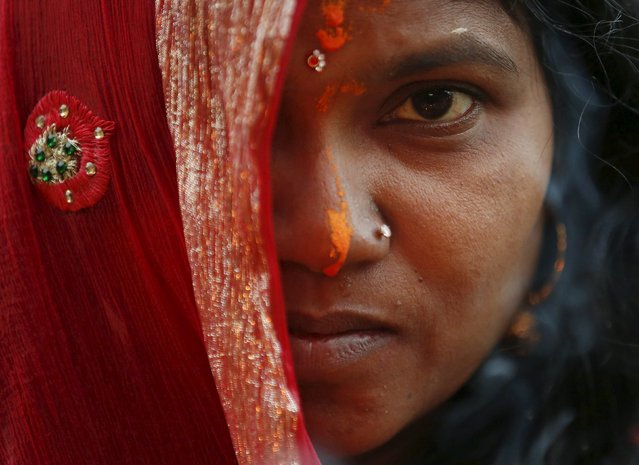
A face of a devotee covered with her cloth is pictured as she offers prayers to the rising sun during the "Chhat" festival in Kathmandu, Nepal November 18, 2015. (Photo by Navesh Chitrakar/Reuters)

A face of a devotee covered with her cloth is pictured as she offers prayers to the rising sun during the "Chhat" festival in Kathmandu, Nepal November 18, 2015. Hindus in Nepal celebrate "Chhat", a four-day festival that honours the sun god by praying at sunrise and sunset and seeking blessings for ones family by giving offerings. (Photo by Navesh Chitrakar/Reuters)
Details
20 Nov 2015 08:00:00
In this February 1, 2017 photo, Anjali Lama, a transgender model from Nepal, looks at her mobile phone backstage during Lakme Fashion week in Mumbai, India. (Photo by Rafiq Maqbool/AP Photo)

In this February 1, 2017 photo, Anjali Lama, a transgender model from Nepal, looks at her mobile phone backstage during Lakme Fashion week in Mumbai, India. Growing up as the fifth son in a poor farming family in rural Nepal the dream to be a fashion model came late in life.(Photo by Rafiq Maqbool/AP Photo)
Details
05 Feb 2017 01:02:00
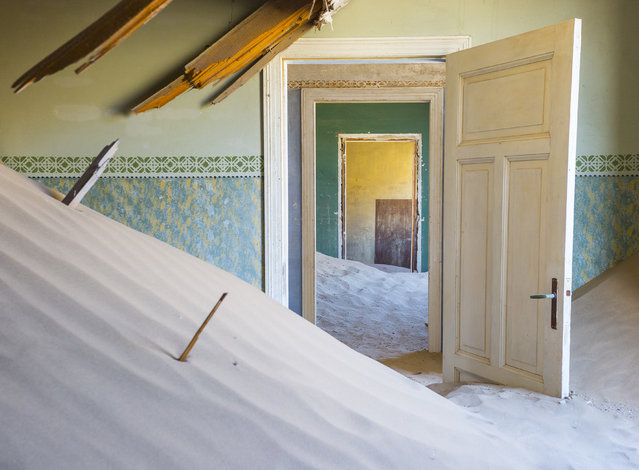
Kolmankop, an abandoned mining town in Namibia. (Photo by David Ogden/Caters News)

These sand-swept images show the ghostly remains of what was once a mineral-rich mining community. In its heyday, the town of Kolmanskop, Namibia, was home to about 700 families. Now all that remains are empty homes filled with sand, while cast-off items such as bathtubs are scattered about the surrounding area. Over time, the sand of the stunning dunes that encircle the town of Kolmanskop has been blown towards the abandoned residences, coating everything from streets to the interiors of houses and workshops. Here: Kolmankop, an abandoned mining town in Namibia. (Photo by David Ogden/Caters News)
Details
13 Mar 2016 09:31:00
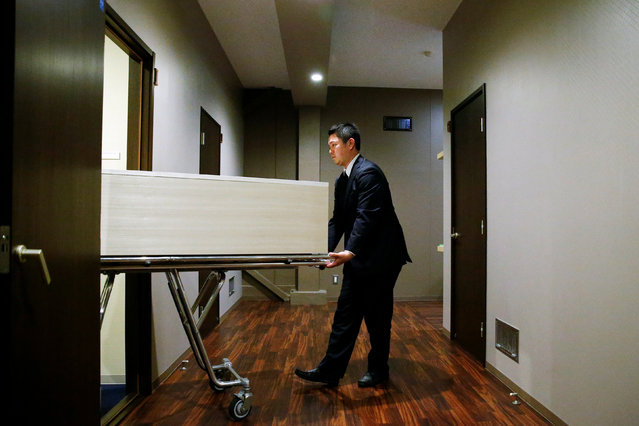
A staff member removes a coffin from a room of the “Corpse Hotel” in Kawasaki, Japan, April 20, 2016. (Photo by Thomas Peter/Reuters)

A staff member removes a coffin from a room of the “Corpse Hotel” in Kawasaki, Japan, April 20, 2016. Many so-called corpse hotels have emerged as a flourishing business in the city following a crunch in crematoriums. Families can rent a room in Sousou on a daily charge of 9,000 Japanese yen (£58, €74, $84) to keep the body of the deceased relative for up to four days until they find a crematorium. (Photo by Thomas Peter/Reuters)
Details
30 Apr 2016 09:46:00