Loading...
Done
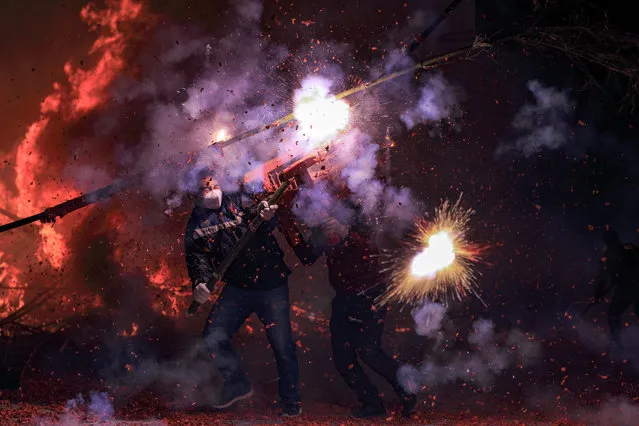
Villagers from Jiexi Jiantan village perform a ritual of “Zha Laoye”, or “Cracking local spirits”, in Chaoshan, Guangdong Province, China, 10 February 2019. Jiexi Jiantan Village celebrates the annual custom of “Zha Laoye” where Laoye are local spirits. Every third day of the lunar New Year, statues of local spirits known as the “Thousand-mile Eye” Laoye and “Ear Following the Wind” Laoye are brought out to the village committee to receive incensed tea offered by believers. By the sixth day of the year, the “Zha Laoye” activities begin with each man holding one of the statues on a chair above his head while run around a bonfire. Two other men light firecrackers strung up on a long bamboo poles and chase the spirit around the bonfire, signifying a bountiful new year. (Photo by EPA/EFE/ZNSEN)

Villagers from Jiexi Jiantan village perform a ritual of “Zha Laoye”, or “Cracking local spirits”, in Chaoshan, Guangdong Province, China, 10 February 2019. Jiexi Jiantan Village celebrates the annual custom of “Zha Laoye” where Laoye are local spirits. Every third day of the lunar New Year, statues of local spirits known as the “Thousand-mile Eye” Laoye and “Ear Following the Wind” Laoye are brought out to the village committee to receive incensed tea offered by believers. (Photo by EPA/EFE/ZNSEN)
Details
23 Feb 2019 00:07:00
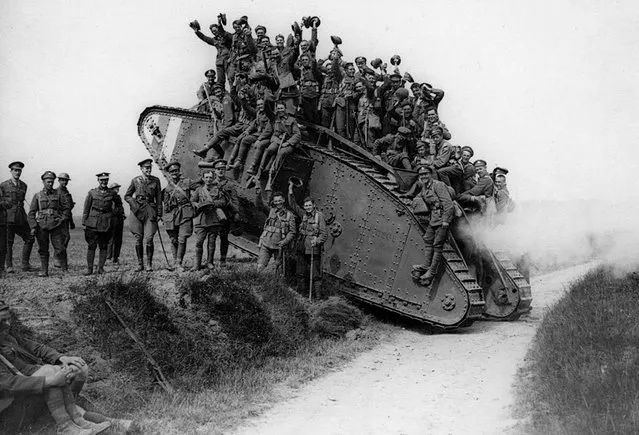
These black-and-white photos are taken from the new book “Armoured Warfare in the First World War 1916 – 1918” by Anthony Tucker-Jones and published by Pen & Sword Military. “Interestingly the British, French and Germans took completely different approaches with varying results”. The British military produced “Little Willie” in Autumn 1915 weighing 18 tonnes, which had a crew of two plus four gunners. “Inspired by a tracked artillery tractor “Little Willie” was referred to as a water tank – hence the name tank – to ensure secrecy”, said Anthony. “This led to the strange looking Mark I with its peculiar rhomboid shape, designed to cross trenches with guns in sponsons on either side. The Germans saw the tank as unchivalrous and were slow to grasp its utility. They favoured the Stormtrooper (specialist soldiers used to infiltrate enemy trenches) and artillery, not the tank”, said Anthony. “However, they didn’t hesitate to make use of captured British tanks. Although the tank helped secure victory and German soldiers dubbed it “Germany’s Downfall” the country was ultimately brought to its knees by the Allies blockade”. Here: British troops hitch a ride on a Mark IV after the massed tank fleet spearheading attack at Cambrai on November 20, 1917. (Photo by Anthony Tucker-Jones/Mediadrumworld.com)

These black-and-white photos are taken from the new book “Armoured Warfare in the First World War 1916 – 1918” by Anthony Tucker-Jones and published by Pen & Sword Military. Here: British troops hitch a ride on a Mark IV after the massed tank fleet spearheading attack at Cambrai on November 20, 1917. (Photo by Anthony Tucker-Jones/Mediadrumworld.com)
Details
23 Feb 2017 00:02:00
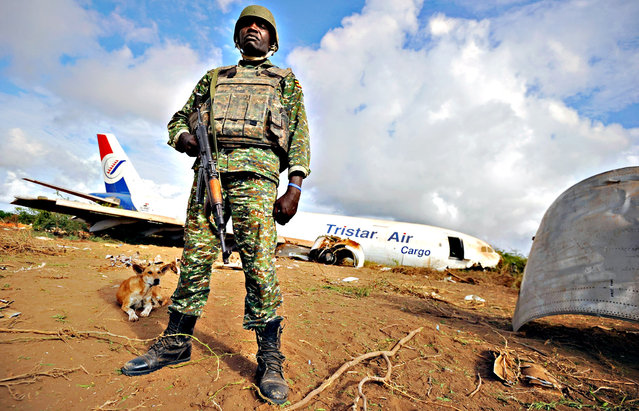
A soldier from the African Union (AU) peacekeeping force stands guard at the site where a cargo plane carrying supplies for AU troops crash-landed outside Somalia's capital, on October 13, 2015 at Abirska, some 18 kilometres outside Somalian capital, Mogadishu. The officials said the Egyptian-owned transport plane went down after making several unsuccessful passes over the seafront airport. (Photo by Mohamed Abdiwahab/AFP Photo)

A soldier from the African Union (AU) peacekeeping force stands guard at the site where a cargo plane carrying supplies for AU troops crash-landed outside Somalia's capital, on October 13, 2015 at Abirska, some 18 kilometres outside Somalian capital, Mogadishu. The officials said the Egyptian-owned transport plane went down after making several unsuccessful passes over the seafront airport. Two of the six crew members suffered light injuries in the crash, the officials said, but added that the plane and those on board were safe having landed in an area controlled by the Somali government and the African Union's AMISOM force. (Photo by Mohamed Abdiwahab/AFP Photo)
Details
16 Oct 2015 08:02:00
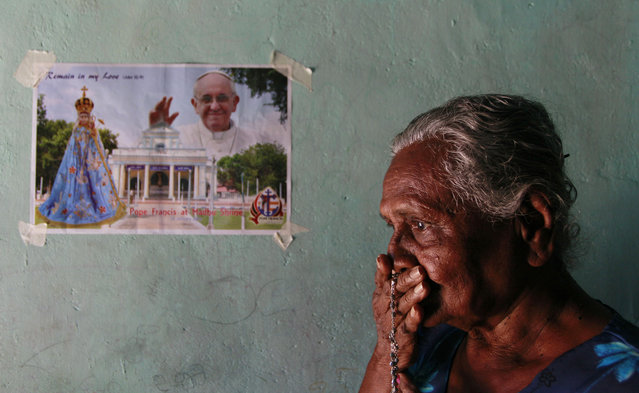
In this Wednesday, January 7, 2015 photo, a Sri Lankan Catholic devotee Rita Anthony kisses her rosary as she prays inside her house in Colombo, Sri Lanka. The Vatican has said that it hopes that Sri Lanka's Christians can play a role in helping heal the wounds of the island nation's bloody 25-year civil war, when the Tamil Tiger rebels fought to create a separate homeland in the north for the minority Tamils, who are mostly Hindu. (Photo by Eranga Jayawardena/AP Photo)

In this Wednesday, January 7, 2015 photo, a Sri Lankan Catholic devotee Rita Anthony kisses her rosary as she prays inside her house in Colombo, Sri Lanka. The Vatican has said that it hopes that Sri Lanka's Christians can play a role in helping heal the wounds of the island nation's bloody 25-year civil war, when the Tamil Tiger rebels fought to create a separate homeland in the north for the minority Tamils, who are mostly Hindu. The war came to a bloody end in 2009, but many Tamils say they feel forgotten by the central government, which is dominated by the country's ethnic Sinhala majority, which is overwhelmingly Buddhist. Sri Lanka's Christians come from both the Tamil and the Sinhala communities, making them a natural bridge between the two sides. (Photo by Eranga Jayawardena/AP Photo)
Details
11 Jan 2015 13:40:00
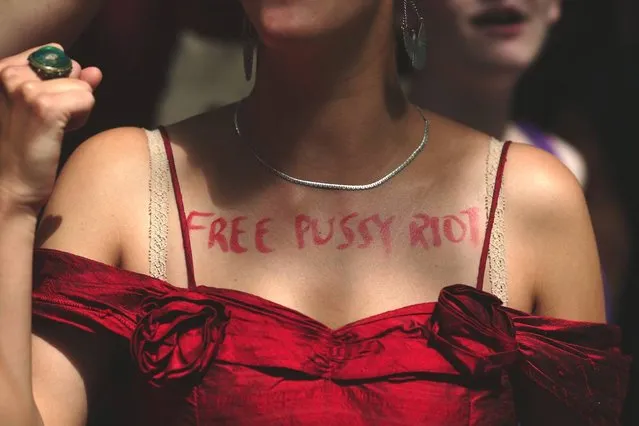
A woman wears on her chest the text 'free p*ssy riot' as a demonstration by supporters of the jailed feminist punk band 'p*ssy Riot' takes place outside the Russian Embassy on August 17, 2012 in London, England. The three women who staged an anti-Kremlin protest in a church in February, were found guilty today of hooliganism motivated by religious hatred, and could face a three-year jail sentence. Supporters are gathering in several cities around the world today as a mark of solidarity. (Photo by Dan Kitwood)

“On Friday, after something of a show trial, three young women in a Russian punk band were found guilty and sentenced to two years in prison for an anti-Vladimir Putin protest in a Moscow cathedral earlier this year”. – Daniel Schwartz via CBC News

Photo: A woman wears on her chest the text “free p*ssy riot” as a demonstration by supporters of the jailed feminist punk band p*ssy Riot takes place outside the Russian Embassy on August 17, 2012 in London, England. The three women who staged an anti-Kremlin protest in a church in February, were found guilty today of hooliganism motivated by religious hatred, and could face a three-year jail sentence. Supporters are gathering in several cities around the world today as a mark of solidarity. (Photo by Dan Kitwood)
Details
18 Aug 2012 11:26:00
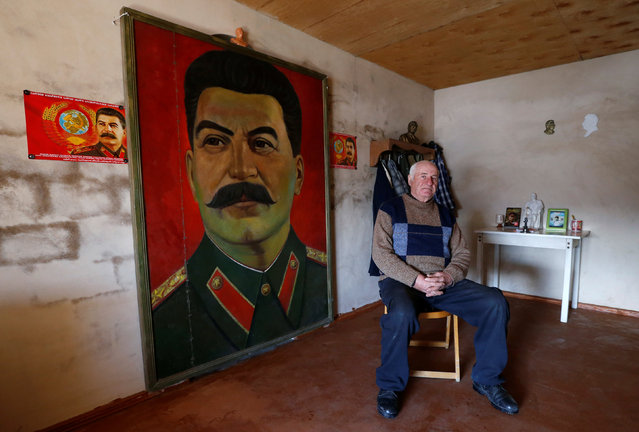
Retired builder Vasili Sidamonidze, 70, poses for a portrait at his home in Gori, Georgia, December 6, 2016. “Unfortunately, Stalin is not popular nowadays. Our people don't respect him. Only we, members of the (Communist) Party, respect him”, Sidamonidze said. “I always try to attend Stalin's birthday anniversaries in Gori. Unfortunately many people don't want to join us even if they live nearby. They look at us from their windows”. Stalin, who was born in Gori in 1878 and died in 1953, is largely reviled today in Georgia, which regained its independence during the 1991 collapse of the Soviet Union. Over the years, his memorials have been dismantled, most recently in 2010 when authorities removed a statue of the dictator from Gori's central square. But Stalin is still revered by a small group of mainly elderly supporters who stress his role in the industrialisation of the Soviet Union and in defeating Nazi Germany in World War Two. Each Dec. 21, a few dozen people mark his birthday by gathering outside a Gori museum dedicated to Stalin, where they make speeches and walk to the square where a 6-meter-high bronze statue of him once stood, calling for it to be reinstated. Opponents say it was a symbol of Moscow's still lingering shadow. In 2008, Russia fought a brief war with Georgia and recognised its breakaway regions of Abkhazia and South Ossetia as independent states. (Photo by David Mdzinarishvili/Reuters)

Retired builder Vasili Sidamonidze, 70, poses for a portrait at his home in Gori, Georgia, December 6, 2016. “Unfortunately, Stalin is not popular nowadays. Our people don't respect him. Only we, members of the (Communist) Party, respect him”, Sidamonidze said. “I always try to attend Stalin's birthday anniversaries in Gori. Unfortunately many people don't want to join us even if they live nearby. They look at us from their windows”. (Photo by David Mdzinarishvili/Reuters)
Details
17 Dec 2016 07:59:00
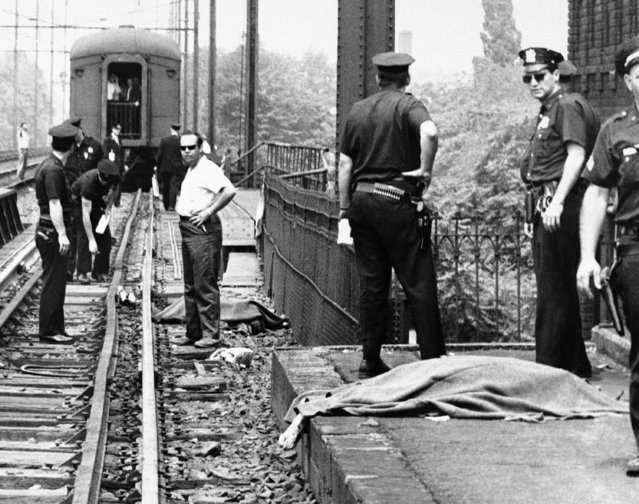
Blankets cover the bodies of a woman (right) and a man (left background) hit by a northbound Penn Central train (background) as they waited with a crowd at Pennsylvania Railroad station in Elizabeth, N.J. on June 8, 1968 to view the southbound train carrying the body of Sen. Robert F. Kennedy to Washington. The woman was identified as Mrs. Antoinette Severini, 54, and the man, John Curia (age unavailable), both of Elizabeth. (Photo by AP Photo)

Blankets cover the bodies of a woman (right) and a man (left background) hit by a northbound Penn Central train (background) as they waited with a crowd at Pennsylvania Railroad station in Elizabeth, N.J. on June 8, 1968 to view the southbound train carrying the body of Sen. Robert F. Kennedy to Washington. The woman was identified as Mrs. Antoinette Severini, 54, and the man, John Curia (age unavailable), both of Elizabeth. (Photo by AP Photo)
Details
09 Dec 2017 02:15:00
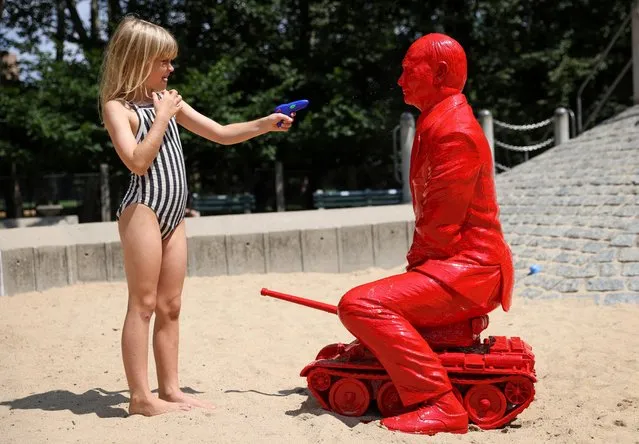
A child points a water pistol at a statue of Russian President Vladimir Putin riding a tank by French artist James Colomina in a playground in Central Park in Manhattan, New York City, U.S., August 2, 2022. (Photo by Andrew Kelly/Reuters)

A child points a water pistol at a statue of Russian President Vladimir Putin riding a tank by French artist James Colomina in a playground in Central Park in Manhattan, New York City, U.S., August 2, 2022. (Photo by Andrew Kelly/Reuters)
Details
04 Aug 2022 05:05:00