Loading...
Done
Supercharged 24 Cylinder Engine

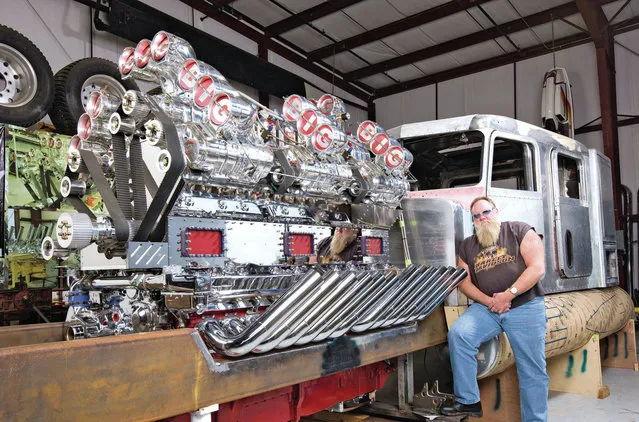
This thing has 24 cylinders, 1,704 cubic inches, 12 GMC superchargers (blowers), 8 nitrous bottles and it runs! Why build such a beast? “Because I can,” Harrah says. There’s no other reason to take a 24V71 and build an intake manifold that weighs 1,000 pounds and mount eight 6-71 superchargers on top of four others. This is a V24 Detroit Diesel (normally used to power ships) which is two V12 Detroits joined together nose to nose with splined cranks.
Details
26 Aug 2014 18:40:00
Animalistic Tendencies By Zarnala

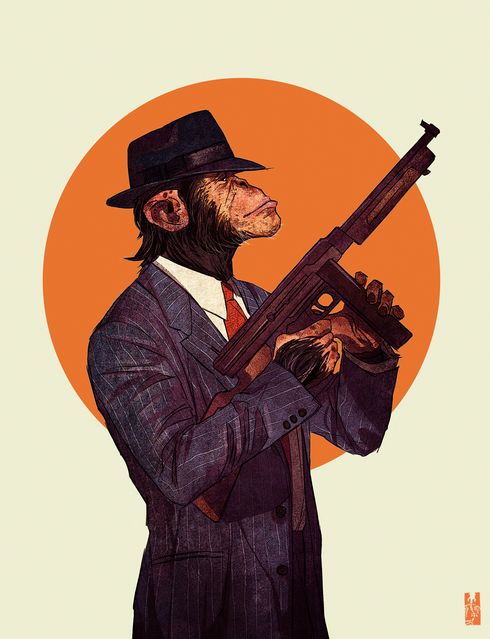
Zarnala is a female illustrator with a knack for anthropomorphic illustration, combining human and animal elements to create something altogether new. Unlike other forms of anthropomorphic art one can find out there though, her work always retains a tasteful, professional edge similar to the feel I get from comics like Juanjo Garnido's take on Blacksad. With an awesome watercolor themed approach to all her illustration work and her use of graphic shapes to frame her characters, at times it gives her art a strangely retro look that reminds one of the works of Norman Rockwell and JC Leyendecker. Check out more of her work after the break!
Details
11 Dec 2013 11:08:00
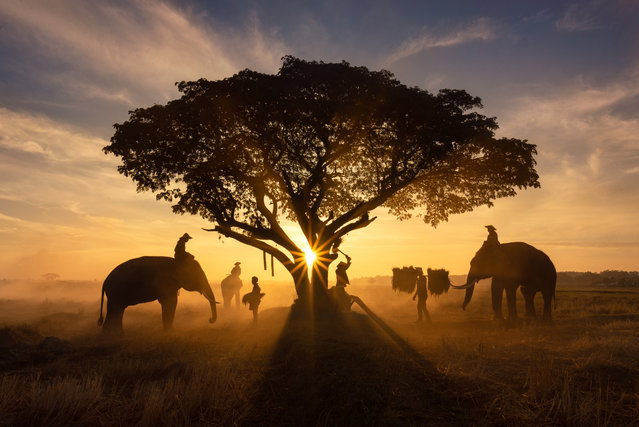
These eye-catching photographs capture the special relationship between a group of farmers and elephants – with a gorgeous sunset in the background. Vithun Khamsong, a civil engineer, shot the images earlier this year while visiting Surin, Thailand. Khamsong said: “My favorite is the one where the sunset can be seen behind the man and the elephant. I was impressed and wanted to capture this lifestyle for other people see it”. (Photo by Vithun Khamsong/Caters News Agency)

These eye-catching photographs capture the special relationship between a group of farmers and elephants – with a gorgeous sunset in the background. Vithun Khamsong, a civil engineer, shot the images earlier this year while visiting Surin, Thailand. (Photo by Vithun Khamsong/Caters News Agency)
Details
11 Sep 2019 00:03:00
“The knight and his steed”. This picture was taken in a natural but controlled environment. There are pictures that can not be done in nature or that would imply a very high cost of both time and money, thats why photography workshops are run conducted at strategic locations and bringing EVERYONE who is interested, the basic notions (lighting, camera handling, composition, etc...) or the specimens, and afford them the opportunity to take pictures like this. (Photo and caption by Nicolas Reusens Boden (Sweden)/2014 Sony World Photography Awards)

“The knight and his steed”. This picture was taken in a natural but controlled environment. There are pictures that can not be done in nature or that would imply a very high cost of both time and money, thats why photography workshops are run conducted at strategic locations and bringing EVERYONE who is interested, the basic notions (lighting, camera handling, composition, etc...) or the specimens, and afford them the opportunity to take pictures like this. Although controlled, this shot was not prepared at all, I was performing a workshop with the agalychnis callidryas treefrog from Costa Rica when the frog managed to jump to the branch where this huge titan was sleeping... I had my gear ready so I only had to change a few settings and shoot... the rest is history. (Photo and caption by Nicolas Reusens Boden (Sweden)/2014 Sony World Photography Awards)
Details
10 Dec 2013 07:23:00
Second Place Winner: “Thunderstorm at False Kiva”. I hiked out to these ruins at night hoping to photograph them with the Milky Way, but instead a thunderstorm rolled through, creating this dramatic image. – Max Seigal. (Photo and caption by Max Seigal/National Geographic Traveler Photo Contest)

Second Place Winner: “Thunderstorm at False Kiva”. I hiked out to these ruins at night hoping to photograph them with the Milky Way, but instead a thunderstorm rolled through, creating this dramatic image. – Max Seigal. National Geographic Traveler Director of Photography Dan Westergren, one of this year's judges, shares his thoughts on the second place winner: “This photo combines two different scenes into one: the small kiva in a cliff dwelling and the grand vista of Canyonlands National Park across the valley. I really like the two different color palettes – warm inside and purple outside. This two-for-one scene was caused by the lightning storm outside the dwelling, which lit up the landscape like it was a huge electronic flash. Looking at this picture I can imagine what a wonderful sight it must have been for the ancient people who lived here. It doesn't seem too amazing now in our modern world, but might have been mind-blowing for the prehistoric residents”. Location: Utah. (Photo and caption by Max Seigal/National Geographic Traveler Photo Contest)
Details
02 Aug 2013 06:16:00
A staff member removes a coffin from a room of the “Corpse Hotel” in Kawasaki, Japan, April 20, 2016. (Photo by Thomas Peter/Reuters)

A staff member removes a coffin from a room of the “Corpse Hotel” in Kawasaki, Japan, April 20, 2016. Many so-called corpse hotels have emerged as a flourishing business in the city following a crunch in crematoriums. Families can rent a room in Sousou on a daily charge of 9,000 Japanese yen (£58, €74, $84) to keep the body of the deceased relative for up to four days until they find a crematorium. (Photo by Thomas Peter/Reuters)
Details
30 Apr 2016 09:46:00
The unromantic gypsies. Children boxing in a gypsy camp in Kent, England on July 1, 1951. Like all boys these gypsy lads like to try their hand at boxing. Encouraged by their friends they fight it out on Corke's Meadow. Few Romanies now live a life of wandering romance. Most are like the three hundred squatters of Corke's Meadow, Kent, which is part of a “gypsy problem” that involves about 100,000 today. Of those about 25,000 can be rightly called gypsies, the rest are Mumpers and Posh-rats and Hobos. Corke's Meadow has both kinds. “Picture Post” cameraman Bert Hardy photographs the Corke's Meadow gypsies in their encampment. (Photo by Hulton-Deutsch Collection/Corbis via Getty Images)

The unromantic gypsies. Children boxing in a gypsy camp in Kent, England on July 1, 1951. Like all boys these gypsy lads like to try their hand at boxing. Encouraged by their friends they fight it out on Corke's Meadow. Few Romanies now live a life of wandering romance. Most are like the three hundred squatters of Corke's Meadow, Kent, which is part of a “gypsy problem” that involves about 100,000 today. Of those about 25,000 can be rightly called gypsies, the rest are Mumpers and Posh-rats and Hobos. Corke's Meadow has both kinds. “Picture Post” cameraman Bert Hardy photographs the Corke's Meadow gypsies in their encampment. (Photo by Hulton-Deutsch Collection/Corbis via Getty Images)
Details
12 Mar 2017 00:01:00
A model in Mongolia costumes prepares backstage in Xiangshawan Desert, also called Sounding Sand Desert on July 18, 2013 in Ordos of Inner Mongolia Autonomous Region, China. Xiangshawan is China's famous tourist resort in the desert. It is located along the middle section of Kubuqi Desert on the south tip of Dalate League under Ordos City. Sliding down from the 110-metre-high, 45-degree sand hill, running a course of 200 metres, the sands produce the sound of automobile engines, a natural phenomenon that nobody can explain. (Photo by Feng Li/Getty Images)

A model in Mongolia costumes prepares backstage in Xiangshawan Desert, also called Sounding Sand Desert on July 18, 2013 in Ordos of Inner Mongolia Autonomous Region, China. Xiangshawan is China's famous tourist resort in the desert. It is located along the middle section of Kubuqi Desert on the south tip of Dalate League under Ordos City. Sliding down from the 110-metre-high, 45-degree sand hill, running a course of 200 metres, the sands produce the sound of automobile engines, a natural phenomenon that nobody can explain. (Photo by Feng Li)
Details
26 Aug 2013 08:43:00