The six-months-old female koala cub holds on to the back of zoo keeper Lena at the zoo in Duisburg, Germany, 23 October 2015. The yet unnamed baby weighs 580 grams. (Photo by Roland Weihrauch/EPA)
Chinelos (traditional costumed dancers) perform in front of San Andres Ocotlan church as part of continuing festivities to welcome the new year in Calimaya, Mexico on January 4, 2016. (Photo by Arturo Hernandez/Demotix/Corbis)
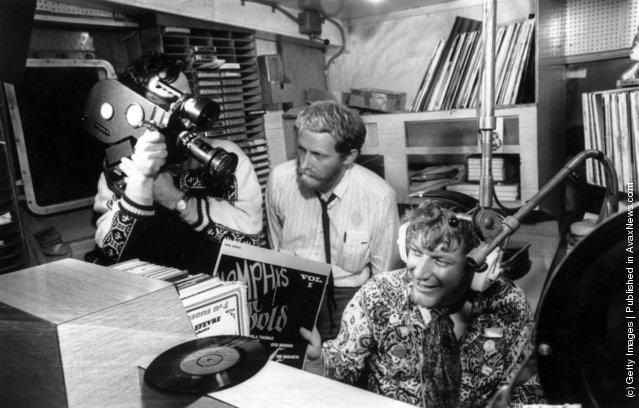
“«Pirate radio» in the UK first became widespread in the early 1960s when pop music stations such as Radio Caroline and Radio London started to broadcast on medium wave to the UK from offshore ships or disused sea forts. At the time these stations were not illegal because they were broadcasting from international waters. The stations were set up by entrepreneurs and music enthusiasts to meet the growing demand for pop and rock music, which was not catered for by the legal BBC Radio services”. – Wikipedia
Photo: The “World in Action” team making a program about the pirate radio ship Caroline, filmed by Paddy Searle, and produced by Mike Hodges. The DJ being filmed is Robbie Dale, and Hodges is standing behind him. (Photo by James Jackson/Evening Standard/Getty Images). 6th September 1967
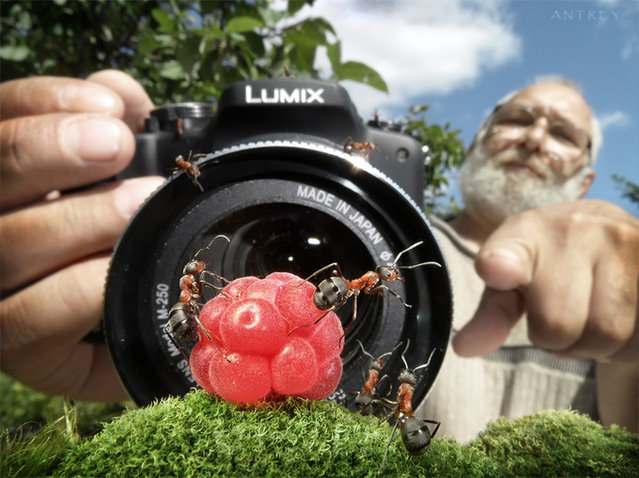
Andrey Pavlov is a photographer and he takes photographs of ants in stunning poses along with certain props that make the images even more fantasy-like. You’ve probably never seen ant photographs like these before.
A fox runs out onto the pitch before the start of the second half. Celtic League 2012/13, Round 19, Leinster v Ulster, RDS, Ballsbridge, Dublin, March 30, 2013. (Photo by Paul Mohan)
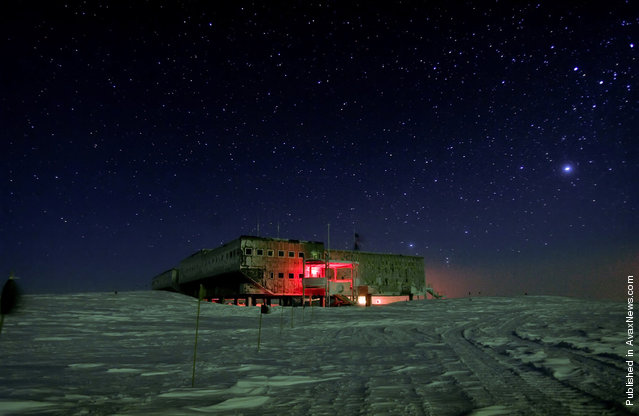
Amundsen-Scott South Pole Station experiences months of darkness. The sun dips below the horizon on March 21, after which follows several weeks of twilight before complete darkness results. Photo taken on June 25, 2009. (National Science Foundation/Jeremy Johnson)
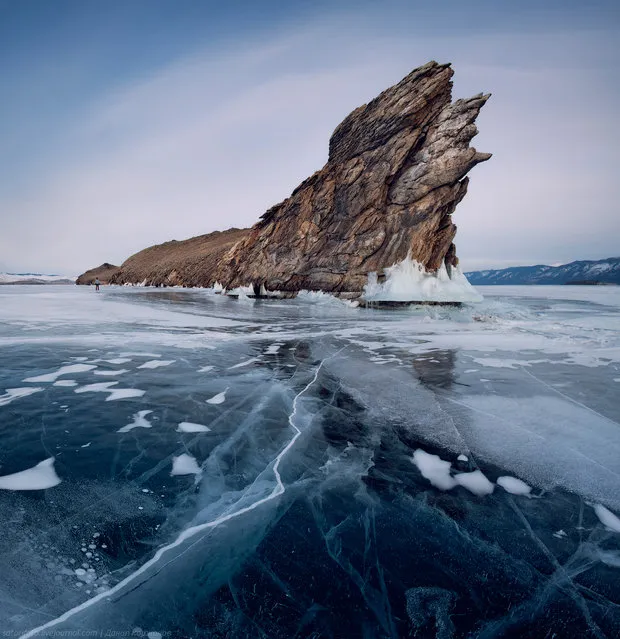
Lake Baikal is the world's oldest lake, at 25 million years (possibly older), and deepest, averaging 744.4 metres (2,442 ft).
Located in the south of the Russian region of Siberia, between Irkutsk Oblast to the northwest and the Buryat Republic to the southeast, it is the most voluminous freshwater lake in the world, containing roughly 20% of the world's unfrozen surface fresh water.
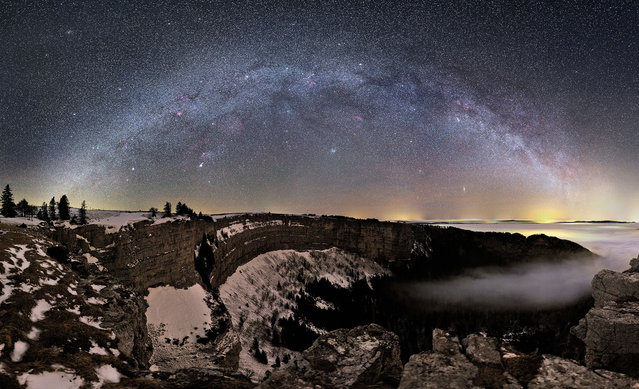
The Milky Way is the galaxy in which Earth is contained. This name derives from its appearance as a dim “milky” glowing band arching across the night sky, in which the naked eye cannot distinguish individual stars. The term “Milky Way” is a translation of the Classical Latin via lactea, from the Hellenistic Greek γαλαξίας κύκλος (pr. galaxías kýklos, “milky circle”). The Milky Way appears like a band because it is a disk-shaped structure being viewed from inside. The fact that this faint band of light is made up of stars was proven in 1610 when Galileo Galilei used his telescope to resolve it into individual stars. In the 1920s, observations by astronomer Edwin Hubble showed that the Milky Way is just one of many galaxies.