Loading...
Done
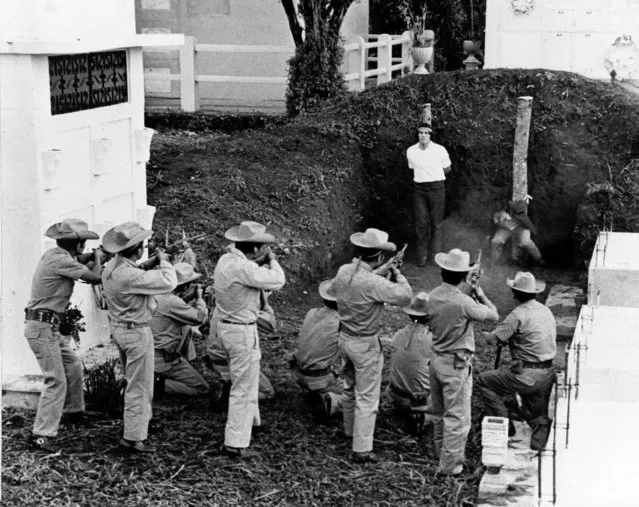
Convicted murderer Hector Alvarado Mazariegos, right, drops to the ground as he is hit by bullets of a Guatemala firing squad in the public cemetery at Mazatenango, June 28, 1975. His companion, Rocael Ortiz, met the same fate a few seconds later. Both were convicted of murder. (Photo by AP Photo/Anzueto)

Convicted murderer Hector Alvarado Mazariegos, right, drops to the ground as he is hit by bullets of a Guatemala firing squad in the public cemetery at Mazatenango, June 28, 1975. His companion, Rocael Ortiz, met the same fate a few seconds later. Both were convicted of murder. (Photo by AP Photo/Anzueto)
Details
29 Jul 2017 07:53:00
Commended. In late May, about a quarter of a million snow geese arrive from North America to nest on Wrangel Island, in northeastern Russia. They form the world's largest breeding colony of snow geese. Photographer Sergey Gorshkov spent two months on the remote island photographing the unfolding dramas. (Photo by Sergey Gorshkov/Veolia Environnement Wildlife Photographer)

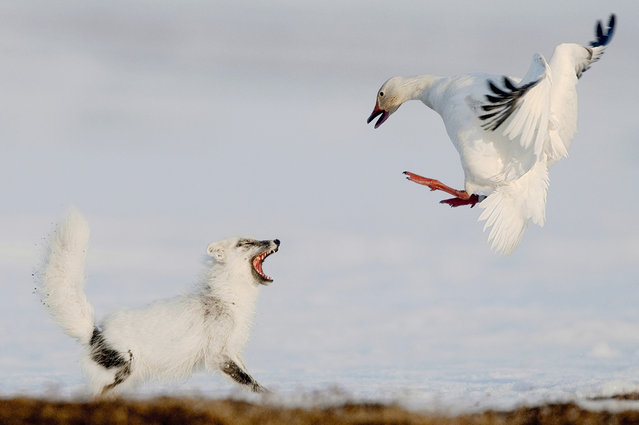
Commended. In late May, about a quarter of a million snow geese arrive from North America to nest on Wrangel Island, in northeastern Russia. They form the world's largest breeding colony of snow geese. Photographer Sergey Gorshkov spent two months on the remote island photographing the unfolding dramas. Arctic foxes take advantage of the abundance of eggs, caching surplus eggs for leaner times. But a goose (here the gander) is easily a match for a fox, which must rely on speed and guile to steal eggs. “The battles were fairly equal”, notes Sergey, “and I only saw a fox succeed in grabbing an egg on a couple of occasions, despite many attempts”. Surprisingly, “the geese lacked any sense of community spirit”, he adds, “and never reacted when a fox harassed a neighboring pair nesting close by”. (Photo by Sergey Gorshkov/Veolia Environnement Wildlife Photographer)

Details
16 Jun 2015 12:30:00
A store mannequin with a protective mask stands before a clothes store as they open for the first time since March during the novel coronavirus (COVID-19) pandemic on April 22, 2020 in Berlin, Germany. Small to midsized-shops are opening across Germany this week as state authorities follow a recommendation by the federal government to ease restrictions imposed in March meant to slow the spread of the coronavirus. Some schools are also planning to reopen soon, as are museums and hair salons in coming weeks. (Photo by Maja Hitij/Getty Images)

A store mannequin with a protective mask stands before a clothes store as they open for the first time since March during the novel coronavirus (COVID-19) pandemic on April 22, 2020 in Berlin, Germany. Small to midsized-shops are opening across Germany this week as state authorities follow a recommendation by the federal government to ease restrictions imposed in March meant to slow the spread of the coronavirus. Some schools are also planning to reopen soon, as are museums and hair salons in coming weeks. (Photo by Maja Hitij/Getty Images)
Details
08 Jan 2021 00:05:00
A monolith placed in the Utah wilderness in November 2020. New clues have surfaced in the disappearance of the gleaming monolith that seemed to melt away as mysteriously as it appeared in the red-rock desert. A Colorado photographer told a TV station in Salt Lake City that he saw four men push over the hollow, stainless steel structure last Friday night. (Photo by Terrance Siemon/AP Photo)

A monolith placed in the Utah wilderness in November 2020. New clues have surfaced in the disappearance of the gleaming monolith that seemed to melt away as mysteriously as it appeared in the red-rock desert. A Colorado photographer told a TV station in Salt Lake City that he saw four men push over the hollow, stainless steel structure last Friday night. (Photo by Terrance Siemon/AP Photo)
Details
17 Feb 2021 09:53:00
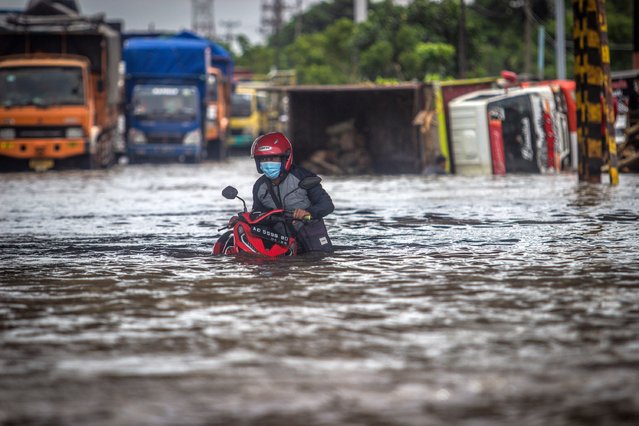
A resident pushes their motorbike through flood waters caused by torrential rain in Semarang, central Java, Indonesia on February 23, 2021. (Photo by W.F. Sihardian/NurPhoto/Rex Features/Shutterstock)

A resident pushes their motorbike through flood waters caused by torrential rain in Semarang, central Java, Indonesia on February 23, 2021. (Photo by W.F. Sihardian/NurPhoto/Rex Features/Shutterstock)
Details
11 Mar 2021 09:49:00
Women dance on top of a car as revelers enjoy spring break festivities despite an 8pm curfew imposed by local authorities, amid the coronavirus disease (COVID-19) pandemic, in Miami Beach, Florida, U.S., March 20, 2021. (Photo by Marco Bello/Reuters)

Women dance on top of a car as revelers enjoy spring break festivities despite an 8pm curfew imposed by local authorities, amid the coronavirus disease (COVID-19) pandemic, in Miami Beach, Florida, U.S., March 20, 2021. (Photo by Marco Bello/Reuters)
Details
30 Mar 2021 09:59:00
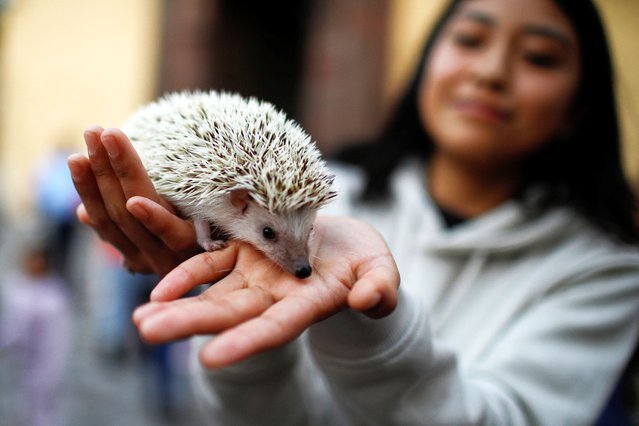
A girl holds her hedgehog to be blessed by a priest at the Cathedral San Bernardino de Siena during the ceremony commemorating the Feast of San Antonio Abad, the patron saint of domestic animals, in Xochimilco on the outskirts of Mexico City, Mexico on January 17, 2024. (Photo by Raquel Cunha/Reuters)

A girl holds her hedgehog to be blessed by a priest at the Cathedral San Bernardino de Siena during the ceremony commemorating the Feast of San Antonio Abad, the patron saint of domestic animals, in Xochimilco on the outskirts of Mexico City, Mexico on January 17, 2024. (Photo by Raquel Cunha/Reuters)
Details
04 Feb 2024 09:30:00
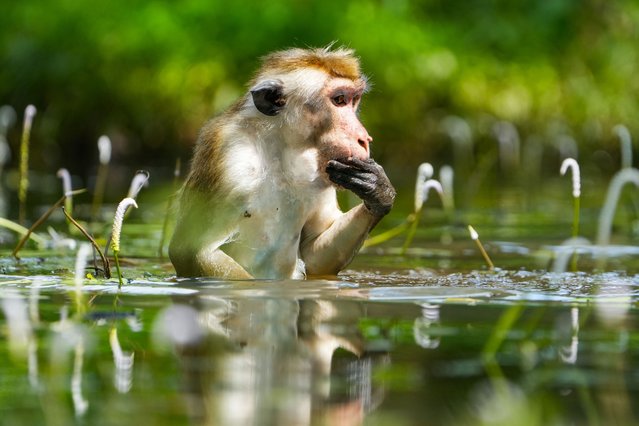
A toque macaque is eating flowers in the water at the pilgrimage site in Polonnaruwa, Sri Lanka, on January 13, 2024. The toque macaque (Macaca sinica), a reddish-brown-colored Old World monkey, is endemic to Sri Lanka, where it is known as the rilewa or rilawa. It is named for the whorl of hair at the crown of its head, which resembles a brimless toque cap. (Photo by Thilina Kaluthotage/NurPhoto/Rex Features/Shutterstock)

A toque macaque is eating flowers in the water at the pilgrimage site in Polonnaruwa, Sri Lanka, on January 13, 2024. The toque macaque (Macaca sinica), a reddish-brown-colored Old World monkey, is endemic to Sri Lanka, where it is known as the rilewa or rilawa. It is named for the whorl of hair at the crown of its head, which resembles a brimless toque cap. (Photo by Thilina Kaluthotage/NurPhoto/Rex Features/Shutterstock)
Details
10 Feb 2024 09:30:00