Loading...
Done


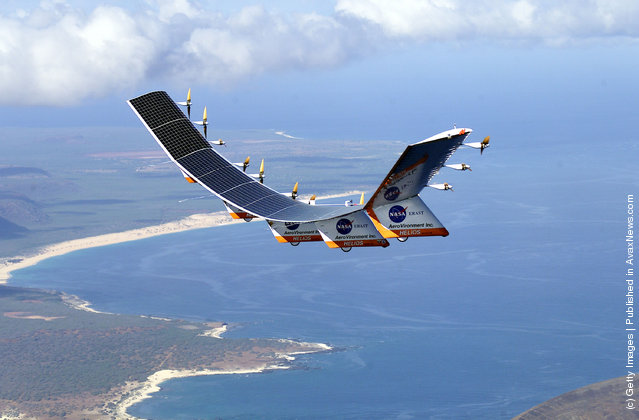
“NASA's Pathfinder, Pathfinder Plus, Centurion and Helios Prototype were an evolutionary series of solar- and fuel-cell-system-powered unmanned aerial vehicles. AeroVironment, Inc. developed the vehicles under NASA's Environmental Research Aircraft and Sensor Technology (ERAST) program. They were built to develop the technologies that would allow long-term, high-altitude aircraft to serve as “atmospheric satellites”, to perform atmospheric research tasks as well as serve as communications platforms”. – Wikipedia

Photo: The solar-electric Helios Prototype flying wing is flies over the Hawaiian islands of Niihau and Lehua during the first solar-powered test flight July 14, 2001 from the U.S. Navy's Pacific Missile Range Facility on Kauai, HI. The 18-hour flight was a functional checkout of the aircraft's systems and performance in preparation for an attempt to reach sustained flight at 100,000 feet altitude later in the summer. (Photo Courtesy of NASA/Getty Images)
Details
14 Jul 2011 09:24:00


“The McDonnell Douglas KC-10 Extender is an air-to-air tanker aircraft in service with the United States Air Force derived from the civilian DC-10-30 airliner. The KC-10 was the second consecutive McDonnell Douglas transport aircraft to be selected by the US Air Force following the C-9 Nightingale. The similar KDC-10 is in service with the Royal Netherlands Air Force.”

Photo: A B-52G Stratofortress aircraft takes off with another B-52G close behind. Three cells of six B-52 and KC-10 Extender aircraft will takeoff seconds apart under combat conditions during the minimum interval takeoff exercise. The exercise is a part of an operational readiness inspection by the Strategic Air Command Inspector General Team. (Photo by USAF). 1998
Details
15 Mar 2011 09:23:00
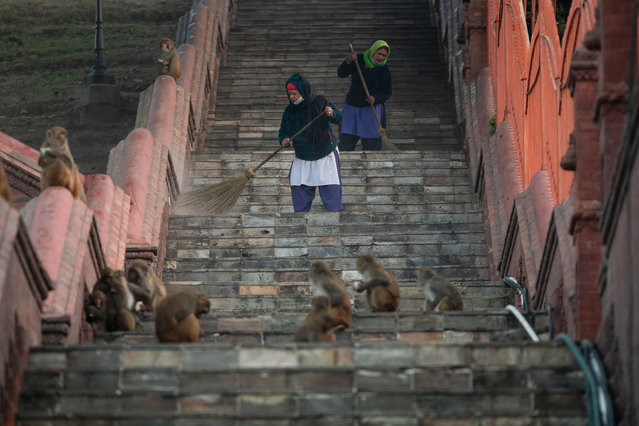
Workers clean the premises of Pashupatinath temple in Kathmandu, Nepal, December 16, 2020. The Pashupatinath Temple in Nepal reopened for devotees on Wednesday morning, almost eight months after it was shut due to the COVID-19 pandemic. (Photo by Xinhua News Agency/Rex Features/Shutterstock)

Workers clean the premises of Pashupatinath temple in Kathmandu, Nepal, December 16, 2020. The Pashupatinath Temple in Nepal reopened for devotees on Wednesday morning, almost eight months after it was shut due to the COVID-19 pandemic. (Photo by Xinhua News Agency/Rex Features/Shutterstock)
Details
22 Jan 2021 09:17:00
Afghan female police cadets are seen during their graduation ceremony at Sivas Police Vocational Center Directorate in Sivas, Turkey on March 13, 2018. (Photo by Serhat Zafer/Anadolu Agency/Getty Images)

Afghan female police cadets are seen during their graduation ceremony at Sivas Police Vocational Center Directorate in Sivas, Turkey on March 13, 2018. (Photo by Serhat Zafer/Anadolu Agency/Getty Images)
Details
14 Mar 2018 08:02:00
A man prays to mourn victims of the March 11, 2011, earthquake and tsunami in front of a ship brought ashore by the disaster in Kesennuma, Miyagi Prefecture, Japan.  (Photo by Kyodo via Reuters)

A man prays to mourn victims of the March 11, 2011, earthquake and tsunami in front of a ship brought ashore by the disaster in Kesennuma, Miyagi Prefecture, Japan. (Photo by Kyodo via Reuters)
Details
13 Mar 2013 12:30:00
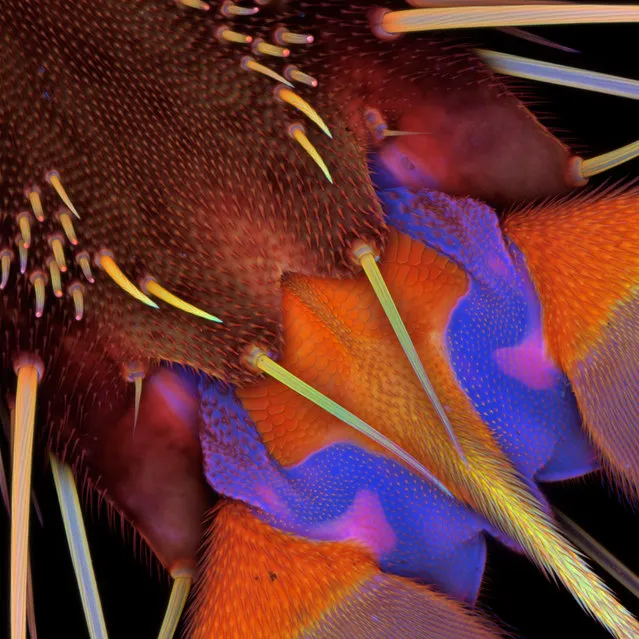
Pretarsus of the third leg of a female drone fly (Eristalis tenax), ventral view, by Dr. Jan Michels, Institute of Zoology, Christian-Albrechts-University of Kiel, Germany. (Photo by Olympus BioScapes)

“Microscope images forge an extraordinary bond between science and art, said Hidenao Tsuchiya, Olympus America's Vice President and General Manager for the Scientific Equipment Group. We founded this competition to focus on the fascinating stories coming out of today's life science research laboratories. The thousands of images that people have shared with the competition over the years reflect some of the most exciting work going on in research today – work that can help shed light on the living universe and ultimately save lives. We look at BioScapes and these beautiful images as sources of education and inspiration to us and the world”. – OlympusBioScapes

Photo: Pretarsus of the third leg of a female drone fly (Eristalis tenax), ventral view, by Dr. Jan Michels, Institute of Zoology, Christian-Albrechts-University of Kiel, Germany. (Photo by Olympus BioScapes)
Details
29 Jul 2012 09:20:00
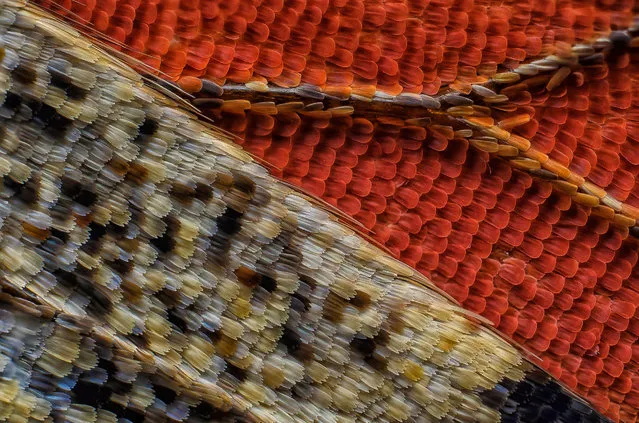
11th Place: Scales of a butterfly wing underside (Vanessa atalanta). (Photo by Francis Sneyers/Nikon's Small World 2016)

Each year Nikon Small World recognizes the excellence of photography taken under the microscope. The contest showcases the beauty and complexity of life. Anyone interested in microscopy and photography can enter the contest and in its 42nd year, Nikon Small World received 2,000 entries from 70 countries. Here: 11th Place; Scales of a butterfly wing underside (Vanessa atalanta). (Photo by Francis Sneyers/Nikon's Small World 2016)
Details
20 Oct 2016 11:19:00
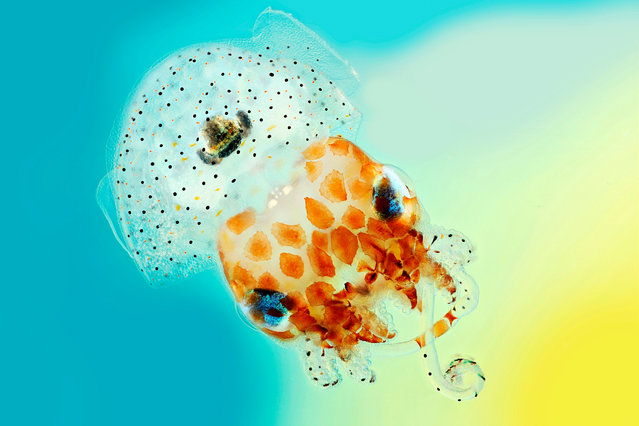
With its huge eyes, comical name and diminutive size, Mark R. Smith’s image of a baby Hawaiian bobtail squid can’t help but raise a smile. A curiously endearing creature, the cephalopod is just 1.5cm across, its mantle cavity bearing more than a passing resemblance to a rather natty shower cap. But it is also a beautiful example of symbiosis – nature’s version of “I’ll scratch your back if you scratch mine” – for on the underside of the squid is a light organ which houses bioluminescent bacteria. The squid offers the bacteria protection and food, while the bacteria emit a glow – a handy trait that the squid uses to offset its silhouette, helping it to evade predators in the depths below. Mark R. Smith’s entry combines several images of a Hawaiian bobtail squid with different focus lengths to create a final picture with greater depth of field than normal. (Photo by Mark R. Smith/Wellcome Images/Macroscopic Solutions)

With its huge eyes, comical name and diminutive size, Mark R. Smith’s image of a baby Hawaiian bobtail squid can’t help but raise a smile. A curiously endearing creature, the cephalopod is just 1.5cm across, its mantle cavity bearing more than a passing resemblance to a rather natty shower cap. But it is also a beautiful example of symbiosis – nature’s version of “I’ll scratch your back if you scratch mine” – for on the underside of the squid is a light organ which houses bioluminescent bacteria. The squid offers the bacteria protection and food, while the bacteria emit a glow – a handy trait that the squid uses to offset its silhouette, helping it to evade predators in the depths below. Mark R. Smith’s entry combines several images of a Hawaiian bobtail squid with different focus lengths to create a final picture with greater depth of field than normal. (Photo by Mark R. Smith/Wellcome Images/Macroscopic Solutions)
Details
08 Mar 2017 00:05:00