Loading...
Done
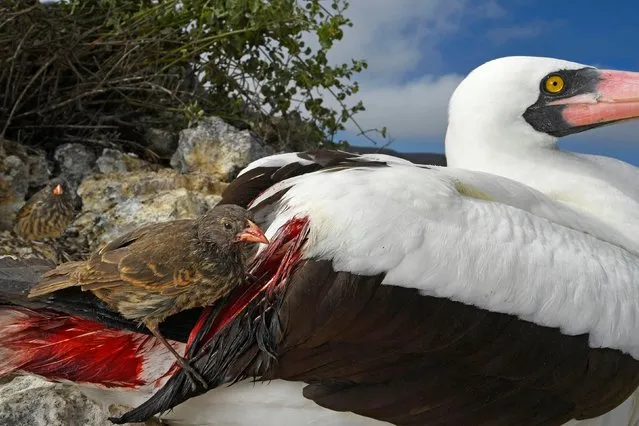
Bloodthirsty by Thomas P Peschak, Germany/South Africa — winner, Behaviour: birds. When rations run short on Wolf Island, in the remote northern Galápagos, the sharp-beaked ground finches become vampires. Their sitting targets are Nazca boobies and other large birds. The finches rely on a scant diet of seeds and insects, which regularly dries up, so they drink blood to survive. ‘I’ve seen more than half a dozen finches drinking from a single Nazca booby,’ says Tom. Rather than leave their nests the boobies tolerate the vampires, and the blood loss doesn’t seem to cause permanent harm. (Photo by Thomas P Peschak/2018 Wildlife Photographer of the Year)

Bloodthirsty by Thomas P. Peschak, Germany/South Africa — winner, Behaviour: birds. When rations run short on Wolf Island, in the remote northern Galápagos, the sharp-beaked ground finches become vampires. Their sitting targets are Nazca boobies and other large birds. The finches rely on a scant diet of seeds and insects, which regularly dries up, so they drink blood to survive. ‘I’ve seen more than half a dozen finches drinking from a single Nazca booby,’ says Tom. Rather than leave their nests the boobies tolerate the vampires, and the blood loss doesn’t seem to cause permanent harm. (Photo by Thomas P. Peschak/2018 Wildlife Photographer of the Year)
Details
19 Oct 2018 00:05:00
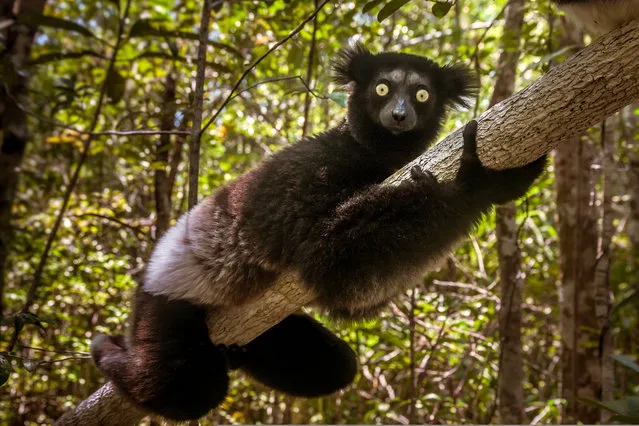
The secretive indri (Indri indri) of Madagascar, the largest living lemur. It is also critically endangered and highly evolutionarily distinct with no close relatives, which makes its branch one of most precarious on the mammal evolutionary tree. In the likely event that the indri goes extinct, we will lose 19m years of unique evolutionary history from the mammal tree of life. (Photo by Pierre-Yves Babelon/Aarhus University)

The secretive indri (Indri indri) of Madagascar, the largest living lemur. It is also critically endangered and highly evolutionarily distinct with no close relatives, which makes its branch one of most precarious on the mammal evolutionary tree. In the likely event that the indri goes extinct, we will lose 19m years of unique evolutionary history from the mammal tree of life. (Photo by Pierre-Yves Babelon/Aarhus University)
Details
18 Nov 2018 00:02:00
Bebe Rexha wears satin fuchsia suit while leaving The Tonight Show Starring Jimmy Fallon in New York City on December 20, 2018. (Photo by Felipe Ramales/Splash News and Pictures)

Bebe Rexha wears satin fuchsia suit while leaving The Tonight Show Starring Jimmy Fallon in New York City on December 20, 2018. (Photo by Felipe Ramales/Splash News and Pictures)
Details
23 Dec 2018 00:01:00
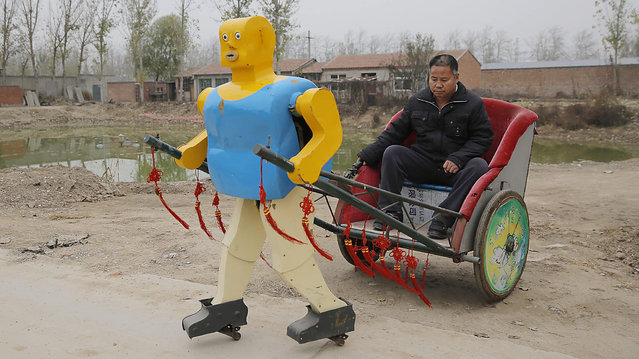
Robot inventor Wu Yulu sits on a rickshaw driven by a robot which he invented in his village in rural Beijing's Tongzhou district, China, 17 November 2016. The 54-year-old Chinese farmer living in rural Beijing's Tongzhou district invented 63 robots in the past 30 years. Wu, who only received primary school education, plans to give up the agricultural work for his robot products. He regularly participates in exhibitions, transfers patent rights and teaches at the university to earn money. (Photo by Wu Hong/EPA)

Robot inventor Wu Yulu sits on a rickshaw driven by a robot which he invented in his village in rural Beijing's Tongzhou district, China, 17 November 2016. The 54-year-old Chinese farmer living in rural Beijing's Tongzhou district invented 63 robots in the past 30 years. Wu, who only received primary school education, plans to give up the agricultural work for his robot products. He regularly participates in exhibitions, transfers patent rights and teaches at the university to earn money. (Photo by Wu Hong/EPA)
Details
21 Nov 2016 10:41:00
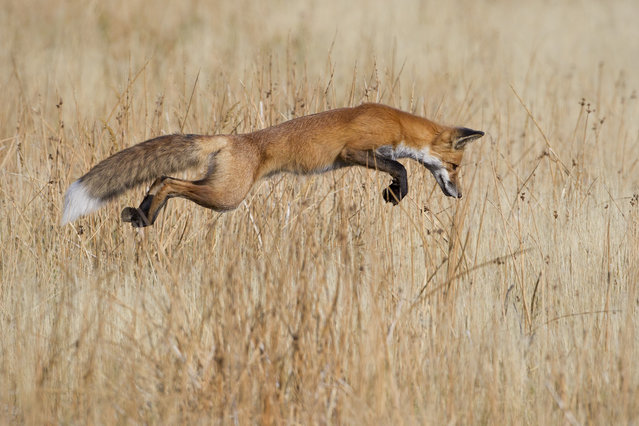
Canada: “Lucky pounce”. (Photo by Connor Stefanison/Wildlife Photographer of the Year 2013)

The winners of The London’s Natural History Museum's prestigious Wildlife Photographer of the Year for 2013 have finally been unveiled. Selected from almost 43,000 entries from 96 countries, the winners offer a glimpse of the stunning array of natural beauty on our planet. Photo: Canada: “Lucky pounce”. “Anticipating the pounce – that was the hardest part”, says Connor, who had come to Yellowstone National Park, Wyoming, USA, in search of wildlife as much as the spectacular landscape. He had found this fox, his first ever, on his last day in the park. It was so absorbed in hunting that Connor had plenty of time to get out of the car and settle behind a rock. It quartered the grassland, back and forth, and then started staring intently at a patch of ground, giving Connor just enough warning of the action to come. When it sprung up, Connor got his shot. And when it landed, the fox got his mouse. (Photo by Connor Stefanison/Wildlife Photographer of the Year 2013)
Details
17 Oct 2013 08:12:00
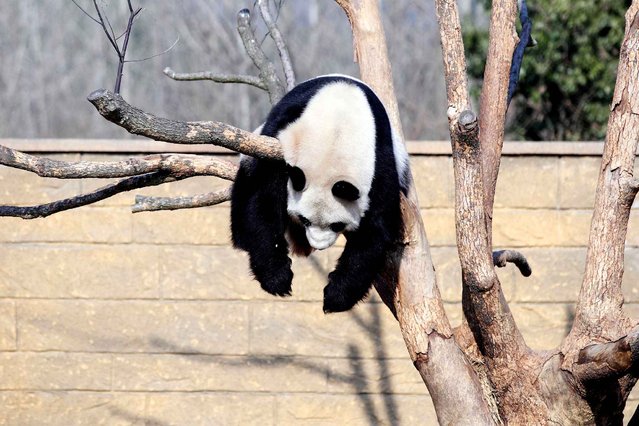
This picture taken on January 1, 2014 shows giant panda “Li Li” sleeping on a tree in Hangzhou Wild Animal World in Hangzhou, east China's Zhejiang province. Giant pandas, notorious for their low s*x drive, are among the world's most endangered animals. Fewer than 1,600 pandas remain in the wild, mainly in China's Sichuan province, with a further 300 in captivity around the world. (Photo by AFP Photo)

This picture taken on January 1, 2014 shows giant panda “Li Li” sleeping on a tree in Hangzhou Wild Animal World in Hangzhou, east China's Zhejiang province. Giant pandas, notorious for their low s*x drive, are among the world's most endangered animals. Fewer than 1,600 pandas remain in the wild, mainly in China's Sichuan province, with a further 300 in captivity around the world. (Photo by AFP Photo)
Details
04 Jan 2014 14:58:00
North Korean children wave to people on a Chinese tourist boat on the banks of Yalu River near the Chongsong county of North Korea, opposite the Chinese border city of Dandong, May 8, 2011. (Photo by Jacky Chen/Reuters)

North Korean children wave to people on a Chinese tourist boat on the banks of Yalu River near the Chongsong county of North Korea, opposite the Chinese border city of Dandong, May 8, 2011. (Photo by Jacky Chen/Reuters)
Details
02 Apr 2015 12:30:00
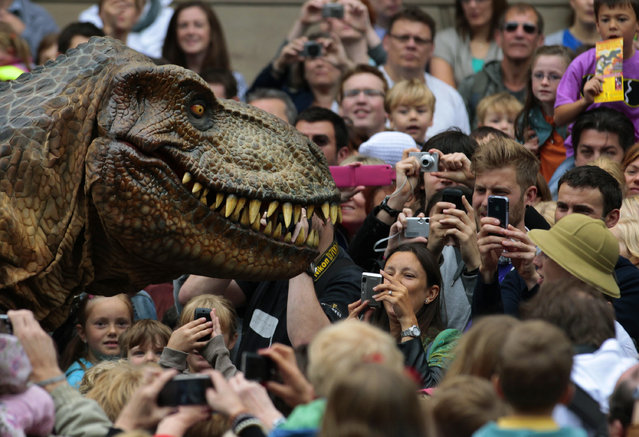
Visitors photograph an animatronic Tyrannosaurus Rex at the National Museum of Scotland, July 29, 2011. (Photo by David Moir/Reuters)

Visitors photograph an animatronic Tyrannosaurus Rex at the National Museum of Scotland, July 29, 2011. (Photo by David Moir/Reuters)
Details
12 Apr 2015 08:02:00