Loading...
Done
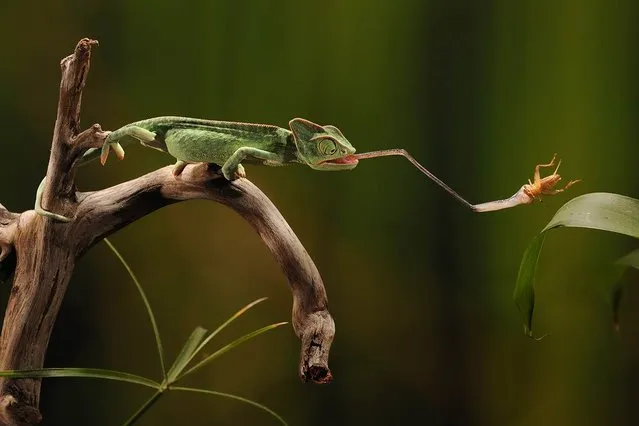
A veiled chameleon extends its tongue to catch a cricket

“Scott Linstead is an internationally published, freelance wildlife photographer/writer. His clients include Natural History Magazine, Hewlett Packard, Ranger Rick Magazine and a number of wildlife publications in North America and Europe. Scott's column on the techniques of bird photography appears in every issue of Outdoor Photography Canada”.

Photo: A veiled chameleon extends its tongue to catch a cricket. Canadian wildlife photographer Scott Linstead, formerly an aerospace engineer and high school teacher, uses a device called Phototrap “to not only photograph the elusive, but also the unimaginably quick”. (Photo by Scott Linstead)
Details
22 May 2012 11:32:00
Tomotaka Takahashi

“Tomotaka Takahashi (born March 27, 1975), roboticist and founder of Kyoto University's ROBO-GARAGE since 1999, creates humanoid robots known for their smooth, fluid motions and sleek appearance. Creating a number of humanoid robots entirely by himself, from concept through to production, Takahashi's designs have been featured in art exhibitions celebrating the creation of Astroboy, Time Magazine's Coolest Inventions of 2004, and promotions for Bandai, Panasonic, and Pepsi”. – Wikipedia

Photo: One of Japan's leading robot creator's Tomotaka Takahashi holds Robo Garage's Chroino and FT during the Robo_Japan 2008 Press Preview at Pacifico Yokohama on October 10, 2008 in Yokohama, Kanagawa, Japan. (Photo by Junko Kimura/Getty Images)
Details
15 Oct 2011 11:12:00
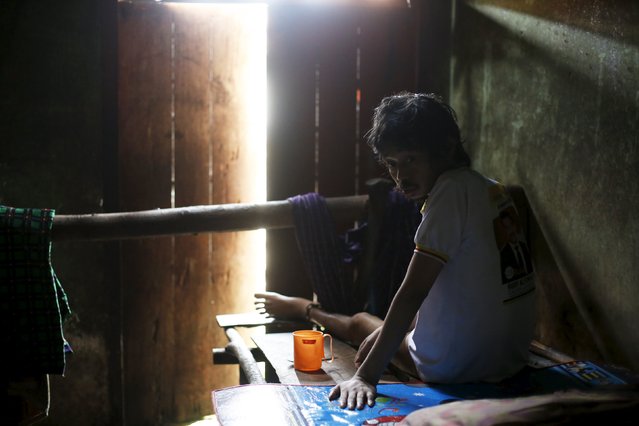
A man suffering from mental illness sits chained on a bed in his room inside his family home in Curug Sulanjana village in Serang, Banten province, Indonesia March 23, 2016. (Photo by Reuters/Beawiharta)

A man suffering from mental illness sits chained on a bed in his room inside his family home in Curug Sulanjana village in Serang, Banten province, Indonesia March 23, 2016. In a programme launched this year, Indonesia sends teams of workers into often-remote hamlets to help free patients kept in chains and ensure they get the medical treatment they need. (Photo by Reuters/Beawiharta)
Details
31 Mar 2016 11:29:00
An employee feeds a one-week-old coati cub with a bottle of milk at the Royev Ruchey zoo in the suburbs of Krasnoyarsk, Siberia, October 10, 2014. The mother of three cubs refused to nurse them, according to zoo employees. (Photo by Ilya Naymushin/Reuters)

An employee feeds a one-week-old coati cub with a bottle of milk at the Royev Ruchey zoo in the suburbs of Krasnoyarsk, Siberia, October 10, 2014. The mother of three cubs refused to nurse them, according to zoo employees. (Photo by Ilya Naymushin/Reuters)
Details
11 Oct 2014 14:18:00
The eruption of Cordon Caulle began on June 4, 2011, located in the Region of Los Rios in Chile. For about 12 months, people and animals became accustomed to living with the daily fall of ash, which also caused problems in the air traffic in South America. The explosions and lightning during first days of the eruption could be seen from hundreds of miles around. This photograph was taken on the second night of eruption from the town of Lago Ranco. (Photo and caption by Francisco Negroni/National Geographic Traveler Photo Contest)

The eruption of Cordon Caulle began on June 4, 2011, located in the Region of Los Rios in Chile. For about 12 months, people and animals became accustomed to living with the daily fall of ash, which also caused problems in the air traffic in South America. The explosions and lightning during first days of the eruption could be seen from hundreds of miles around. This photograph was taken on the second night of eruption from the town of Lago Ranco. (Photo and caption by Francisco Negroni/National Geographic Traveler Photo Contest)

ATTENTION! All pictures are presented in high resolution. To see Hi-Res images – just TWICE click on any picture. In other words, click small picture – opens the BIG picture. Click BIG picture – opens VERY BIG picture.
Details
23 Jun 2013 11:24:00
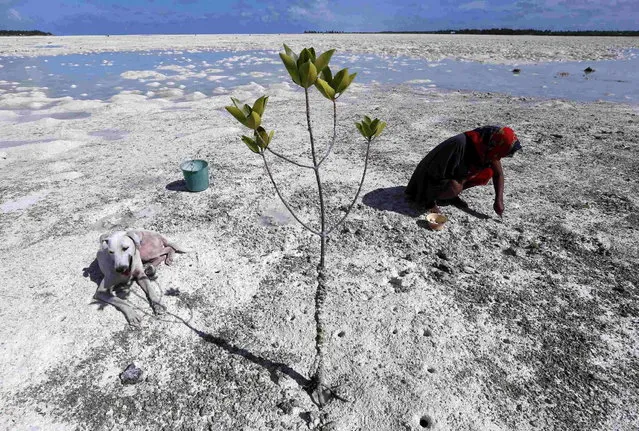
A dog sits in the shade of a mangrove tree as a woman uses a fork to dig for shellfish on the reef-mud flats of a lagoon located at South Tarawa in the central Pacific island nation of Kiribati May 23, 2013. (Photo by David Gray/Reuters)

A dog sits in the shade of a mangrove tree as a woman uses a fork to dig for shellfish on the reef-mud flats of a lagoon located at South Tarawa in the central Pacific island nation of Kiribati May 23, 2013. Kiribati consists of a chain of 33 atolls and islands that stand just metres above sea level, spread over a huge expanse of otherwise empty ocean. With surrounding sea levels rising, Kiribati President Anote Tong has predicted his country will likely become uninhabitable in 30-60 years because of inundation and contamination of its freshwater supplies. (Photo by David Gray/Reuters)
Details
13 Jun 2013 09:23:00
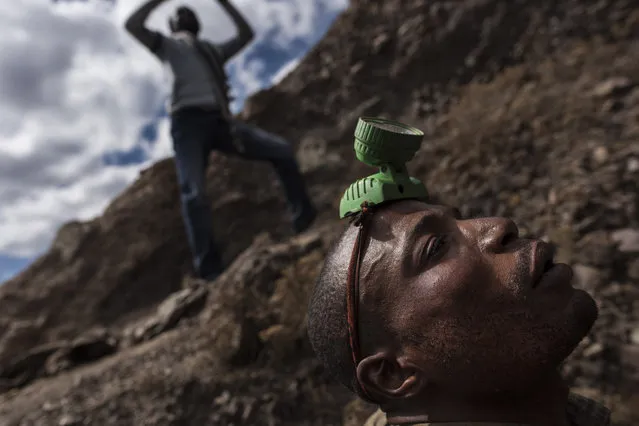
A “creuseur”, or digger, a plastic lantern on his head, readies to enter a copper and cobalt mine in Kawama, Democratic Republic of Congo on June 8, 2016. Cobalt is used in the batteries for electric cars and mobile phones. Working conditions are dangerous, often with no safety equipment or structural support for the tunnels. The diggers say they are paid on average US$2-3/day. (Photo by Michael Robinson Chavez/The Washington Post)

A “creuseur”, or digger, a plastic lantern on his head, readies to enter a copper and cobalt mine in Kawama, Democratic Republic of Congo on June 8, 2016. Cobalt is used in the batteries for electric cars and mobile phones. Working conditions are dangerous, often with no safety equipment or structural support for the tunnels. The diggers say they are paid on average US$2-3/day. (Photo by Michael Robinson Chavez/The Washington Post)
Details
30 Dec 2016 10:29:00
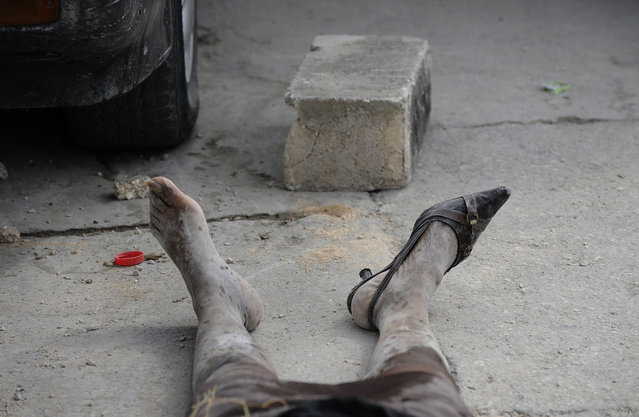
In this photo submitted by the Washington Post tilted “The Moment Time Stopped”, survivors piled bodies of the dead outside for weeks after earthquake on January 14, 2010 in Port-au-Prince, Haiti. The Washington Post has won a Pulitzer Prize for breaking news photography on Monday, April 18, 2011 for images taken in Haiti following the earthquake there.(Photo by Carol Guzy/AP Photo/The Washington Post)

In this photo submitted by the Washington Post tilted “The Moment Time Stopped”, survivors piled bodies of the dead outside for weeks after earthquake on January 14, 2010 in Port-au-Prince, Haiti. The 7.0 magnitude earthquake struck in 2010, and the Haitian government has said more than 300,000 people were killed. The exact toll is unknown because there was no systematic effort to count bodies among the chaos and destruction. (Photo by Carol Guzy/AP Photo/The Washington Post)
Details
13 Jan 2015 14:17:00