Loading...
Done
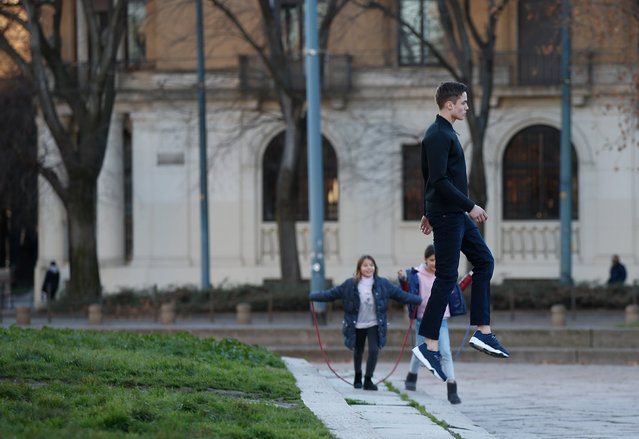
A model jumps during a photo shooting, in Milan, Italy, Friday, January 15, 2016. Men's fashion week starts today and will run until Tuesday, January 19. (Photo by Luca Bruno/AP Photo)

A model jumps during a photo shooting, in Milan, Italy, Friday, January 15, 2016. Men's fashion week starts today and will run until Tuesday, January 19. (Photo by Luca Bruno/AP Photo)
Details
17 Jan 2016 10:22:00
Palestinian barber Ramadan Odwan styles and straightens the hair of a customer with fire at his salon in Rafah, in the southern Gaza Strip February 2, 2017. In Ramadan Odwan's barbershop in Gaza, hair isn't just blow-dried, it's blowtorch-dried. “People have gone crazy about it, many people are curious to go through the experience and they are not afraid”, he told Reuters. “People here love adventures”. Odwan, 37, is not the first stylist in the world to use flame to straighten hair, but his craft is unique in the Gaza Strip. In his salon in the southern Gaza town of Rafah, Odwan applied what he described as a protective liquid coating to a customer's hair – he declined to disclose its contents – before aiming for the head and pressing the button on a small blowtorch. “I control how long I apply fire, I keep it on and off for 10 seconds or 15 seconds. It is completely safe and I have not encountered any accident since I started it two months ago”, Odwan added. Odwan charges 20 shekels ($5.20) for a haircut and fire-straightening. A barber for the past 18 years, he said part of the reason he uses the technique is to show that Palestinian barbers are as “professional as those out there around the world”. (Photo by Ibraheem Abu Mustafa/Reuters)

Palestinian barber Ramadan Odwan styles and straightens the hair of a customer with fire at his salon in Rafah, in the southern Gaza Strip February 2, 2017. In Ramadan Odwan's barbershop in Gaza, hair isn't just blow-dried, it's blowtorch-dried. “People have gone crazy about it, many people are curious to go through the experience and they are not afraid”, he told Reuters. “People here love adventures”. (Photo by Ibraheem Abu Mustafa/Reuters)
Details
11 Feb 2017 00:05:00
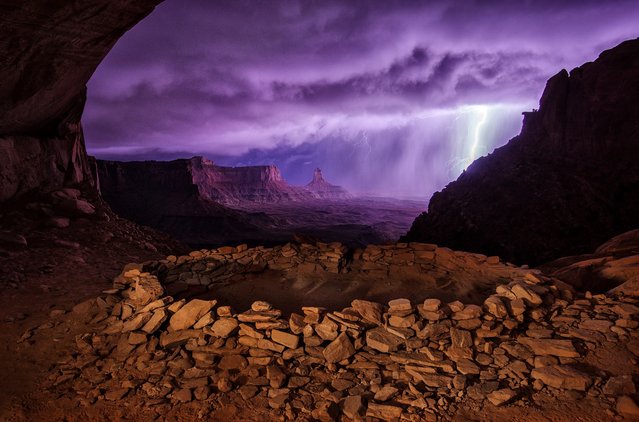
Second Place Winner: “Thunderstorm at False Kiva”. I hiked out to these ruins at night hoping to photograph them with the Milky Way, but instead a thunderstorm rolled through, creating this dramatic image. – Max Seigal. (Photo and caption by Max Seigal/National Geographic Traveler Photo Contest)

Second Place Winner: “Thunderstorm at False Kiva”. I hiked out to these ruins at night hoping to photograph them with the Milky Way, but instead a thunderstorm rolled through, creating this dramatic image. – Max Seigal. National Geographic Traveler Director of Photography Dan Westergren, one of this year's judges, shares his thoughts on the second place winner: “This photo combines two different scenes into one: the small kiva in a cliff dwelling and the grand vista of Canyonlands National Park across the valley. I really like the two different color palettes – warm inside and purple outside. This two-for-one scene was caused by the lightning storm outside the dwelling, which lit up the landscape like it was a huge electronic flash. Looking at this picture I can imagine what a wonderful sight it must have been for the ancient people who lived here. It doesn't seem too amazing now in our modern world, but might have been mind-blowing for the prehistoric residents”. Location: Utah. (Photo and caption by Max Seigal/National Geographic Traveler Photo Contest)
Details
02 Aug 2013 06:16:00
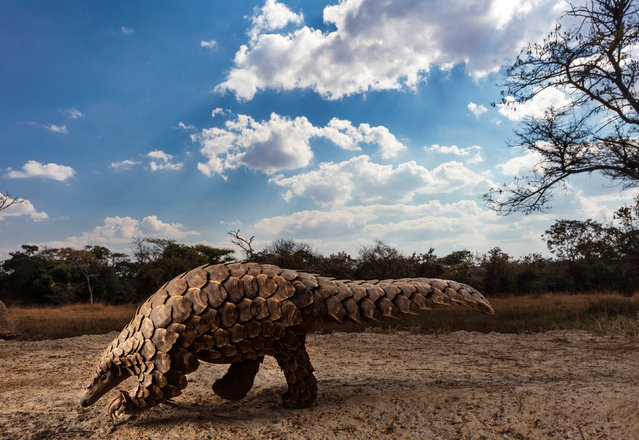
Pangolins in Crisis: Brent Stirton, South Africa; 1st place, Natural world and wildlife. “Pangolins are the world’s most illegally trafficked mammals, with an estimated one million trafficked to Asia in the last 10 years. Their scales are used in traditional Chinese and Vietnamese medicine, and their meat is sold as a high-priced delicacy. As a result, pangolins are listed as critically endangered and anyone who trades or consumes them is breaking the law. This body of work exposes the trade, while exploring aspects of illegality and celebrating the people who are trying to save these animals”. (Photo by Brent Stirton/Sony World Photography Awards 2020)

Pangolins in Crisis: Brent Stirton, South Africa; 1st place, Natural world and wildlife. “Pangolins are the world’s most illegally trafficked mammals, with an estimated one million trafficked to Asia in the last 10 years. Their scales are used in traditional Chinese and Vietnamese medicine, and their meat is sold as a high-priced delicacy. As a result, pangolins are listed as critically endangered and anyone who trades or consumes them is breaking the law. This body of work exposes the trade, while exploring aspects of illegality and celebrating the people who are trying to save these animals”. (Photo by Brent Stirton/Sony World Photography Awards 2020)
Details
11 Jun 2020 00:05:00
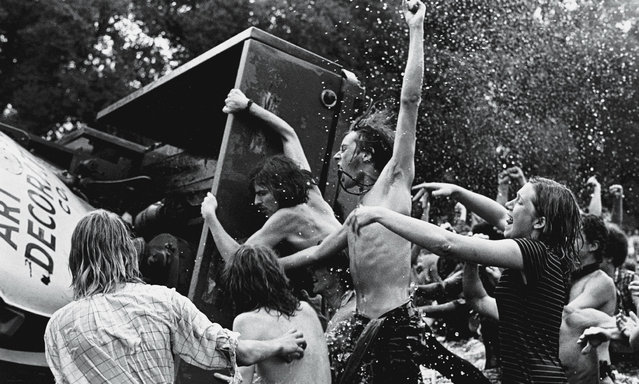
Young demonstrators (many shirtless) shout and cheer as they overturn a truck trailer in the Reflecting Pool on the Mall facing the Washington Monument during the “Honor America Day Smoke-In” thrown by marijuana activists to protest the official “Honor America Day” ceremonies being held at the Lincoln Memorial, Washington, DC, July 4, 1970. (Photo by David Fenton/Getty Images)

Young demonstrators (many shirtless) shout and cheer as they overturn a truck trailer in the Reflecting Pool on the Mall facing the Washington Monument during the “Honor America Day Smoke-In” thrown by marijuana activists to protest the official “Honor America Day” ceremonies being held at the Lincoln Memorial, Washington, DC, July 4, 1970. (Photo by David Fenton/Getty Images)
Details
05 Jul 2020 00:03:00
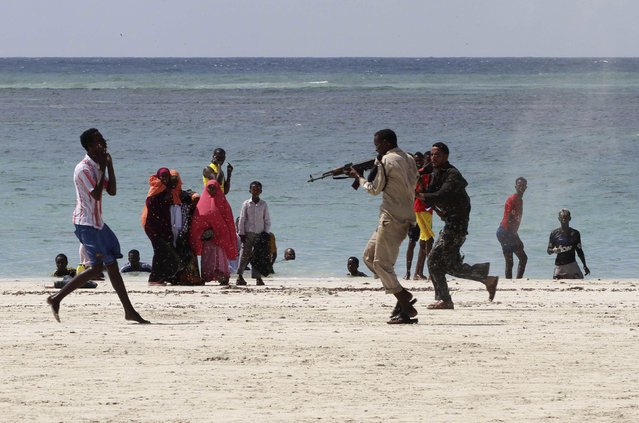
A Somali police officer arrests a suspected rebel member of the al Qaeda-affiliated al Shabaab among beach goers in Mogadishu. Al Shabaab claimed responsibility for today's pre-dawn attack on a Kenyan university campus near the Somali border.  (Photo by Feisal Omar/Reuters)

A Somali police officer arrests a suspected rebel member of the al Qaeda-affiliated al Shabaab among beach goers in Mogadishu. Al Shabaab claimed responsibility for today's pre-dawn attack on a Kenyan university campus near the Somali border. The following gallery examines who is al Shabaab. Here: Somali police officer (R) arrests a suspected rebel member (L) of the Al Qaeda-affiliated al Shabaab among beach goers at the Lido beach north of Somalia's capital Mogadishu March 23, 2012. (Photo by Feisal Omar/Reuters)
Details
03 Apr 2015 13:15:00
Bride Yulia Tagil sits on the backseat of a bike as she arrives for her alternative wedding ceremony on a square in Tel Aviv July 25, 2010. The alternative wedding ceremony was intended to demonstrate against the current situation in Israel, where the only way for Jews to get married by law is through the Chief Rabbinate. (Photo by Nir Elias/Reuters)

Bride Yulia Tagil sits on the backseat of a bike as she arrives for her alternative wedding ceremony on a square in Tel Aviv July 25, 2010. The alternative wedding ceremony was intended to demonstrate against the current situation in Israel, where the only way for Jews to get married by law is through the Chief Rabbinate. (Photo by Nir Elias/Reuters)
Details
28 Aug 2013 11:40:00
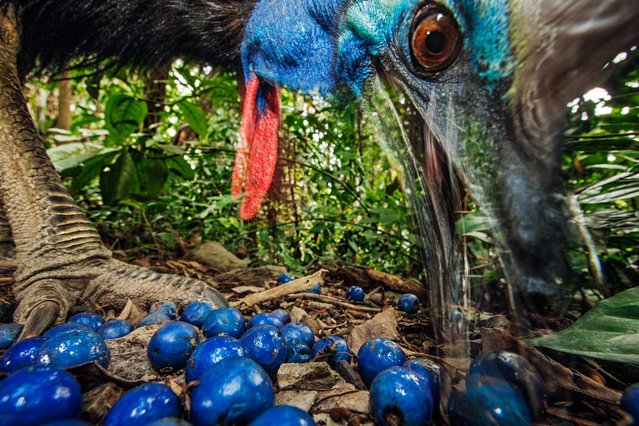
“Cassowaries are large, flightless birds related to emus and (more distantly) to ostriches, rheas, and kiwis”, writes Olivia Judson in the September issue of National Geographic magazine. (Photo by Christian Ziegler/National Geographic)

“Cassowaries are large, flightless birds related to emus and (more distantly) to ostriches, rheas, and kiwis”, writes Olivia Judson in the September issue of National Geographic magazine. How large? People-size: Adult males stand well over five foot five and top 110 pounds. Females are even taller, and can weigh more than 160 pounds. Dangerous when roused, they’re shy and peaceable when left alone. But even birds this big and tough are prey to habitat loss. The dense New Guinea and Australia rain forests where they live have dwindled. Today cassowaries might number 1,500 to 2,000. And because they help shape those same forests – by moving seeds from one place to another – “if they vanish”, Judson writes, “the structure of the forest would gradually change” too. (Photo by Christian Ziegler/National Geographic)
Details
06 Jan 2014 12:21:00