Loading...
Done
Family Tree By Zhang Huan

All the people we meet, all the things we know, and all of our experiences shape our souls, forever marking our faces. This was probably the main idea of the performance piece created by Chinese artist Zhang Huan, in which his face was painted over by three calligraphers with the names of people he knew, personal stories, and random thoughts. Truly, it amazing just how much we can find out about a person just by looking at their face. Surely, not everyone has the ability to see into the soul of the person just by looking at their face, but those that do can easily see the person’s personality, their intelligence, and sometimes even get glimpse into their past. Though it sounds like magic to people who don’t have this ability, it is completely true. Somehow, our mind can pick up on the miniscule changes of the facial structure and figure out the dominant facial expressions of that person. (Photo by Zhang Huan)
Details
23 Nov 2014 12:47:00
Life Fox And Hound

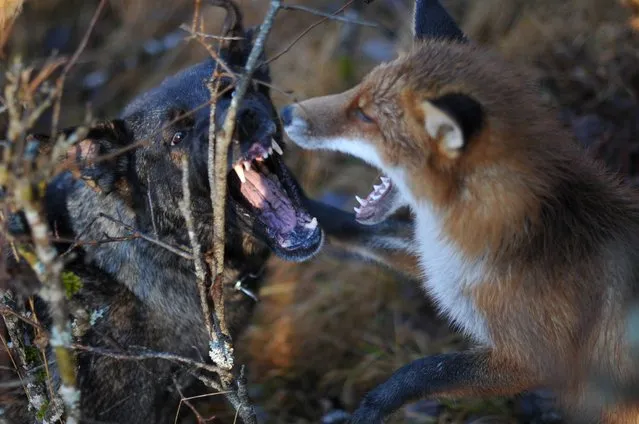
Tinni the dog and Sniffer the fox became quick friends, prompting the pooch's owner Torgeir Berge to start a campaign against the highly controversial fur trade after he noticed "how similar foxes and dogs actually are," calling the fox the "dog of the forest." Berge and his friend Berit Helberg plan to release a book sometime next year chronicling the duo, because "no animals should be living like the animals in the fur industry are living." According to animal advocacy group PETA, many creatures bound for the fur industry are allegedly kept in small, restrictive cages for their entire lives. Berge and Helberg said they plan to donate a portion of the proceeds to help save the Sniffers of the world, and we can totally see why.
Details
24 Apr 2014 14:40:00
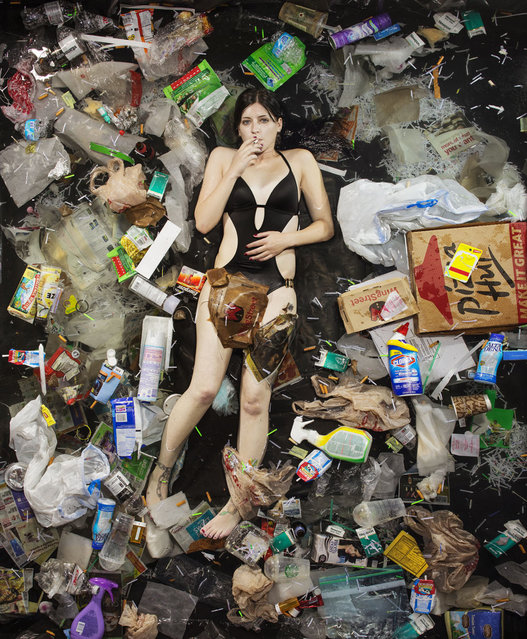
Dan surrounded by seven days of her own rubbish in Pasadena, California. (Photo by Gregg Segal/Barcroft Media)

Dan surrounded by seven days of her own rubbish in Pasadena, California. If you've never thought about how much rubbish you throw away an honest photographic series will open your eyes. Men, women, couples and families with young children have been photographed lying on their backs surrounded by a week's worth of their own rubbish – from old cartons of milk, used nappies and even tampons. The startling series “Seven Days of Garbage” by Californian photographer Gregg Segal is an unforgettable reminder of the amount of waste a human collects in just seven days. (Photo by Gregg Segal/Barcroft Media)
Details
16 Jul 2014 14:41:00
Where's the fish?/n. South Kamchatka Sanctuary<><>South Kamchatka Sanctuary; Kuril Lake; Kamchatka; bear; salmon; spawning

Igor Shpilenok works in the reserve at Kamchatka, Russia. Igor is a fellow of the International League of Conservation Photographers and a winner of the 2006 BBC Wildlife Photographer Competition. Igor’s work has been published in numerous international and Russian magazines, including Smithsonian, National Wildlife, Geo, and BBC Wildlife.

“How does a bear behave when encounter a human? In most cases he runs away. But before running he almost always would rise to stand on his rear feet. And this behavior does not indicate the attack, as many people think...” – Igor Shpilenok. (Photo by Igor Shpilenok via Wildlife Photo Russia)
Details
16 Sep 2012 12:54:00


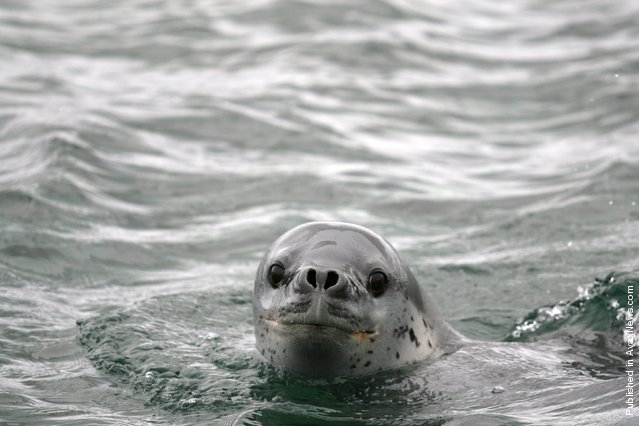
“The leopard seal (Hydrurga leptonyx), also referred to as the sea leopard, is the second largest species of seal in the Antarctic (after the southern elephant seal). It is most common in the southern hemisphere along the coast of Antarctica and on most sub-Antarctic islands, but can also be found on the coasts of southern Australia, Tasmania, South Africa, New Zealand, Lord Howe Island, Tierra del Fuego, the Cook Islands, and the Atlantic coast of South America. It can live twenty-six years, possibly more. Orcas and large sharks are the only natural predators of leopard seals”. – Wikipedia

Photo by: Gilad Rom; Source: Flickr
Details
13 Nov 2011 11:24:00
Concept Design Home Reversible Destiny Lofts MITAKA: In Memory Of Helen Keller By Reversible Destiny Foundation and Shusaku Arakawa

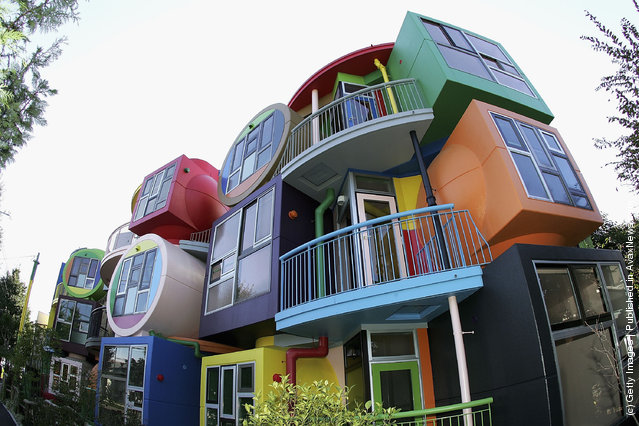
“The Reversible Destiny Lofts – Mitaka (In Memory of Helen Keller) is a nine-unit multiple dwelling. It was first completed example of procedural architecture put to residential use. These lofts reflexively articulate the residents’ operative tendencies and coordinating skills essential to and determinative of human thought and behavior; which means to say, the lofts manage, by virtue of how they are constructed, to reveal to their residents the ins and outs of what makes a person, in this case the resident. This is the same set of tendencies and skills to which Arakawa and Madeline Gins gave diagrammatic form in their decades-long research project The Mechanism of Meaning”. – Wikipedia

Photo: The exterior of the concept design home “Reversible Destiny Lofts MITAKA: In Memory of Helen Keller” is seen on October 27, 2005 in Tokyo, Japan. (Photo by Koichi Kamoshida/Getty Images)
Details
30 Nov 2011 11:58:00
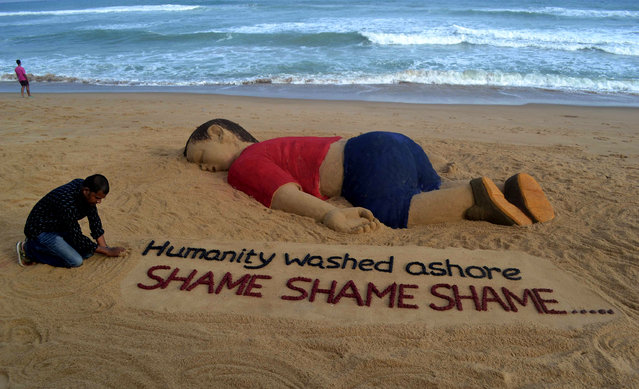
Indian artist Sudarsan Pattnaik works on a sand sculpture depicting drowned Syrian boy Aylan Kurdi at Puri beach, some 65 kilometers away from Bhubaneswar, on September 4, 2015. Charities helping refugees saw a surge in donations on September 4 across Europe as people shocked by the heart-rending images of a drowned Syrian boy on a Turkish beach dug deep to help out. (Photo by Asit Kumar/AFP Photo)

Indian artist Sudarsan Pattnaik works on a sand sculpture depicting drowned Syrian boy Aylan Kurdi at Puri beach, some 65 kilometers away from Bhubaneswar, on September 4, 2015. Charities helping refugees saw a surge in donations on September 4 across Europe as people shocked by the heart-rending images of a drowned Syrian boy on a Turkish beach dug deep to help out. The photos of the lifeless body of three-year-old Aylan Kurdi, lying on a beach in Bodrum, Turkey, have triggered a wave of emotion across the continent, despite deep divisions among European governments on how to deal with the crisis. (Photo by Asit Kumar/AFP Photo)
Details
05 Sep 2015 12:59:00
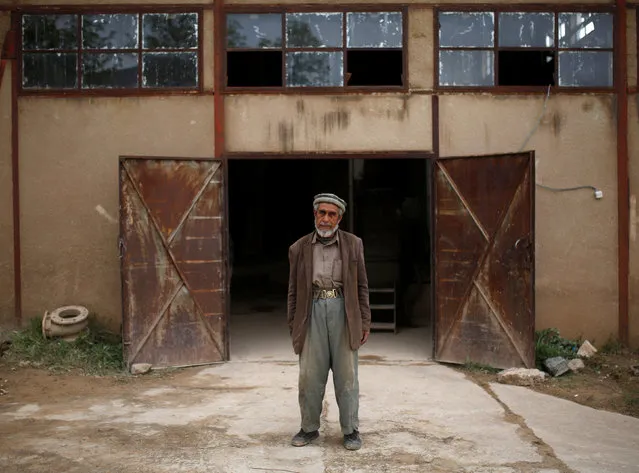
A worker at the Jabal Saraj cement factory poses for a photograph in Jabal Saraj, north of Kabul, Afghanistan April 19, 2016. (Photo by Ahmad Masood/Reuters)

A worker at the Jabal Saraj cement factory poses for a photograph in Jabal Saraj, north of Kabul, Afghanistan April 19, 2016. In an area desperately short of industry and jobs, local workers hope that the relaunch of the plant in Jabal Saraj, built by Czech engineers in 1957 and closed down by the Taliban in 1995, can show that Afghanistan's shattered industry can climb back to its feet after decades of war and destruction. But the outdated state-owned plant some 75 kilometres outside Kabul also shows how far it has to go before that promise can be achieved and there are serious questions over whether it has a viable future unless a new, modern facility is built to replace it. (Photo by Ahmad Masood/Reuters)
Details
31 May 2016 11:29:00