Loading...
Done
Malabon Zoo owner Manny Tangco holds a full-grown but very small rooster named “Small But Terrible” from Malaysia to compare it with the giant red rooster from France named “Mr. Universe” as they are shown to the media as part of the “Roosters of the World” exhibition to celebrate the “Red Fire Rooster” in the Chinese lunar calendar Friday, January 27, 2017 in suburban Malabon city north of Manila, Philippines. The Roosters of the World exhibition features roosters from countries as the United States, Japan, United Kingdom, France, China, Malaysia, Indonesia and Poland. (Photo by Bullit Marquez/AP Photo)

Malabon Zoo owner Manny Tangco holds a full-grown but very small rooster named “Small But Terrible” from Malaysia to compare it with the giant red rooster from France named “Mr. Universe” as they are shown to the media as part of the “Roosters of the World” exhibition to celebrate the “Red Fire Rooster” in the Chinese lunar calendar Friday, January 27, 2017 in suburban Malabon city north of Manila, Philippines. The Roosters of the World exhibition features roosters from countries as the United States, Japan, United Kingdom, France, China, Malaysia, Indonesia and Poland. (Photo by Bullit Marquez/AP Photo)
Details
29 Jan 2017 11:42:00
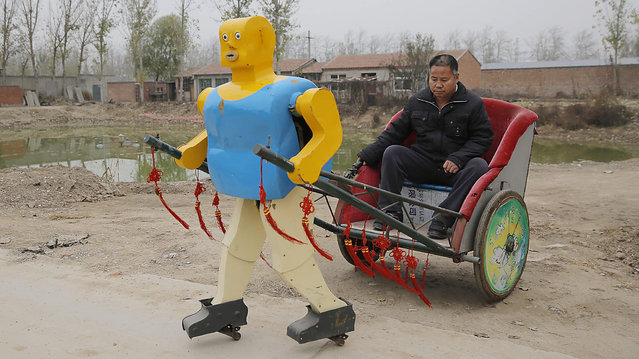
Robot inventor Wu Yulu sits on a rickshaw driven by a robot which he invented in his village in rural Beijing's Tongzhou district, China, 17 November 2016. The 54-year-old Chinese farmer living in rural Beijing's Tongzhou district invented 63 robots in the past 30 years. Wu, who only received primary school education, plans to give up the agricultural work for his robot products. He regularly participates in exhibitions, transfers patent rights and teaches at the university to earn money. (Photo by Wu Hong/EPA)

Robot inventor Wu Yulu sits on a rickshaw driven by a robot which he invented in his village in rural Beijing's Tongzhou district, China, 17 November 2016. The 54-year-old Chinese farmer living in rural Beijing's Tongzhou district invented 63 robots in the past 30 years. Wu, who only received primary school education, plans to give up the agricultural work for his robot products. He regularly participates in exhibitions, transfers patent rights and teaches at the university to earn money. (Photo by Wu Hong/EPA)
Details
21 Nov 2016 10:41:00
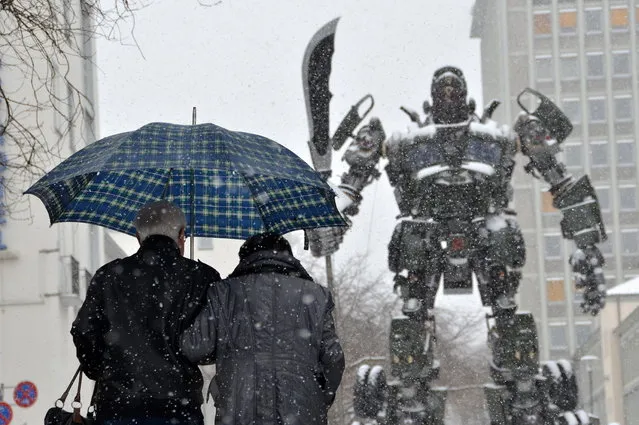
A couple passes the sculpture “Transformer” by Chinese artist Bi Heng during snowfall  in Kassel, central Germany, Tuesday March 12, 2013.  Frankfurt airport closed, a quarter of flights out of Paris were canceled, Belgium suffered record traffic jams and high-speed trains were stuck in stations – all because of a sudden dump of oddly late snowfall on Western Europe.   Less prepared for the kind of heavy snow that regularly hits northern and eastern neighbors, France, Britain and Belgium struggled Tuesday to keep moving amid the frosty, blustery conditions. (Photo by Uwe Zucchi/AP Photo/Dpa)

A couple passes the sculpture “Transformer” by Chinese artist Bi Heng during snowfall in Kassel, central Germany, Tuesday March 12, 2013. Frankfurt airport closed, a quarter of flights out of Paris were canceled, Belgium suffered record traffic jams and high-speed trains were stuck in stations – all because of a sudden dump of oddly late snowfall on Western Europe. Less prepared for the kind of heavy snow that regularly hits northern and eastern neighbors, France, Britain and Belgium struggled Tuesday to keep moving amid the frosty, blustery conditions. (Photo by Uwe Zucchi/AP Photo/Dpa)
Details
14 Mar 2013 13:46:00
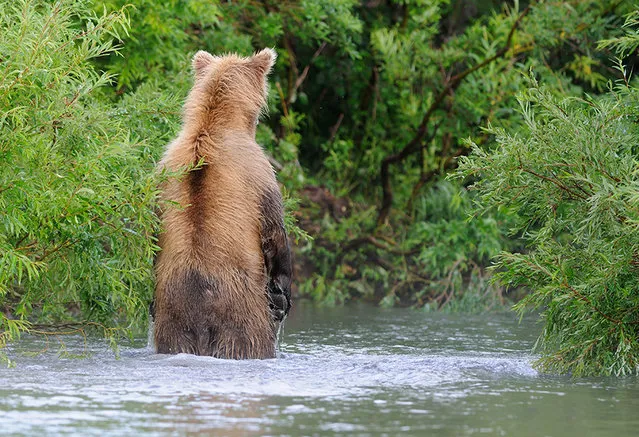
Where's the fish?/n. South Kamchatka Sanctuary<><>South Kamchatka Sanctuary; Kuril Lake; Kamchatka; bear; salmon; spawning

Igor Shpilenok works in the reserve at Kamchatka, Russia. Igor is a fellow of the International League of Conservation Photographers and a winner of the 2006 BBC Wildlife Photographer Competition. Igor’s work has been published in numerous international and Russian magazines, including Smithsonian, National Wildlife, Geo, and BBC Wildlife.

“How does a bear behave when encounter a human? In most cases he runs away. But before running he almost always would rise to stand on his rear feet. And this behavior does not indicate the attack, as many people think...” – Igor Shpilenok. (Photo by Igor Shpilenok via Wildlife Photo Russia)
Details
16 Sep 2012 12:54:00


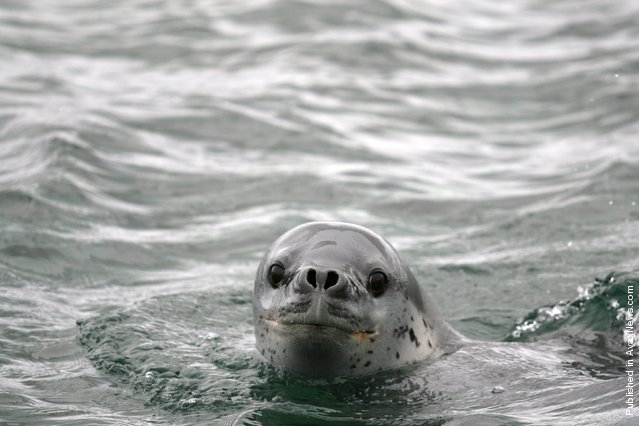
“The leopard seal (Hydrurga leptonyx), also referred to as the sea leopard, is the second largest species of seal in the Antarctic (after the southern elephant seal). It is most common in the southern hemisphere along the coast of Antarctica and on most sub-Antarctic islands, but can also be found on the coasts of southern Australia, Tasmania, South Africa, New Zealand, Lord Howe Island, Tierra del Fuego, the Cook Islands, and the Atlantic coast of South America. It can live twenty-six years, possibly more. Orcas and large sharks are the only natural predators of leopard seals”. – Wikipedia

Photo by: Gilad Rom; Source: Flickr
Details
13 Nov 2011 11:24:00
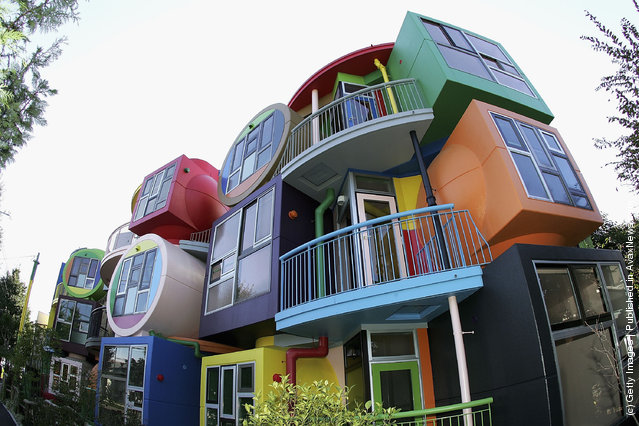
Concept Design Home Reversible Destiny Lofts MITAKA: In Memory Of Helen Keller By Reversible Destiny Foundation and Shusaku Arakawa

“The Reversible Destiny Lofts – Mitaka (In Memory of Helen Keller) is a nine-unit multiple dwelling. It was first completed example of procedural architecture put to residential use. These lofts reflexively articulate the residents’ operative tendencies and coordinating skills essential to and determinative of human thought and behavior; which means to say, the lofts manage, by virtue of how they are constructed, to reveal to their residents the ins and outs of what makes a person, in this case the resident. This is the same set of tendencies and skills to which Arakawa and Madeline Gins gave diagrammatic form in their decades-long research project The Mechanism of Meaning”. – Wikipedia

Photo: The exterior of the concept design home “Reversible Destiny Lofts MITAKA: In Memory of Helen Keller” is seen on October 27, 2005 in Tokyo, Japan. (Photo by Koichi Kamoshida/Getty Images)
Details
30 Nov 2011 11:58:00
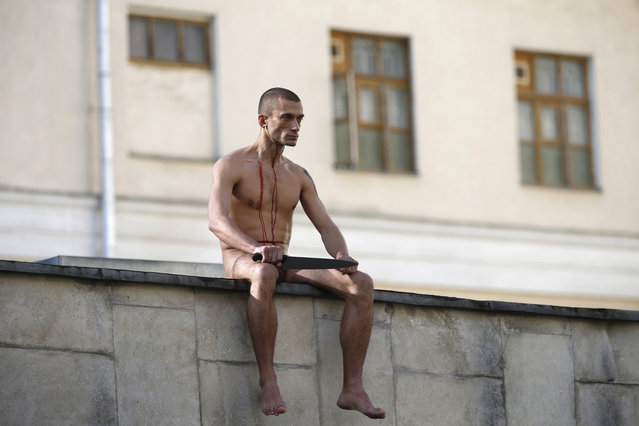
Artist Pyotr Pavlensky sits on the wall enclosing the Serbsky State Scientific Center for Social and Forensic Psychiatry after he cut off a part of his earlobe during his protest action titled “Segregation” in Moscow October 19, 2014. (Photo by Maxim Zmeyev/Reuters)

Artist Pyotr Pavlensky sits on the wall enclosing the Serbsky State Scientific Center for Social and Forensic Psychiatry after he cut off a part of his earlobe during his protest action titled “Segregation” in Moscow October 19, 2014. Pavlensky protested against the usage of forensic psychiatry for politically motivated purposes. He cut off his earlobe to demonstrate how authorities could “cut off” an unwanted individual from society by using psychiatric and medical diagnosis to forcefully send a person to a penitentiary hospital, according to Pavlensky. (Photo by Maxim Zmeyev/Reuters)
Details
21 Oct 2014 12:10:00
The Swarovski Crystal Head Fountain In Austria

A stone giant exhausted after his long travels decided to rest a while and drink from a pond far below. He lay down and started drinking from the crystal clear pond. So delicious was the water that he was unable to quench his thirst no matter how much he tried. Weeks have passed, months, years. The body of the stone giant became one with the hills and even his tongue has turned to water. This might seem like a fairy tale, yet you’ll be able to see this stone giant if you ever come to Wattens, Austria. He’s still there, guarding the entrance to Swarovski Kristallwelted, otherwise known as the Crystal Worlds. This is a one-of-a-kind theme park that was created by the people who first created Swarovski crystals.
Details
02 Mar 2015 08:30:00