Loading...
Done
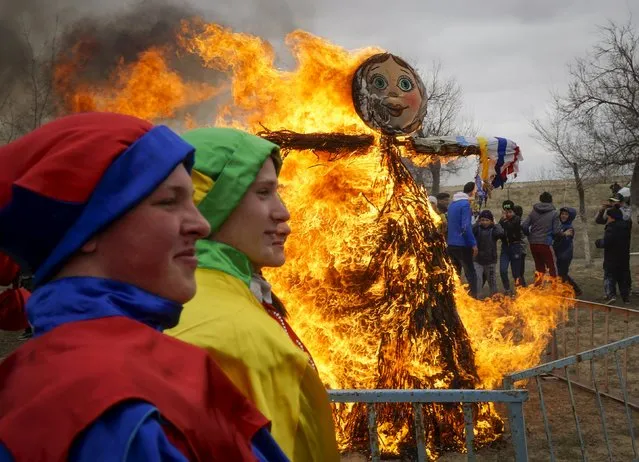
Artists watch burning an effigy of Lady Maslenitsa as they celebrate Maslenitsa, or Pancake Week, in Baikonur, Kazakhstan, March 13, 2016. (Photo by Shamil Zhumatov/Reuters)

Artists watch burning an effigy of Lady Maslenitsa as they celebrate Maslenitsa, or Pancake Week, in Baikonur, Kazakhstan, March 13, 2016. Maslenitsa is widely viewed as a pagan holiday marking the end of winter and is celebrated with pancake eating and shows of strength, while the Orthodox Church considers it as the week of feasting before Lent. (Photo by Shamil Zhumatov/Reuters)
Details
14 Mar 2016 10:37:00
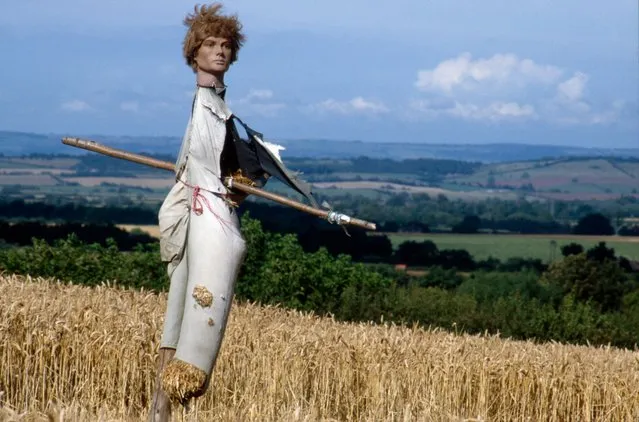
“The ripening crops eloquently signify that the scarecrow’s work is done. Few remain to see their task fulfilled because if they become entangled in the harvesting machinery it causes serious damage”. (Photo by Colin Garratt)

When Colin Garratt went to photograph the traditional sentinels of the British countryside, he found they ranged from the dapper to the downright sinister. “They are not from the anaesthetised world of the craft fair”, says Colin Garratt, “but are the direct descendants of the ancient spectres which have haunted the landscape for centuries”. The Scarecrow Exhibition is at Geddes Gallery, London, from 25 to 30 March. (Photo by Colin Garratt)
Details
29 Mar 2016 11:46:00
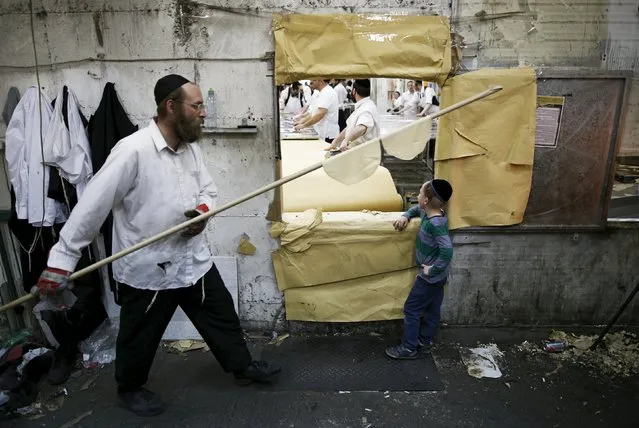
Ultra-Orthodox Jewish men prepare matza, traditional unleavened bread eaten during the upcoming Jewish holiday of Passover, in the southern city of Ashdod April 17, 2016. (Photo by Amir Cohen/Reuters)

Ultra-Orthodox Jewish men prepare matza, traditional unleavened bread eaten during the upcoming Jewish holiday of Passover, in the southern city of Ashdod April 17, 2016. (Photo by Amir Cohen/Reuters)
Details
18 Apr 2016 10:09:00
Dancers perform a routine at the Renault display at the Beijing International Automotive Exhibition in Beijing, Tuesday, April 26, 2016. (Photo by Mark Schiefelbein/AP Photo)

Dancers perform a routine at the Renault display at the Beijing International Automotive Exhibition in Beijing, Tuesday, April 26, 2016. (Photo by Mark Schiefelbein/AP Photo)
Details
27 Apr 2016 09:40:00
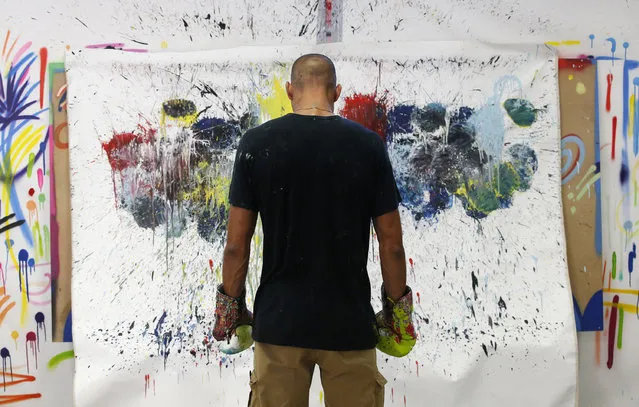
In this photo taken on Tuesday, September 6, 2016 Omar Hassan poses in front of his creation “Breaking Through Milano” in his studio in Milan, Italy. (Photo by Antonio Calanni/AP Photo)

In this photo taken on Tuesday, September 6, 2016 Omar Hassan poses in front of his creation “Breaking Through Milano” in his studio in Milan, Italy. (Photo by Antonio Calanni/AP Photo)
Details
01 Oct 2016 11:09:00
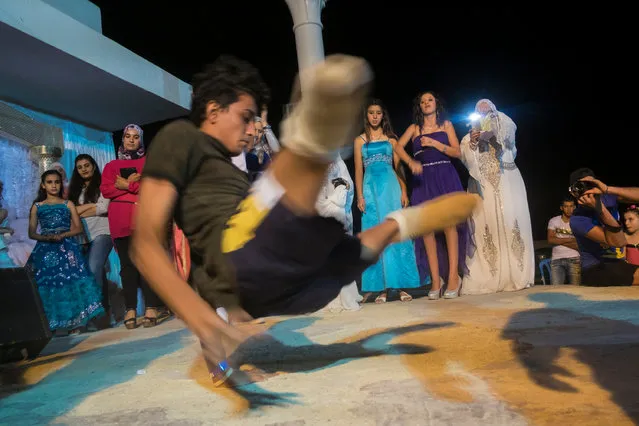
He performs his moves during the wedding celebrations, with his prosthetic limbs removed. (Photo by Yassine Alaoui Ismaili/The Guardian)

Street photographer Yassine Alaoui Ismaili follows 16-year-old Emeer Guesmi, aka B-boy Zulu Rema, as he trains and performs breakdance moves – all without the use of his legs. At a breakdance championship in Tunisia, Casablanca-based street photographer Yassine Alaoui Ismaili noticed an unusual competitor: Emeer Guesmi, dancing without the aid of his lower legs. He started following him as he trained and performed. (Photo by Yassine Alaoui Ismaili/The Guardian)
Details
23 Nov 2016 12:33:00
Two young women embrace in bed together, both wearing white lace underwear. (Photo by Popperfoto/Getty Images)

Two young women embrace in bed together, both wearing white lace underwear. (Photo by Popperfoto/Getty Images)
Details
12 Dec 2016 10:43:00
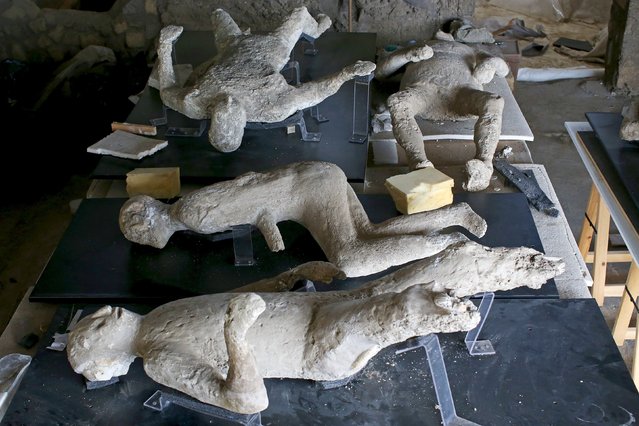
Plaster cast moulds of victims of the Mount Vesuvius eruption lie on a display table in a laboratory at Pompeii October 13, 2015. An expert team made up of archaeologists, radiologists, orthodontists and anthropologists began on September 2015 to use CAT scan technology (computerised axial tomography) to peer inside the plaster cast moulds of Pompeii's victims, in a study that has added more detail to previous findings. (Photo by Alessandro Bianchi/Reuters)

Plaster cast moulds of victims of the Mount Vesuvius eruption lie on a display table in a laboratory at Pompeii October 13, 2015. An expert team made up of archaeologists, radiologists, orthodontists and anthropologists began on September 2015 to use CAT scan technology (computerised axial tomography) to peer inside the plaster cast moulds of Pompeii's victims, in a study that has added more detail to previous findings. A 16-layer scan had to be used in order to penetrate the hardened plaster but the results showed up impressive skeletal remains and near perfect teeth. (Photo by Alessandro Bianchi/Reuters)
Details
22 Oct 2015 08:02:00