Loading...
Done
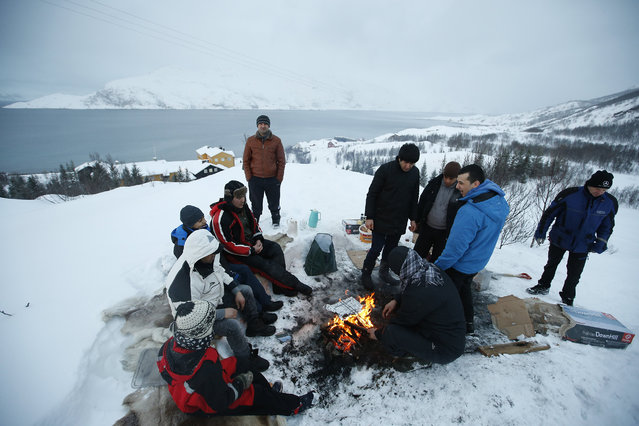
In this photo taken Tuesday, February 2, 2016, asylum seekers gather round a fire as they cook a meal overlooking the temporary Altnes camp refugee camp on the island of Seiland, northern Norway. (Photo by Alastair Grant/AP Photo)

In this photo taken Tuesday, February 2, 2016, asylum seekers gather round a fire as they cook a meal overlooking the temporary Altnes camp refugee camp on the island of Seiland, northern Norway. Waiting for their asylum claims to be processed, hundreds of people in emergency shelters in Hammerfest and neighboring towns are slowly getting used to the extreme climate and unfamiliar customs of the High North. They say they have adapted to the cold – the temperature rarely drops below minus 10 degrees C (14 F) along the coast, though it gets much colder further inland. It’s the darkness that throws them off. (Photo by Alastair Grant/AP Photo)
Details
18 Feb 2016 13:22:00
Remarkable discoveries were made, like the decapitated head of a bronze statue of Roman emperor Augustus, sacked from a raid on Roman garrisons further north in Egypt. Here: A group visiting the excavations at Meroë, including (from left) Midwinter Bey, director of Sudan Railways; Lord Kitchener; General Sir Francis Reginald Wingate, Sirdar of the Egyptian Army; Professor Archibald Sayce; John Garstang; and Lady Catherine Wingate, 1911. (Photo by Garstang Museum of Archaeology)

The city of Meroë laid undiscovered for two millennia before British archaeologist John Garstang excavated it in the early 20th century. Garstang took the radical decision to document his discoveries with photography – and immortalised an ancient world. “Meroë: Africa’s Forgotten Empire” is being shown until 14 September at Garstang Museum of Archaeology, Liverpool. Here: A group visiting the excavations at Meroë, including (from left) Midwinter Bey, director of Sudan Railways; Lord Kitchener; General Sir Francis Reginald Wingate, Sirdar of the Egyptian Army; Professor Archibald Sayce; John Garstang; and Lady Catherine Wingate, 1911. (Photo by Garstang Museum of Archaeology)
Details
15 Jun 2016 14:49:00
A pregnant woman poses on June 19, 2018 in Vertou, western France. France had an estimated population of 68.4 million by January 1, 2024, representing a further year-on-year increase of 0.3 percent, limited by a marked drop in the birth rate, the INSEE national statistics bureau of France reported on January 16, 2024. In 2023, 678,000 babies were born in France, 6.6 percent fewer than the previous year, the lowest number of births in any year since 1946. Over the same period, there were 631,000 deaths, down 6.5 percent on 2022, a year marked by the consequences of the Covid-19 pandemic and episodes of extreme heat. (Photo by Loic Venance/AFP Photo)

A pregnant woman poses on June 19, 2018 in Vertou, western France. France had an estimated population of 68.4 million by January 1, 2024, representing a further year-on-year increase of 0.3 percent, limited by a marked drop in the birth rate, the INSEE national statistics bureau of France reported on January 16, 2024. In 2023, 678,000 babies were born in France, 6.6 percent fewer than the previous year, the lowest number of births in any year since 1946. Over the same period, there were 631,000 deaths, down 6.5 percent on 2022, a year marked by the consequences of the Covid-19 pandemic and episodes of extreme heat. (Photo by Loic Venance/AFP Photo)
Details
27 Feb 2024 07:29:00
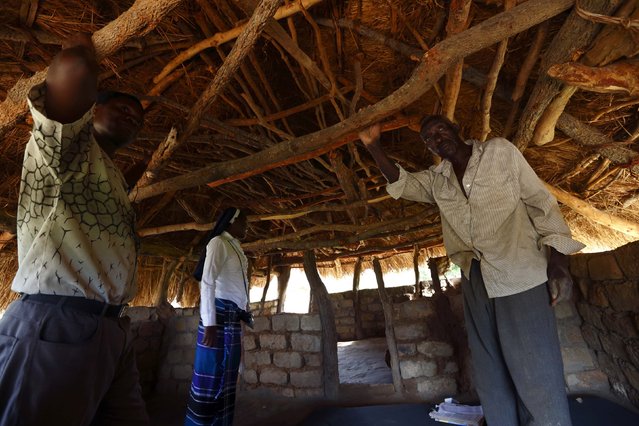
HIV-positive 71-year-old Sylverio Hachiploa (R) talks with caregivers Glandwel Muleya (L) and Sister Abigail Mwaka Mazuba (C) in his thatched hut during a visit by a home-based care team in the village of Nedwmba, south of the Chikuni Mission in the south of Zambia February 23, 2015. (Photo by Darrin Zammit Lupi/Reuters)

HIV-positive 71-year-old Sylverio Hachiploa (R) talks with caregivers Glandwel Muleya (L) and Sister Abigail Mwaka Mazuba (C) in his thatched hut during a visit by a home-based care team in the village of Nedwmba, south of the Chikuni Mission in the south of Zambia February 23, 2015. The caregivers in the Jesuit-run home-based care project at the Chikuni Mission run a capacity-building and empowerment project at the household level, offering training and assistance in crop-growing and animal rearing, as well as offering companionship, pastoral care and monitoring of the antiretroviral treatment compliance of HIV-AIDS patients. (Photo by Darrin Zammit Lupi/Reuters)
Details
25 Feb 2015 09:04:00
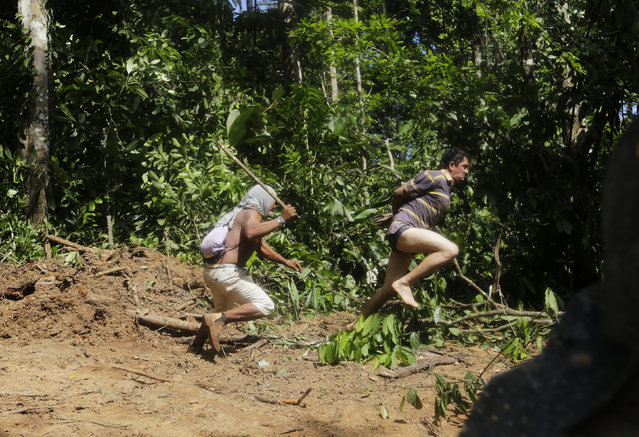
A Ka'apor Indian warrior (L) chases a logger who tried to escape after they captured him during a jungle expedition to search for and expel loggers from the Alto Turiacu Indian territory, near the Centro do Guilherme municipality in the northeast of Maranhao state in the Amazon basin, August 7, 2014. (Photo by Lunae Parracho/Reuters)

A Ka'apor Indian warrior (L) chases a logger who tried to escape after they captured him during a jungle expedition to search for and expel loggers from the Alto Turiacu Indian territory, near the Centro do Guilherme municipality in the northeast of Maranhao state in the Amazon basin, August 7, 2014. Tired of what they say is a lack of sufficient government assistance in keeping loggers off their land, the Ka'apor Indians, who along with four other tribes are the legal inhabitants and caretakers of the territory, have sent their warriors out to expel all loggers they find and set up monitoring camps in the areas that are being illegally exploited. (Photo by Lunae Parracho/Reuters)
Details
05 Sep 2014 11:41:00
SpaceX’s Dragon spacecraft, March 6, 2014. SpaceX's Falcon 9 rocket and Dragon spacecraft launched from Launch Complex 40 at the Cape Canaveral Air Force Station, Florida, for their third official Commercial Resupply (CRS) mission to the orbiting lab on April 18, 2014. Dragon is the only operational spacecraft capable of returning a significant amount of supplies back to Earth, including experiments. (Photo by Ron Lin/SpaceX Photos)

SpaceX’s Dragon spacecraft, March 6, 2014. SpaceX's Falcon 9 rocket and Dragon spacecraft launched from Launch Complex 40 at the Cape Canaveral Air Force Station, Florida, for their third official Commercial Resupply (CRS) mission to the orbiting lab on April 18, 2014. Dragon returned to Earth with a parachute-assisted splashdown off the coast of southern California on May 14, 2014. Dragon is the only operational spacecraft capable of returning a significant amount of supplies back to Earth, including experiments. (Photo by Ron Lin/SpaceX Photos)
Details
30 Mar 2015 13:11:00
CGAP Photo Contest – South Asia Regional Winner: Bricks Worker, Bangladesh. A private enterprise worker is working at a brick field. These small businesses are creating new job opportunities for many poor people. (Photo by Moksumul Haque)

The shoemaker in Turkey, the potato seller in Vietnam, and the weaver in Bolivia are among the billions of low-income entrepreneurs who make the world go round. They are also the type of people who can benefit significantly from microfinance. Every year, the Consultative Group To Assist The Poor (or CGAP) hosts a photo contest asking entrants to submit photos based around the idea of microfinance.The purpose of the contest is to give amateur and professional photographers a chance to show the different ways that poor households manage their financial lives and make their lives better through financial inclusion. Photo: South Asia Regional Winner – “Bricks Worker”, Bangladesh. A private enterprise worker is working at a brick field. These small businesses are creating new job opportunities for many poor people. (Photo by Moksumul Haque)
Details
14 Aug 2014 10:58:00


“Josephine Baker (June 3, 1906 – April 12, 1975) was an American-born French dancer, singer, and actress. Nicknamed the “Bronze Venus”, the “Black Pearl”, and even the “Créole Goddess” in anglophone nations.

Baker was the first African American female to star in a major motion picture and to integrate an American concert hall, and to become a world-famous entertainer. She is also noted for her contributions to the Civil Rights Movement in the United States (she was offered the unofficial leadership of the movement by Coretta Scott King in 1968 following Martin Luther King, Jr.'s assassination, but turned it down), for assisting the French Resistance during World War II and for being the first American-born woman to receive the French military honor, the Croix de guerre”.

Photo: American entertainer Josephine Baker in costume for her famous “banana dance”. Baker was an overnight sensation when she arrived in Paris in the mid-1920s. (Photo by Walery/Getty Images)
Details
18 Mar 2011 10:22:00