Loading...
Done
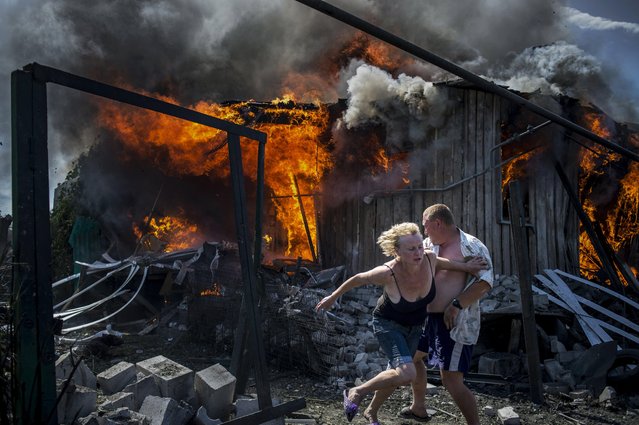
A handout photo made available by the World Press Photo (WPP) organization on 13 February 2017 shows a picture by Rossiya Segodnya photographer Valery Melnikov that won the Long-Term Projects – First Prize award of the 60th annual World Press Photo Contest, it was announced by the WPP Foundation in Amsterdam, The Netherlands on 13 February 2017. Caption: Civilians escape from a fire at a house destroyed by an air attack in the Luhanskaya village. Story: Ordinary people became victims of the conflict between self-proclaimed republics and the official Ukrainian authorities from 2014 onwards in the region of Donbass. Disaster came into their lives unexpectedly. These people were involved in the military confrontation against their will. They experienced the most terrible things: the death of their friends and relatives, destroyed homes and the ruined lives of thousands of people. (Photo by Valery Melnikov/EPA/Rossiya Segodnya/World Press Photo)

A handout photo made available by the World Press Photo (WPP) organization on 13 February 2017 shows a picture by Rossiya Segodnya photographer Valery Melnikov that won the Long-Term Projects – First Prize award of the 60th annual World Press Photo Contest, it was announced by the WPP Foundation in Amsterdam, The Netherlands on 13 February 2017. Caption: Civilians escape from a fire at a house destroyed by an air attack in the Luhanskaya village. (Photo by Valery Melnikov/EPA/Rossiya Segodnya/World Press Photo)
Details
15 Feb 2017 00:06:00
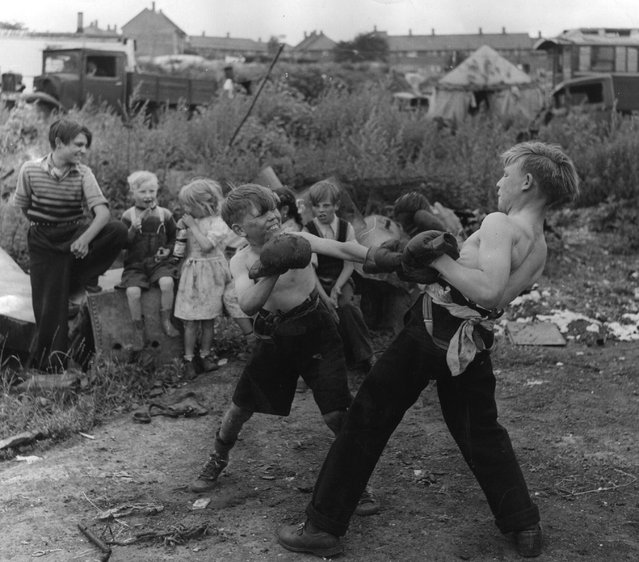
The unromantic gypsies. Children boxing in a gypsy camp in Kent, England on July 1, 1951. Like all boys these gypsy lads like to try their hand at boxing. Encouraged by their friends they fight it out on Corke's Meadow. Few Romanies now live a life of wandering romance. Most are like the three hundred squatters of Corke's Meadow, Kent, which is part of a “gypsy problem” that involves about 100,000 today. Of those about 25,000 can be rightly called gypsies, the rest are Mumpers and Posh-rats and Hobos. Corke's Meadow has both kinds. “Picture Post” cameraman Bert Hardy photographs the Corke's Meadow gypsies in their encampment. (Photo by Hulton-Deutsch Collection/Corbis via Getty Images)

The unromantic gypsies. Children boxing in a gypsy camp in Kent, England on July 1, 1951. Like all boys these gypsy lads like to try their hand at boxing. Encouraged by their friends they fight it out on Corke's Meadow. Few Romanies now live a life of wandering romance. Most are like the three hundred squatters of Corke's Meadow, Kent, which is part of a “gypsy problem” that involves about 100,000 today. Of those about 25,000 can be rightly called gypsies, the rest are Mumpers and Posh-rats and Hobos. Corke's Meadow has both kinds. “Picture Post” cameraman Bert Hardy photographs the Corke's Meadow gypsies in their encampment. (Photo by Hulton-Deutsch Collection/Corbis via Getty Images)
Details
12 Mar 2017 00:01:00
Aerialist Erin Blaire, 33, performs a hair hanging trick for a photographer while hanging from a metal bar on a subway platform on March 14, 2023 in New York City. Erin Blaire, originally from Vermont, has lived in New York City for eight years and has been performing her aerial hair routine for the last three. The origin of hair hanging is believed to have originated in China, according to reports, and is a closely guarded circus trick passed from mentor to mentee. Although it is possible to find the technique and secrets online it is most-likely not how professional performers learned the skillset, and not how Blaire did either. (Photo by Alexi Rosenfeld/Getty Images)

Aerialist Erin Blaire, 33, performs a hair hanging trick for a photographer while hanging from a metal bar on a subway platform on March 14, 2023 in New York City. Erin Blaire, originally from Vermont, has lived in New York City for eight years and has been performing her aerial hair routine for the last three. The origin of hair hanging is believed to have originated in China, according to reports, and is a closely guarded circus trick passed from mentor to mentee. Although it is possible to find the technique and secrets online it is most-likely not how professional performers learned the skillset, and not how Blaire did either. (Photo by Alexi Rosenfeld/Getty Images)
Details
23 Mar 2023 04:45:00
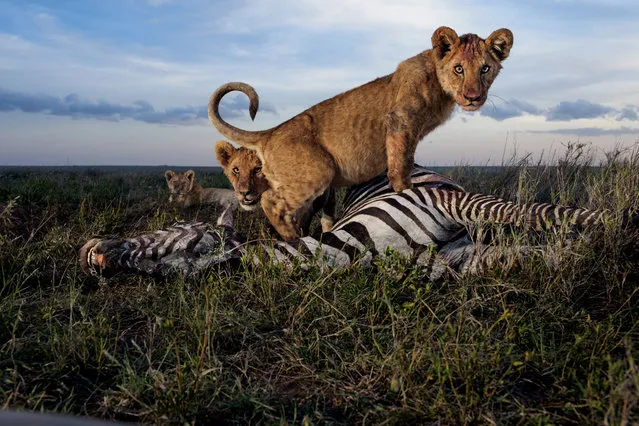
Cubs of the Simba East pride: too young to kill but old enough to crave meat. Adult females, and sometimes males, do the hunting. Zebras and wildebeests rank high as chosen prey in the rainy season. (Photo by Michael Nichols/National Geographic via The Atlantic)

“Serengeti National Park encompasses 5,700 square miles of grassy plains and woodlands near the northern border of Tanzania, and is home to more than 3,500 lions grouped into a couple dozen prides. Photographer Nick Nichols and videographer Nathan Williamson made several extended trips to the Serengeti between July 2011 and January 2013, determined to break new visual ground in their coverage of the Serengeti Lions”. Photo: Cubs of the Simba East pride: too young to kill but old enough to crave meat. Adult females, and sometimes males, do the hunting. Zebras and wildebeests rank high as chosen prey in the rainy season. (Photo by Michael Nichols/National Geographic via The Atlantic)
Details
09 Aug 2013 08:15:00
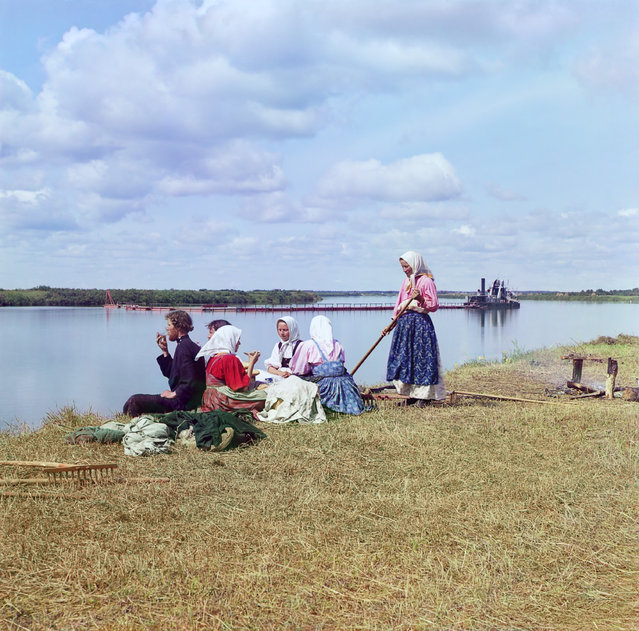
Photos by Sergey Prokudin-Gorsky. Dinner during haying. Russian Empire, Novgorod province, county Cherepovets, 1909

“Sergey Mikhaylovich Prokudin-Gorsky (August 30 1863 Russian Empire – September 27, 1944 Paris, France) was a Russian chemist and photographer. He is best known for his pioneering work in color photography of early 20th-century Russia”. – Wikipedia

Photo: Dinner during haying. Russian Empire, Novgorod province, county Cherepovets, 1909. (Photos by Sergey Prokudin-Gorsky via US Library of Congress and Prokudin-Gorsky.org)

P.S. All pictures are presented in high resolution. To see Hi-Res images – just TWICE click on any picture. In other words, click small picture – opens the BIG picture. Click BIG picture – opens VERY BIG picture (if available; this principle works anywhere on the site AvaxNews). Enjoy.
Details
24 Jul 2012 12:03:00
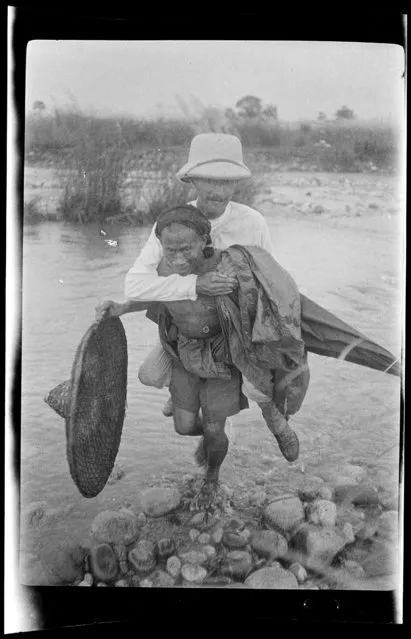
Hillcoat Riding Fu Tu. China, An Xian, 1917-1919. (Photo by Sidney David Gamble)

“Sidney D. Gamble (July 12, 1890 – 1968) was born in Cincinnati, Ohio, to David Berry and Mary Huggins Gamble; grandson of James Gamble, who, with William Procter, founded Procter & Gamble in 1837. in 1912 he graduated magna cum laude from Princeton University with a Bachelor of Literature degree and was elected to Phi Beta Kappa. He visited China for four extended periods, 1908, 1917–1919, 1924–27, and 1931–1932, doing Christian social work for the Y.M.C.A and conducting social surveys. He is now best known for his remarkable and extensive photographs of Peking and North China.” – Wikipedia. (Photo by Sidney David Gamble via Duke University Libraries)

Photo: Hillcoat Riding Fu Tu. China, An Xian, 1917-1919. P.S. All photos are available in high resolution.
Details
16 Aug 2012 11:24:00


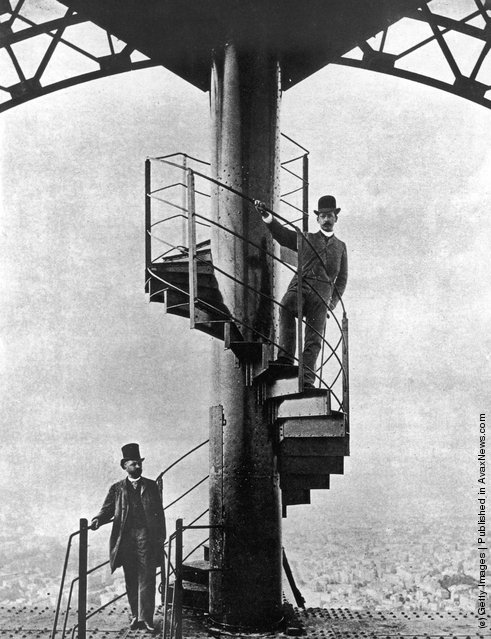
“The Eiffel Tower (French: La Tour Eiffel, nickname La dame de fer, the iron lady) is a puddle iron lattice tower located on the Champ de Mars in Paris. Built in 1889, it has become both a global icon of France and one of the most recognizable structures in the world. The tower is the tallest building in Paris and the most-visited paid monument in the world. Named for its designer, engineer Gustave Eiffel, the tower was built as the entrance arch to the 1889 World's Fair. The tower stands 324 metres (1,063 ft) tall, about the same height as an 81-storey building”. – Wikipedia

Photo: French engineer Alexandre Gustave Eiffel (1832–1923), left, poses high on the steps of the completed Eiffel Tower, which he designed for the 1889 Paris Exposition. (Photo by General Photographic Agency/Getty Images)
Details
08 May 2011 09:56:00


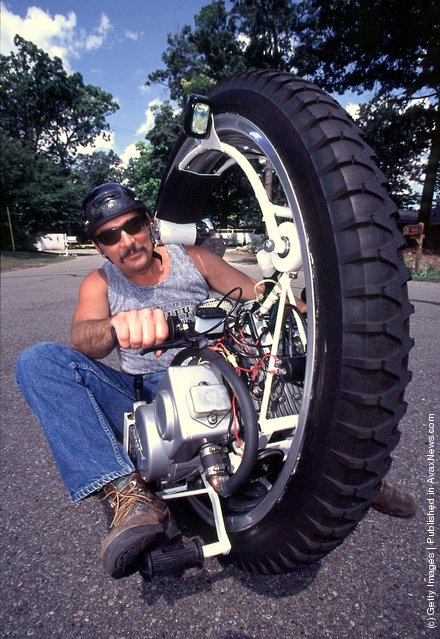
“A monowheel is a one-wheeled single-track vehicle similar to a unicycle. However, instead of sitting above the wheel, the rider sits either within it or next to it. The wheel is a ring, usually driven by smaller wheels pressing against its inner rim. Most are single-passenger vehicles, though multi-passenger models have been built.

Pedal-powered monowheels were built in the late 19th century; most built in the 20th century have been motorized. Some modern builders refer to these vehicles as monocycles, though that term is also sometimes used to describe motorized unicycles. Today, monowheels are generally built and used for fun and entertainment purposes, though from the 1860s through to the 1930s, they were proposed for use as serious transportation”. – Wikipedia

Photo: Cycle inventor Kerry McLean poses for the photographer 2000 in Walled Lake, Michigan. The “Monocycle” is equipped with a 40-horsepower engine, 4ft tire and is expected to reach speeds upwards of 100 mph. (Photo by Bill Pugliano/Liaison)
Details
02 Jul 2011 12:24:00