Loading...
Done
A makeshift aircraft plummets into the Moskva River during the Red Bull Flugtag Moscow 2011 competition. (Photo by Sergei Karpukhin/Reuters)

Spectators in Moscow were treated to the site of humorously designed makeshift aircraft plunging into the Muskova River during the Red Bull Flugtag Moscow 2011 competition. 38 teams took part at the Flugtag – which means “flying day” – a competition in which teams in fancy dress attempt to pilot human-powered, home-made flying machines off a six-meter-high platform into water.

Photo: A makeshift aircraft plummets into the Moskva River during the Red Bull Flugtag Moscow 2011 competition. (Photo by Sergei Karpukhin/Reuters)
Details
27 Jul 2012 08:09:00
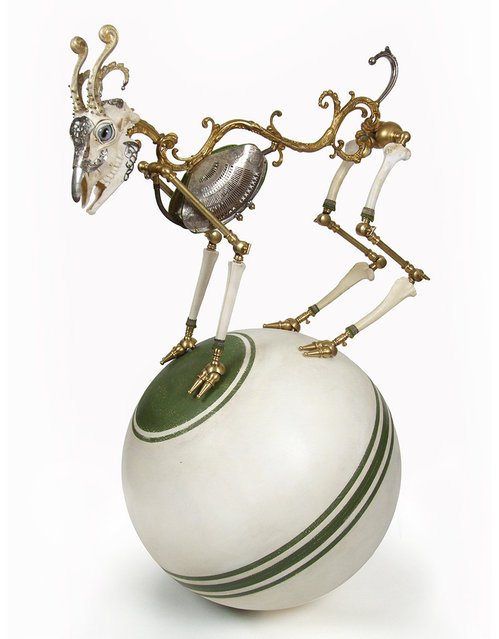
Sculpture By Jessica Joslin

More great and peculiar work from Chicago based sculptor Jessica Joslin. Joslin assembles her hybrid creatures from objects found in obscure junk shops, flea markets, attics, taxidermy supply houses, specialty hardware distributors…or even just walking through the woods. “Miniature machine bolts, springs and couplings comprise anatomical structures. Many of the beasts have hidden movements: a spring loaded beak, snapping jaws, jointed legs and adjustable tails. Some creatures are free-standing but have mechanisms to allow for movement or multiple positions.”
Details
03 Nov 2013 14:28:00
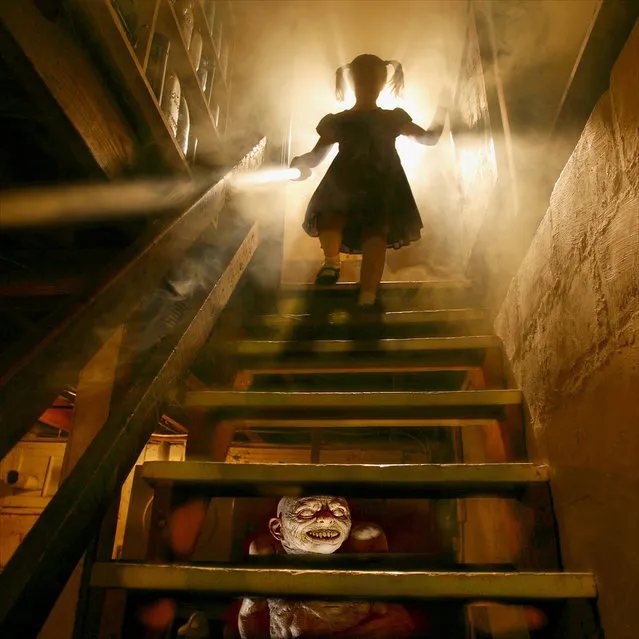
“Basement”. (Photo by Joshua Hoffine/The Washington Post)

Joshua Hoffine, based in Kansas City, Mo., and a self-proclaimed “Horror Photographer”, is interested in the psychology of fear. In his project “After Dark, My Sweet”, Hoffine’s surreal and staged images render these fears visible with the “visual grammar of a child”. Through elaborate sets, costumes, makeup and fog machines, Hoffine’s children act out these terrifying scenes in front of his camera. Here: “Basement”. (Photo by Joshua Hoffine/The Washington Post)
Details
29 Oct 2016 11:47:00
Pictures of deceased people are seen inside a chapel at a cemetery in the village of Smoljinac, Serbia, October 25, 2016. (Photo by Marko Djurica/Reuters)

Pictures of deceased people are seen inside a chapel at a cemetery in the village of Smoljinac, Serbia, October 25, 2016. From a distance, the cemetery in the eastern Serbian village of Smoljinac looks like a residential neighbourhood eerily placed among graves. But once inside the grounds, after passing a section with the usual stone slabs, visitors find rows of small bungalows painted in pastel colours. They have one or two rooms, large windows and ornate plaques – some inside, some outside – memorialising the deceased. These are the burial chapels of Smoljinac, cosy cabins with a furnished room inside, a storage place for wreaths and funeral paraphernalia, and the family crypt below. Some even have electric power inside. (Photo by Marko Djurica/Reuters)
Details
12 Nov 2016 10:37:00
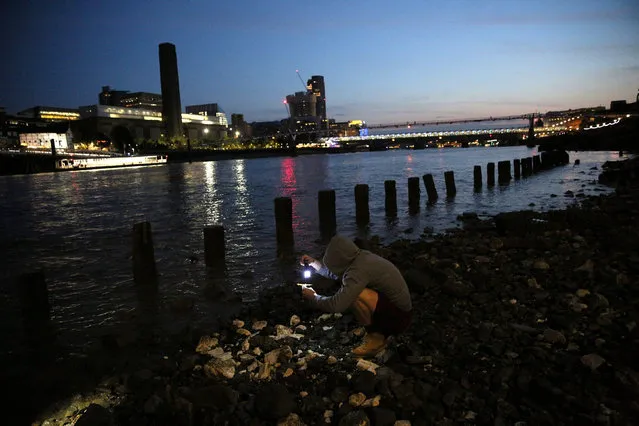
A mudlark uses a torch to look for items on the bank of the River Thames in London, Britain June 06, 2016. Mudlarking is believed to trace its origins to the 18th and 19th century, when scavengers searched the Thames' shores for items to sell. These days, history and archaeology fans are the ones hoping to find old relics such as coins, ceramics, artifacts or everyday items from across centuries. They wait for the low tide and then scour specific areas of exposed shores. "If you're in a field you could be out all day long, with the river you're restricted to about two or three hours," mudlark Nick Stevens said. While many just use the naked eye for their searches, others rely on metal detectors for which a permit from the Port of London Authority is needed. Digging also requires consent. (Photo by Neil Hall/Reuters)

A mudlark uses a torch to look for items on the bank of the River Thames in London, Britain June 06, 2016. Mudlarking is believed to trace its origins to the 18th and 19th century, when scavengers searched the Thames' shores for items to sell. These days, history and archaeology fans are the ones hoping to find old relics such as coins, ceramics, artifacts or everyday items from across centuries. their finds with the Portable Antiquities Scheme. Any item over 300 years old must be recorded. (Photo by Neil Hall/Reuters)
Details
27 Aug 2016 10:43:00
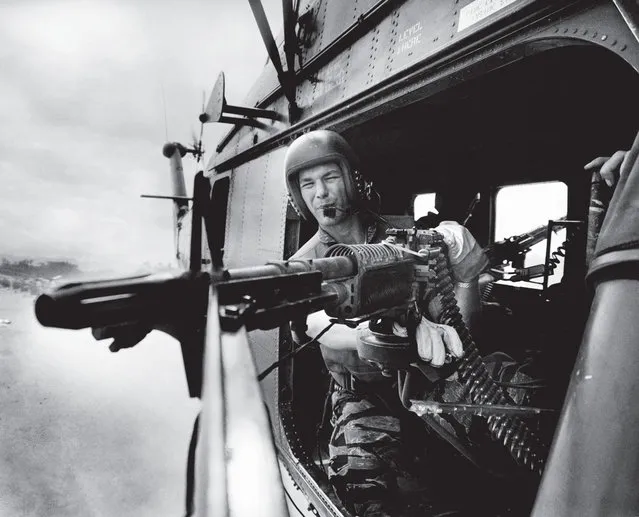
Man your battle stations: The crew chief of helicopter Yankee Papa 13, lance corporal James C. Farley, mans an M-60 machine gun during a mission near Da Nang, Vietnam on March 31, 1965. (Photo by Larry Burrows/Time & Life Pictures)

In the spring of 1965, within weeks of 3,500 American Marines arriving in Vietnam, a 39-year-old Briton named Larry Burrows began work on a feature for LIFE magazine, chronicling the day-to-day experience of U.S. troops on the ground – and in the air – in the midst of the rapidly widening war. The photographs in this gallery focus on a calamitous March 31, 1965, helicopter mission; Burrows’ “report from Da Nang”, featuring his pictures and his personal account of the harrowing operation, was published two weeks later as a now-famous cover story in the April 16, 1965, issue of LIFE.

Photo: Man your battle stations: The crew chief of helicopter Yankee Papa 13, lance corporal James C. Farley, mans an M-60 machine gun during a mission near Da Nang, Vietnam on March 31, 1965. (Photo by Larry Burrows/Time & Life Pictures)
Details
07 Apr 2013 07:08:00
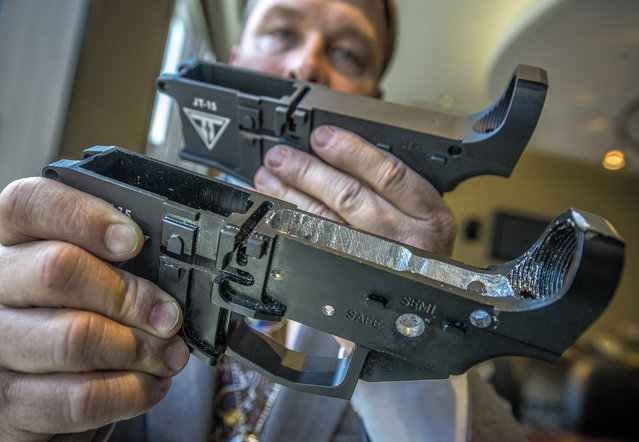
An ATF agent holds a generic unfinished receiver, back, and one that has been machined, front, at an ATF field office, on May, 06, 2014 in Washington, DC. Unfinished receivers can be turned into working automatic weapons that are untraceable. (Photo by Bill O'Leary/The Washington Post)

An unknown number of guns are being built with the mechanisms, causing problems for the police and ATF officials. Photo: An ATF agent holds a generic unfinished receiver, back, and one that has been manufactured, front, at an ATF field office in Washington, on May 06, 2014. The ATF is trying to crack down on the trade in the makeshift guns by targeting shops and individuals who offer to turn the unfinished receivers into functional pieces for firearms. (Photo by Bill O'Leary/The Washington Post)
Details
19 May 2014 09:22:00
This photo taken on August 13, 2014, shows a robot carrying food to customers in a restaurant in Kunshan. It's more teatime than Terminator – a restaurant in China is electrifying customers by using more than a dozen robots to cook and deliver food. (Photo by Johannes Eisele/AFP Photo)

Located in Kunshan, eastern China, the restaurant relies on over a dozen machines for tasks such as greeting customers, waiting on tables and cooking basic meals. The eatery becomes the third café in the world to rely on the use of robot employees, potentially giving a glimpse into how future businesses could operate. Photo: This photo taken on August 13, 2014, shows a robot carrying food to customers in a restaurant in Kunshan. It's more teatime than Terminator – a restaurant in China is electrifying customers by using more than a dozen robots to cook and deliver food. (Photo by Johannes Eisele/AFP Photo)
Details
24 Aug 2014 09:40:00