Loading...
Done
A rat's head rests as it is constricted in an opening in the bottom of a garbage can in the Brooklyn borough of New York, U.S., October 18, 2016. (Photo by Lucas Jackson/Reuters)

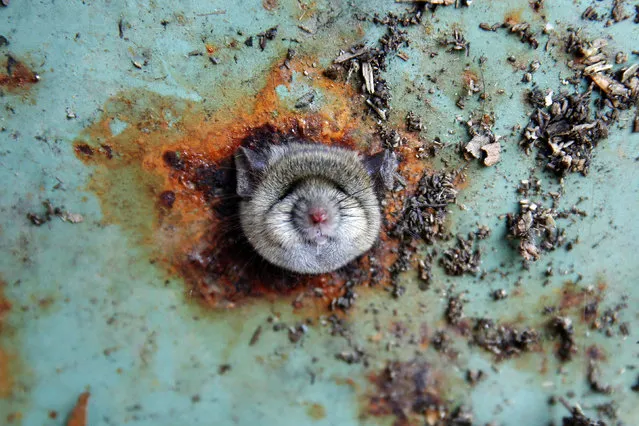
A rat's head rests as it is constricted in an opening in the bottom of a garbage can in the Brooklyn borough of New York, U.S., October 18, 2016. The Brooklyn rat was saved on Tuesday after getting its head stuck in the dumpster while scavenging for food, according to the New York Daily News. As the rat was scurrying around the bottom of the trash can, it came across a few ventilation holes. The hungry creature poked his head into one of them, but to its dismay couldn't get back out,Reuters photographer Lucas Jackson told the Daily News. Jackson was able to take some adorable photos of the rat's unfortunate situation before it was rescued. (Photo by Lucas Jackson/Reuters)
Details
19 Oct 2016 12:26:00
Letchworth Village is located just an hour's drive from NYC in Thiells, NY.  It was founded in 1912 to house the city's developmentally disabled as a ”state institution for the epileptic and feeble-minded”. (Photo by Will Ellis)

From Manhattan and Brooklyn's trendiest neighborhoods to the far-flung edges of theouter boroughs, Will Ellis has spent the last three years photographing and researching the lost and lonely corners of the United States' most populous city. His photo book Abandoned NYC is packed with 150 color images of sixteen of New York's most beautiful and mysterious abandoned spaces, paired with detailed essays on the fascinating history of these forgotten sites. Here: Letchworth Village is located just an hour's drive from NYC in Thiells, NY. It was founded in 1912 to house the city's developmentally disabled as a ”state institution for the epileptic and feeble-minded”. (Photo by Will Ellis)
Details
31 Mar 2015 12:31:00
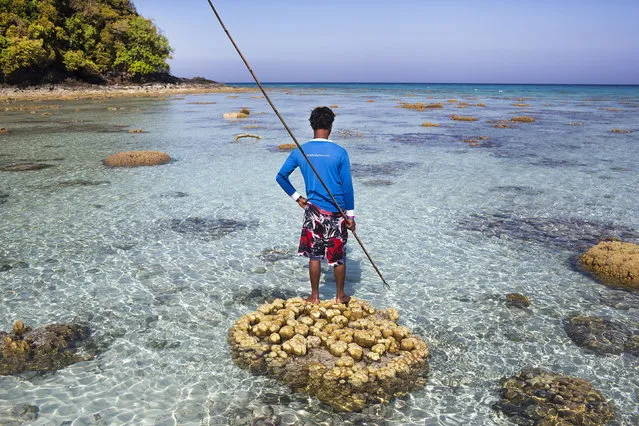
Hook, an indigenous Moken man, holds a three-pronged throwing spear and searches for fish in the waters of Ko Surin National Park. March 1, 2013 – Ko Surin, Thailand. (Photo by Taylor Weidman/zReportage via ZUMA Press)

“For centuries, the Moken sea nomads have traveled the islands between Thailand and Myanmar fishing and foraging for food on the sea floor. Throughout the Mergui Archipelago, Moken migrate in flotillas of Kabangs (traditional boat of the Moken people), stopping at different islands and beaches. Expert freedivers, the Moken have adapted physically to an aquatic life, developing unique characteristics that let them see better and hold their breath longer while underwater”. – Taylor Weidman. Photo: Hook, an indigenous Moken man, holds a three-pronged throwing spear and searches for fish in the waters of Ko Surin National Park. March 1, 2013 – Ko Surin, Thailand. (Photo by Taylor Weidman/zReportage via ZUMA Press)
Details
24 Mar 2014 06:45:00
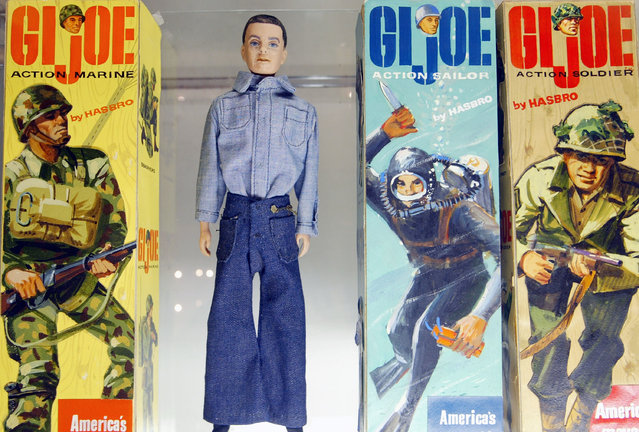
Vintage G.I. Joe figurers are on display at the 2003 Hasbro International G.I. Joe Collectors' Convention June 27, 2003 in Burlingame, California. Hundreds of G.I. Joe fans from around the country are attending the convention to buy, sell and trade G.I. Joe and military action figures. (Photo by Justin Sullivan/Getty Images)

“G.I. Joe is a line of action figures produced by the toy company Hasbro. The term G.I. stands, in popular usage, for Government Issued and after the First World War became a generic term for U.S. soldiers. The origin of the term dates to World War I, when much of the equipment issued to U.S. soldiers was stamped “G.I.”, meaning that it was made from galvanized iron. The development of G.I. Joe led to the coining of the term “action figure”. G.I. Joe's appeal to children has made it an American icon among toys”. – Wikipedia. Photo: Vintage G.I. Joe figurers are on display at the 2003 Hasbro International G.I. Joe Collectors' Convention June 27, 2003 in Burlingame, California. (Photo by Justin Sullivan/Getty Images)
Details
27 Mar 2014 07:46:00
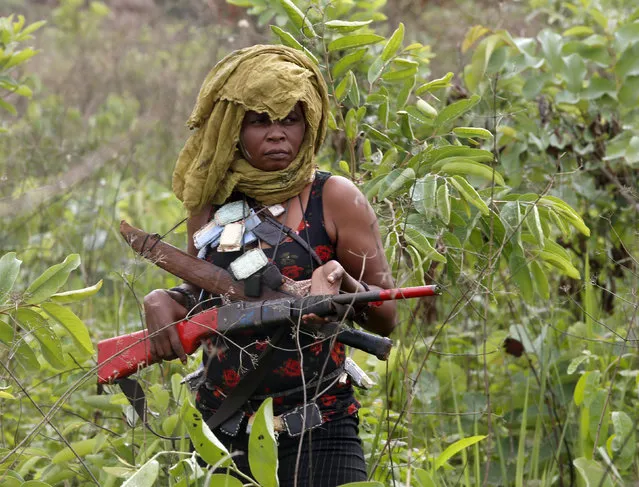
A female member of the anti-balaka, a Christian militia, patrols with other militiamen outside village of Zawa April 8, 2014. (Photo by Goran Tomasevic/Reuters)

Anti-balaka militia originally sprang up to protect the Christian population of the Central African Republic, but now stand accused of human rights abuses themselves. Last month, the African Union branded militia targeting Muslims in Central African Republic as “terrorists” and said they would be treated as enemy combatants, a day after killing a Congolese peacekeeper and amid deepening international frustration at continuing violence in the impoverished and landlocked country. Photo: A female member of the anti-balaka, a Christian militia, patrols with other militiamen outside village of Zawa April 8, 2014. (Photo by Goran Tomasevic/Reuters)
Details
10 Apr 2014 10:26:00
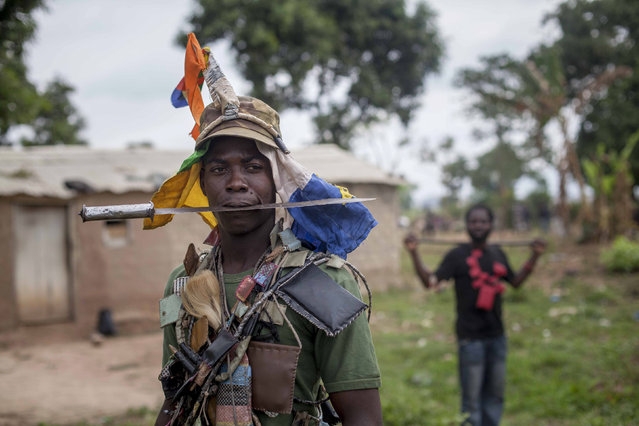
Anti-balaka fighters from the town of Bossembele patrol in the Boeing district of Bangui, Central African Republic, February 24, 2014. (Photo by Camille Lepage/Reuters)

“Camille Lepage, a 26-year-old French photojournalist who had spent months documenting deadly conflict in Central African Republic has been killed, the French presidency said Tuesday, May 13. Lepage, a freelance photographer whose work was published in major French and American newspapers, died in western Central African Republic not far from the border with Cameroon, authorities said”. – Associated Press. Photo: Anti-balaka fighters from the town of Bossembele patrol in the Boeing district of Bangui, Central African Republic, February 24, 2014. (Photo by Camille Lepage/Reuters)
Details
18 May 2014 08:54:00
Traditional wooden boats, or dhows, compete at sunrise during the Al Gaffal race, a long-distance dhow sailing race, near Sir Bu Nuayr, near Sharjah May 18, 2014. (Photo by Martin Dokoupil/Reuters)

The Al-Gaffal is an annual long-distance race between crews sailing 60-ft. traditional wooden boats called dhows and takes place in the Persian Gulf, between the island of Sir Bu Nair, near the Iranian coast and the Gulf emirate of Dubai. Photo: Traditional wooden boats, or dhows, compete at sunrise during the Al Gaffal race, a long-distance dhow sailing race, near Sir Bu Nuayr, near Sharjah May 18, 2014. (Photo by Martin Dokoupil/Reuters)
Details
19 May 2014 10:59:00
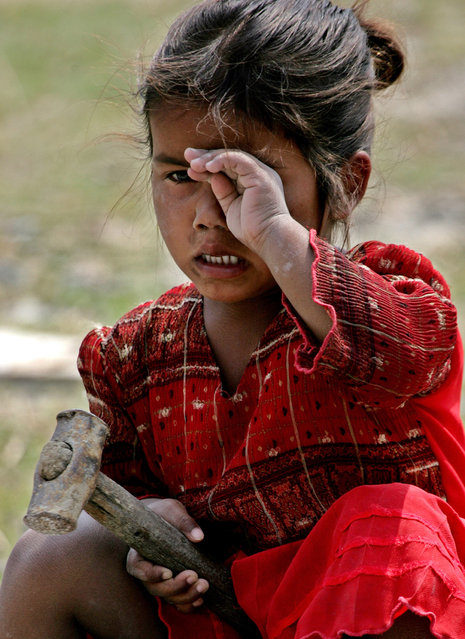
5-year-old Rina Kumari rubs her eye while cracking stones on the banks of Mahananda river in Siliguri, northeast India, March 5, 2005. Over 400 million people in India live below the internationally agreed poverty line (living on less than US $1 per day). According to estimates, several hundred thousand children work as labourers and beg on the streets in India. Photo taken on March 5, 2005. (Photo by Desmond Boylan/Reuters)

5-year-old Rina Kumari rubs her eye while cracking stones on the banks of Mahananda river in Siliguri, northeast India, March 5, 2005. Over 400 million people in India live below the internationally agreed poverty line (living on less than US $1 per day). According to estimates, several hundred thousand children work as labourers and beg on the streets in India. (Photo by Desmond Boylan/Reuters)
Details
13 Jun 2014 12:07:00