Loading...
Done
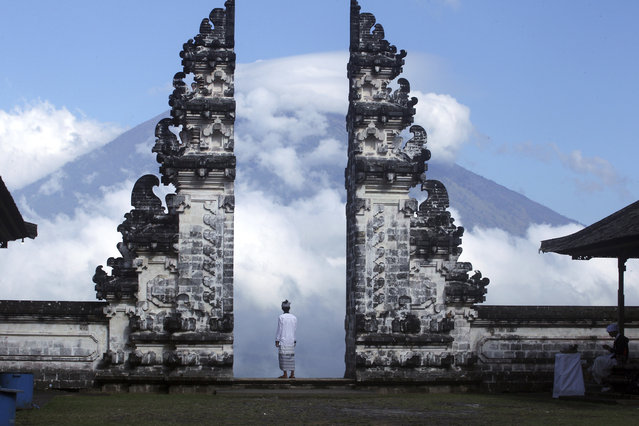
Balinese man watches Mount Agung volcano almost covered with clouds as he stands at a temple in Karangasem, Bali, Indonesia, Tuesday, September 26, 2017. An increasing frequency of tremors from the volcano indicates magma is continuing to move toward the surface and an eruption is possible, a disaster agency official said Tuesday. Tourists are cutting short their stay to the island, where an eruption would force the airport to close and strand thousands. (Photo by Firdia Lisnawati/AP Photo)

Balinese man watches Mount Agung volcano almost covered with clouds as he stands at a temple in Karangasem, Bali, Indonesia, Tuesday, September 26, 2017. An increasing frequency of tremors from the volcano indicates magma is continuing to move toward the surface and an eruption is possible, a disaster agency official said Tuesday. Tourists are cutting short their stay to the island, where an eruption would force the airport to close and strand thousands. (Photo by Firdia Lisnawati/AP Photo)
Details
30 Sep 2017 06:17:00
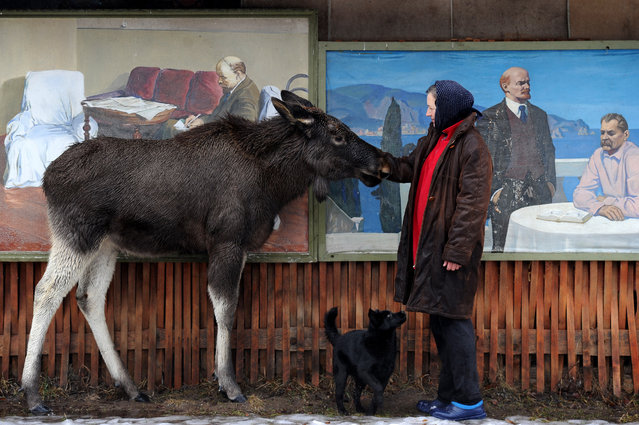
Svetlana Tseyko feeds a 10-month-old moose named Grisha in the courtyard in the village of Abramy, some 160 km northwest of Minsk, on February 21, 2017. (Photo by Sergei Gapon/AFP Photo)

Svetlana Tseyko feeds a 10-month-old moose named Grisha in the courtyard in the village of Abramy, some 160 km northwest of Minsk, on February 21, 2017. (Photo by Sergei Gapon/AFP Photo)
Details
23 Oct 2017 07:00:00
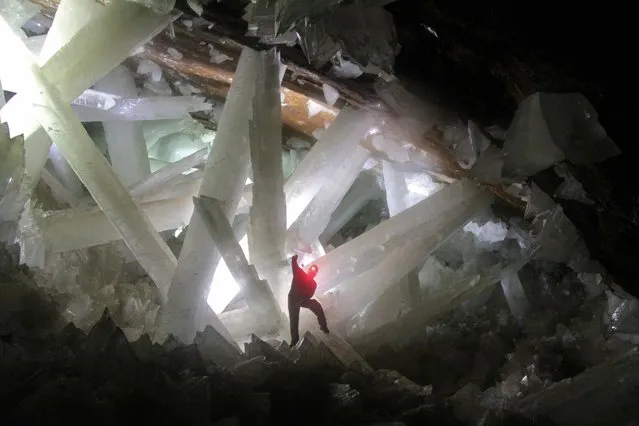
Giant Crystal Cave in Naica, Mexico

Cave of the Crystals or Giant Crystal Cave is a cave connected to the Naica Mine 300 metres (980 ft) below the surface in Naica, Chihuahua, Mexico. The main chamber contains giant selenite crystals (gypsum, CaSO4·2 H2O), some of the largest natural crystals ever found. The cave's largest crystal found to date is 12 m (39 ft) in length, 4 m (13 ft) in diameter and 55 tons in weight. The cave is extremely hot with air temperatures reaching up to 58 °C (136 °F) with 90 to 99 percent humidity. The cave is relatively unexplored due to these factors. Without proper protection people can only endure approximately ten minutes of exposure at a time.
Details
20 May 2014 07:56:00
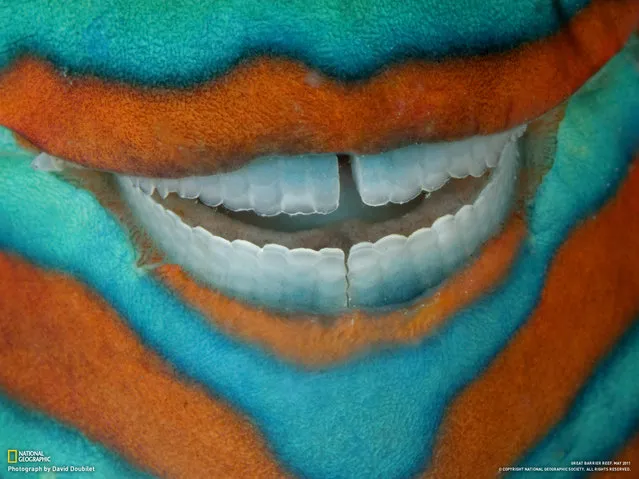
Photographers: David Doubilet

“David Doubilet (born 28 November 1946) is a well known underwater photographer known primarily for his work published in National Geographic Magazine. He was born in New York and started taking photos underwater at the young age of 12. He started with a Brownie Hawkeye in a rubber anesthesiologist's bag to keep the water out of the camera. During his summer holidays, he spent his time along the New Jersey coast. He later worked as a diver and photographer for the Sandy Hook Marine Laboratories in New Jersey. He also spent much time in the Caribbean. While a dive instructor in the Bahamas he found his motivation to capture the beauty of the sea and everything in it”. – Wikipedia. (Photo by David Doubilet/National Geographic)
Details
16 May 2012 12:21:00
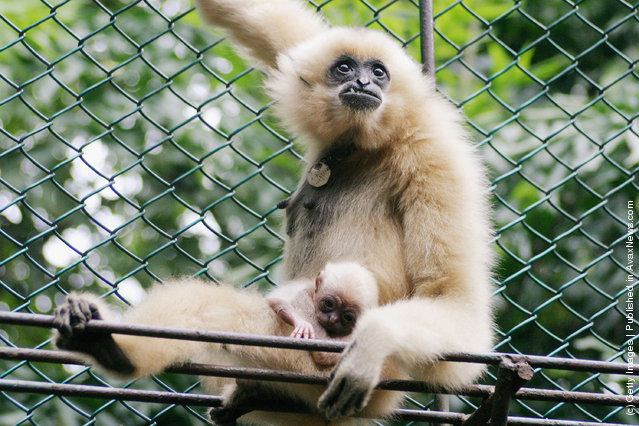
Newborn White-Cheeked Gibbon Nomascus

“Nomascus is the second most speciose genus of gibbons (family Hylobatidae). Originally this genus was a subgenus of Hylobates, and all individuals were considered one species, Hylobates concolor. Species within Nomascus are characterized by 52 chromosomes. Some species are all black, some light with a distinct black tuft of crown fur, and some by distinct, light-colored cheek patches. Nomascus is found from southern China (Yunnan) to southern Vietnam, and also on Hainan Island. One of the genus' species, Nomascus nasutus, has been deemed “the most critically endangered ape species in the world”. All of the species in this genus are endangered or critically endangered”. – Wikipedia

Photo: A newborn White-Cheeked Gibbon clings to its mother in the Nanning Zoo on April 12, 2004 in Nanning, Guangxi province, China. The White-Cheeked Gibbon's natural habitat is Southern China as well as Vietnam and Laos. They are classified as highly endangered and are on the brink of extinction due to poaching and reduction of natural rainforests. (Photo by Getty Images)
Details
12 Aug 2011 11:51:00
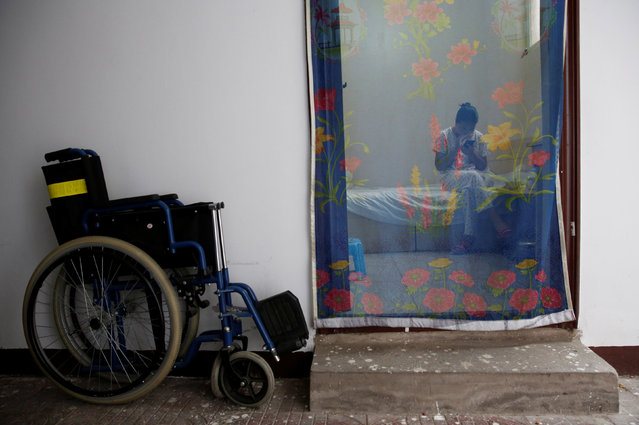
Wang uses a mobile phone as she take a rest in her room at the accommodation where patients and their family members stay while seeking medical treatments in Beijing, China, June 23, 2016. Wang, who suffers from cervical cancer, came from Inner Mongolia to seek treatment at a specialist hospital in Beijing. (Photo by Kim Kyung-Hoon/Reuters)

Wang uses a mobile phone as she take a rest in her room at the accommodation where patients and their family members stay while seeking medical treatments in Beijing, China, June 23, 2016. Wang, who suffers from cervical cancer, came from Inner Mongolia to seek treatment at a specialist hospital in Beijing. (Photo by Kim Kyung-Hoon/Reuters)
Details
30 Sep 2016 09:03:00
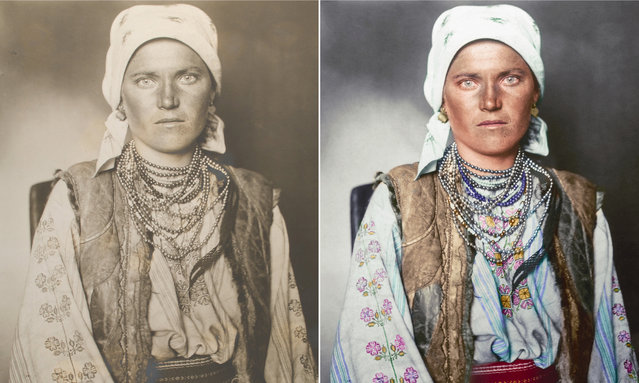
A Ruthenian woman circa 1906 from the region historically inhabiting the kingdom of the Rus, incorporating parts of modern-day Slavic speaking countries. Her outfit consists of a shirt and underskirt made from linen embroidered with traditional floral-based patterns. (Photo by Augustus Francis Sherman/New York Public Library/The Guardian)

Many of the 12 million people who entered the US through New York’s Ellis Island wore traditional dress from their homelands. Here: A Ruthenian woman circa 1906 from the region historically inhabiting the kingdom of the Rus, incorporating parts of modern-day Slavic speaking countries. Her outfit consists of a shirt and underskirt made from linen embroidered with traditional floral-based patterns. (Photo by Augustus Francis Sherman/New York Public Library/The Guardian)
Details
03 Oct 2016 09:15:00
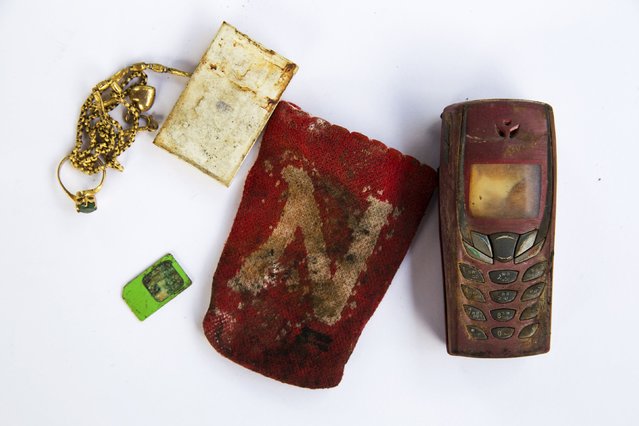
Personal possessions of 2004 tsunami victims are arranged to be photographed outside a police station in Takua Pa, in Phang Nga province December 19, 2014. (Photo by Damir Sagolj/Reuters)

Personal possessions of 2004 tsunami victims are arranged to be photographed outside a police station in Takua Pa, in Phang Nga province December 19, 2014. Thai police opened a shipping container filled with documents and possessions of victims of the 2004 Indian Ocean Tsunami after being asked by Reuters for permission to film its contents. The three metre by 12 metre container was handed over to Thai police in 2011 and contains hundreds of plastic police evidence bags – each one holding the precious items found on the body of a victim. (Photo by Damir Sagolj/Reuters)
Details
24 Dec 2014 13:44:00