Loading...
Done
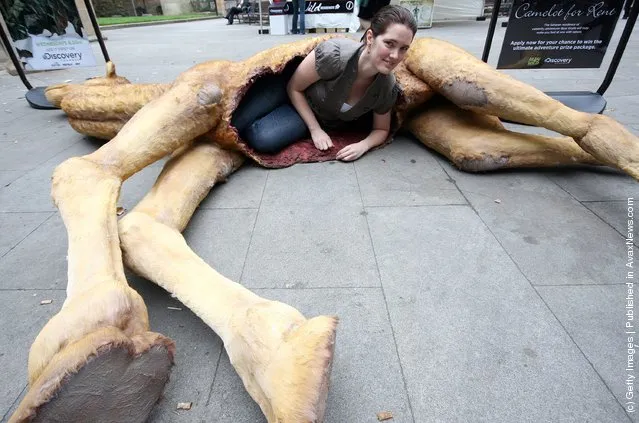
Passer inspects Camelot, a replica camel carcass simulating that used by adventurer Bear Grylls to shelter in the Sahara desert during an episode of the Discovery Channel's Man Vs. Wild

“Bear Grylls, (born Edward Michael Grylls, 7 June 1974) is an English adventurer, writer and television presenter. He is best known for his television series Man vs. Wild, known as Born Survivor in the United Kingdom. He was the youngest Briton to climb Mount Everest, doing so at age 23. In July 2009, Grylls was appointed the youngest ever Chief Scout at the age of 35”. – Wikipedia

Photos: Passer inspects “Camelot”, a replica camel carcass simulating that used by adventurer Bear Grylls to shelter in the Sahara desert during an episode of the Discovery Channel's “Man Vs. Wild”, in Wynyard Park on March 1, 2010 in Sydney, Australia. (Photo by Discovery Channel via Getty Images)
Details
04 Aug 2011 11:24:00
Nuclear Football

“The nuclear football (also known as the atomic football, the president's emergency satchel, the button, the black box, or just the football) is a briefcase, the contents of which are to be used by the President of the United States of America to authorize a nuclear attack while away from fixed command centers, such as the White House Situation Room. It functions as a mobile hub in the strategic defense system of the United States. It is a metallic Zero Halliburton briefcase carried in a black leather “jacket”. The package weighs around 45 pounds (20 kilograms). A small antenna protrudes from the bag near the handle”. – Wikipedia

Photo: A U.S. Military officer carries the “football”, which carries nuclear launch codes, on South Lawn after returning with U.S. President George W. Bush to the White House January 7, 2002 in Washington, DC. (Photo by Mark Wilson/Getty Images)
Details
06 Aug 2011 12:53:00
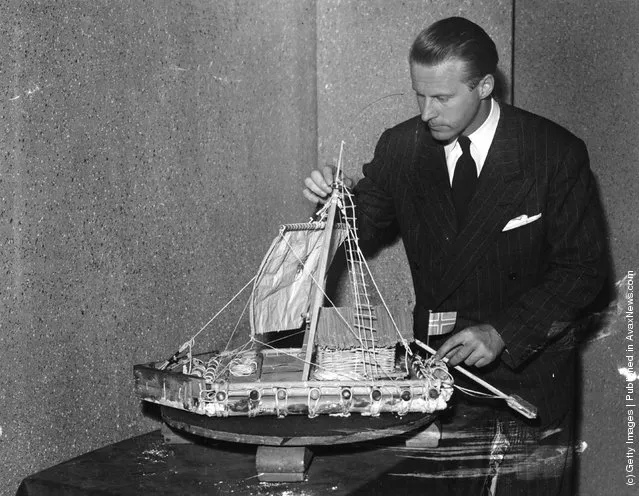
Thor Heyerdahl with a model of the balsa raft Kon Tiki

“Thor Heyerdahl (October 6, 1914, Larvik, Norway – April 18, 2002, Colla Micheri, Italy) was a Norwegian ethnographer and adventurer with a background in zoology and geography. He became notable for his Kon-Tiki expedition, in which he sailed 8,000 km (4,300 miles) by raft from South America to the Tuamotu Islands. All his expeditions are shown in the Kon-Tiki Museum, Oslo”. – Wikipedia

Photo: Norwegian anthropologist Thor Heyerdahl with a model of the balsa raft “Kon-Tiki” on which he drifted 4,300 miles from Peru to the Tuamotu Islands, proving his theory that Polynesia could originally have been populated by South Americans. (Photo by Express/Express/Getty Images). 1950
Details
09 Aug 2011 11:05:00


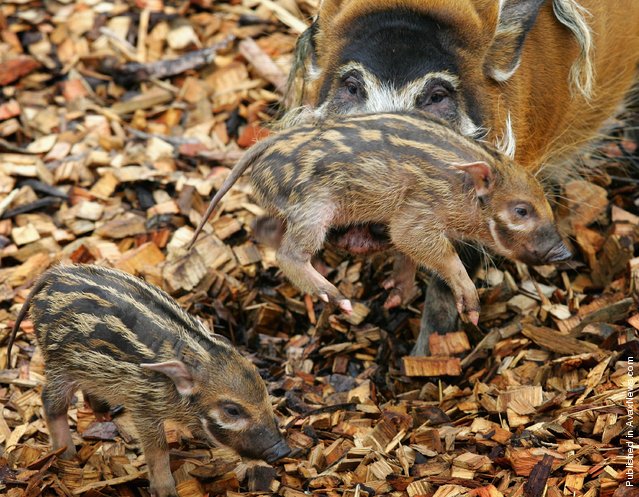
“The Red River Hog (Potamochoerus porcus), also known as the Bush Pig (but not to be confused with P. larvatus, common name “Bushpig”), is a wild member of the pig family living in Africa, with most of its distribution in the Guinean and Congolian forests. It is rarely seen away from rainforests, and generally prefers areas near rivers or swamps.

Red River Hogs eat grass, berries, roots, insects, molluscs, small vertebrates and carrion. They are capable of causing damage to plantations. Red River Hogs typically live in herds of 6-20 members led by a dominant boar. Sows rear 3-6 piglets at a time.”

Photo: Two 17 day old red river hoglet twins forage for food next to their mother Bahiti at London Zoo on August 23, 2007 in London, England. Red River hoglets inhabit the forests and swamps of West and Central Africa. The recent additions to the London Zoo pig pen have been eagerly awaited by zoo keepers. (Photo by Chris Jackson/Getty Images)
Details
18 Mar 2011 15:15:00


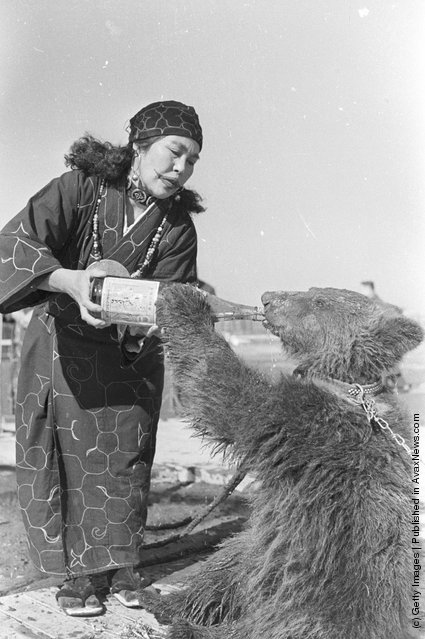
“The Ainu (アイヌ?), also called Aynu, Aino (アイノ), and in historical texts Ezo (蝦夷), are indigenous people or groups in Japan and Russia. Historically they spoke the Ainu language and related varieties and lived in Hokkaidō, the Kuril Islands, and much of Sakhalin. Most of those who identify themselves as Ainu still live in this same region, though the exact number of living Ainu is unknown. This is due to ethnic issues in Japan resulting in those with Ainu backgrounds hiding their identities and confusion over mixed heritages. In Japan, because of intermarriage over many years with Japanese, the concept of a 'pure Ainu' ethnic group is no longer feasible. Official estimates of the population are of around 25,000, while the unofficial number is upwards of 200,000 people”. – Wkipedia

Photo: A captive bear drinking from a large bottle held by an Ainu tribeswoman. (Photo by Evans/Three Lions/Getty Images). Circa 1955
Details
24 Mar 2011 14:01:00


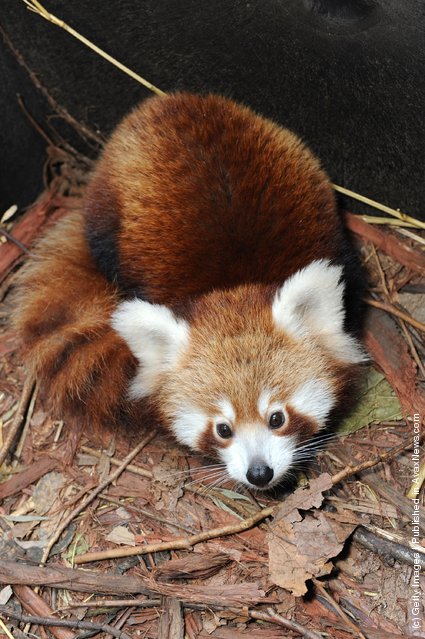
“The red panda (Ailurus fulgens, or shining-cat), is a small arboreal mammal native to the eastern Himalayas and southwestern China. It is the only species of the genus Ailurus. Slightly larger than a domestic cat, it has reddish-brown fur, a long, shaggy tail, and a waddling gait due to its shorter front legs. It feeds mainly on bamboo, but is omnivorous and may also eat eggs, birds, insects, and small mammals. It is a solitary animal, mainly active from dusk to dawn, and is largely sedentary during the day”. – Wikipedia

Photo: In this handout image provided by Taronga Zoo, Seba, a baby Red Panda, explores his new home at Taronga Zoo on April 7, 2011 in Sydney, Australia. The Red Panda cub was born at Christmas and is the 45th to be born at the zoo since 1977. (Photo by Peter Hardin/Taronga Zoo via Getty Images)
Details
07 Apr 2011 08:51:00


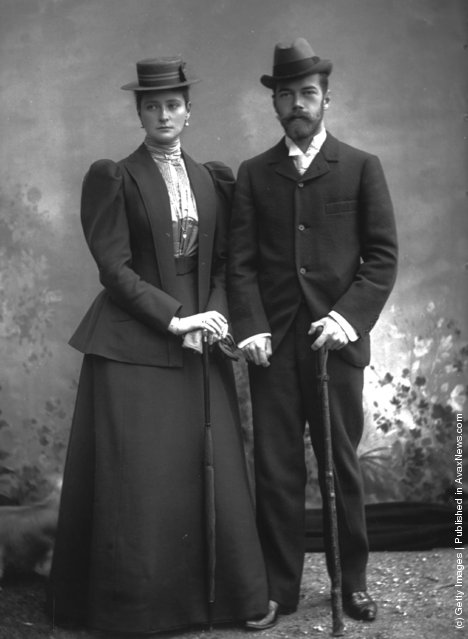
“Nicholas II (Russian: Николай II, Николай Александрович Романов, tr. Nikolay II, Nikolay Alexandrovich Romanov) (18 May [O.S. 6 May] 1868 – 17 July 1918) was the last Emperor of Russia, Grand Prince of Finland, and titular King of Poland. His official title was Nicholas II, Emperor and Autocrat of All the Russias and he is known as Saint Nicholas the Passion-Bearer by the Russian Orthodox Church. Nicholas II, his wife, his son, his four daughters, the family's medical doctor, the Tsar's valet, the Empress' lady-in-waiting and the family's cook were murdered in the same room by the Bolsheviks on the night of 16/17 July 1918”. – Wikipedia

Photo: Tsar Nicholas II (1868–1918) with his wife. (Photo by W. & D. Downey/Getty Images). Circa 1900
Details
12 May 2011 07:26:00
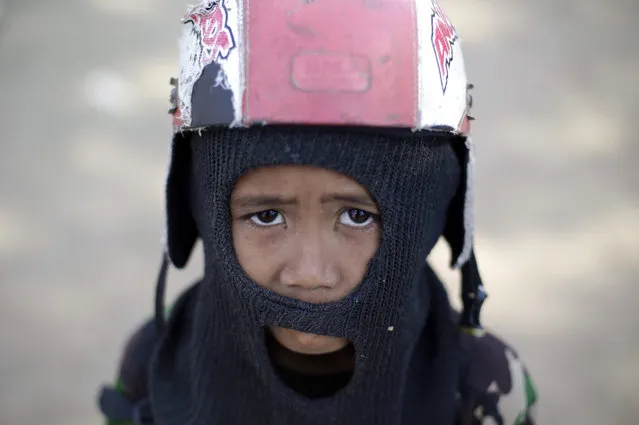
Indonesian child jockey Egi, 8, poses for photographs as he participates in a traditional horse race marking Indonesia's 70th independence anniversary, in Bima, West Nusa Tenggara province, Indonesia, 08 August 2015. (Photo by Mast Irham/EPA)

Indonesian child jockey Egi, 8, poses for photographs as he participates in a traditional horse race marking Indonesia's 70th independence anniversary, in Bima, West Nusa Tenggara province, Indonesia, 08 August 2015. Horse racing is the traditional sport in the area and a cultural heritage which continues to be preserved by the people of Bima, a small city on the east side of Sumbawa island. Similar races also held in Sumbawa Besar regency and Dompu regency. (Photo by Mast Irham/EPA)
Details
19 Sep 2015 12:32:00