Loading...
Done
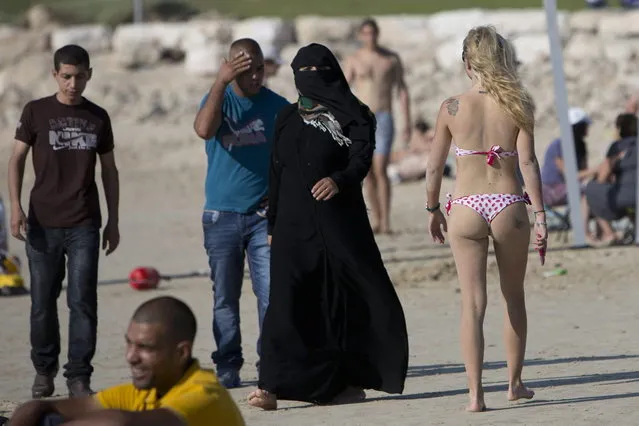
Palestinians and Israelis enjoy the Mediterranean sea during the first day of the Eid al-Fitr holiday in Tel Aviv, Israel, Thursday, August 8, 2013. The three-day Eid al-Fitr holiday marks the end of the holy fasting month of Ramadan. One of the most important holidays in the Muslim world, Eid al-Fitr, is marked with prayers, family reunions and other festivities. (Photo by Oded Balilty/AP Photo)

Palestinians and Israelis enjoy the Mediterranean sea during the first day of the Eid al-Fitr holiday in Tel Aviv, Israel, Thursday, August 8, 2013. The three-day Eid al-Fitr holiday marks the end of the holy fasting month of Ramadan. One of the most important holidays in the Muslim world, Eid al-Fitr, is marked with prayers, family reunions and other festivities. (Photo by Oded Balilty/AP Photo)
Details
13 Aug 2013 11:02:00
File photo taken on July 24, 2011 shows the scenery of karst landform in Dacai Township under Maonan Autonomous County of Huaijiang, south China's Guangxi Zhuang Autonomous Region. The World Heritage Committee on Monday inscribed an extension of South China Karst, a natural World Heritage Site since 2007, into the UNESCO's World Heritage List. (Photo by Wang Xiufa/Xinhua)

File photo taken on July 24, 2011 shows the scenery of karst landform in Dacai Township under Maonan Autonomous County of Huaijiang, south China's Guangxi Zhuang Autonomous Region. The World Heritage Committee on Monday inscribed an extension of South China Karst, a natural World Heritage Site since 2007, into the UNESCO's World Heritage List. (Photo by Wang Xiufa/Xinhua)
Details
07 Aug 2014 10:19:00
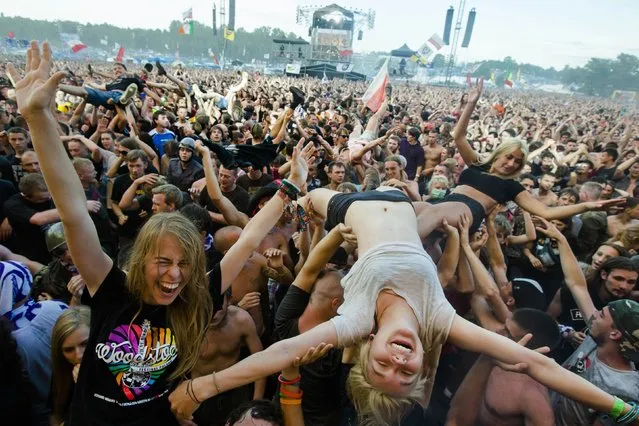
A woman crowd-surfs in front of the main stage at the Woodstock Festival in Kostrzyn-upon-Odra, close to the Polish-German border, August 2, 2014. Some 500 thousand people attended the festival that is the brainchild of Polish journalist and social campaigner Jerzy Owsiak. He initiated the event to say thank you to those who donated money to his GOCC charity organisation that delivers medical care for children. (Photo by Thomas Peter/Reuters)

A woman crowd-surfs in front of the main stage at the Woodstock Festival in Kostrzyn-upon-Odra, close to the Polish-German border, August 2, 2014. Some 500 thousand people attended the festival that is the brainchild of Polish journalist and social campaigner Jerzy Owsiak. He initiated the event to say thank you to those who donated money to his GOCC charity organisation that delivers medical care for children. (Photo by Thomas Peter/Reuters)
Details
09 Aug 2014 11:26:00
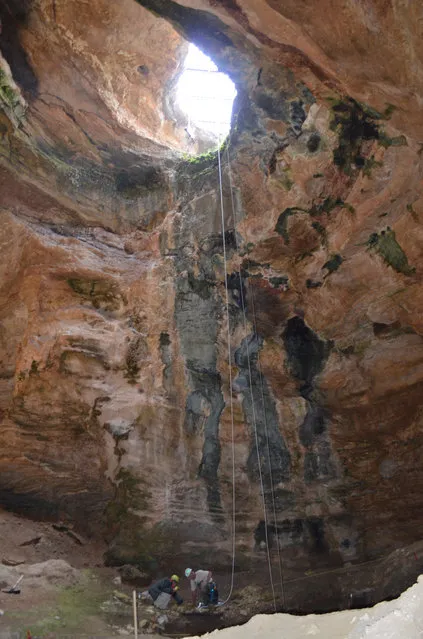
This July 2014 image provided by the Bureau of Land Management shows the interior of the Natural Trap Cave in north-central Wyoming. The cave holds the remains of tens of thousands of animals, including many now-extinct species, from the late Pleistocene period tens of thousands of years ago. Scientists have resumed digging for the first time in more than 30 years. (Photo by AP Photo/Bureau of Land Management)

This July 2014 image provided by the Bureau of Land Management shows the interior of the Natural Trap Cave in north-central Wyoming. The cave holds the remains of tens of thousands of animals, including many now-extinct species, from the late Pleistocene period tens of thousands of years ago. Scientists have resumed digging for the first time in more than 30 years. (Photo by AP Photo/Bureau of Land Management)
Details
10 Aug 2014 10:35:00
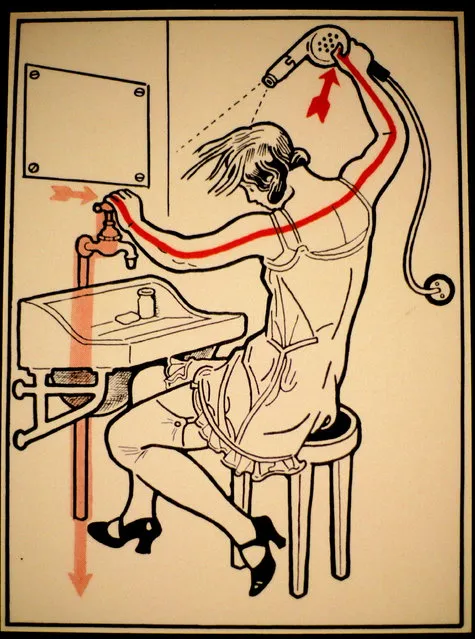
The book “Elektroschutz in 132 Bildern” (Electrical Protection in 132 Pictures) was published in Vienna in the early 1900s by a Viennese physician named Stefan Jellinek (1878-1968, a founder of the Electro-Pathological Museum). The pictures are nice and direct and unambiguous; they teach, graphically, that the surest way to kill yourself with electricity is to form a complete path from source (usually the bright red arrow) to ground (the screened back, pink arrow). Arrowheads provide the path for current flow. (Photo by The Vienna Technical Museum)

The book “Elektroschutz in 132 Bildern” (Electrical Protection in 132 Pictures) was published in Vienna in the early 1900s by a Viennese physician named Stefan Jellinek (1878-1968, a founder of the Electro-Pathological Museum). The pictures are nice and direct and unambiguous; they teach, graphically, that the surest way to kill yourself with electricity is to form a complete path from source (usually the bright red arrow) to ground (the screened back, pink arrow). Arrowheads provide the path for current flow. (Photo by The Vienna Technical Museum)
Details
11 Aug 2014 11:10:00
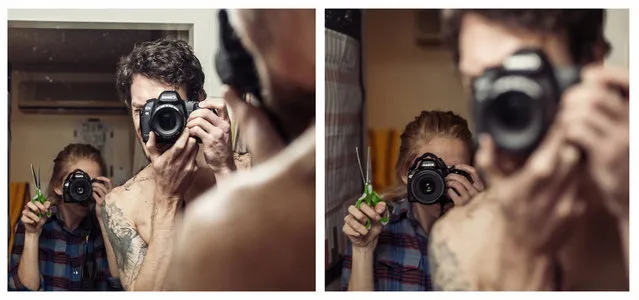
Globe-trotting photographer couple Peter Sedlacik and Zuzu Galova have found a fun way to document their travels around the world. Wherever they are, they face each other, frame up a great composition, and take a picture of each other… taking a picture of each other. Thus was born the photo series/project “Lens Between Us”. (Photo by Peter Sedlacik/Zuzu Galova)

Globe-trotting photographer couple Peter Sedlacik and Zuzu Galova have found a fun way to document their travels around the world. Wherever they are, they face each other, frame up a great composition, and take a picture of each other… taking a picture of each other. Thus was born the photo series/project “Lens Between Us”, which is quickly scooping up followers on Tumblr, Facebook and Instagram alike. The resulting diptychs are creative, well-composed, and whimsical in the best way. A tribute to how their focus is always on each other, the images are part travel photography, part portraiture, and challenging to boot since each shot requires that they figure out not one, but two compositions. (Photo by Peter Sedlacik/Zuzu Galova)
Details
11 Aug 2014 11:30:00
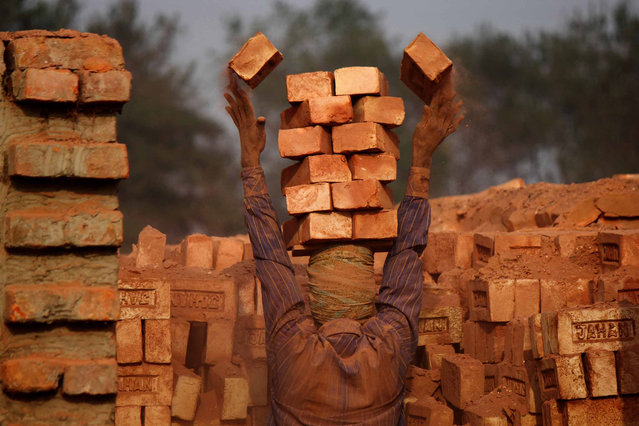
CGAP Photo Contest – South Asia Regional Winner: Bricks Worker, Bangladesh. A private enterprise worker is working at a brick field. These small businesses are creating new job opportunities for many poor people. (Photo by Moksumul Haque)

The shoemaker in Turkey, the potato seller in Vietnam, and the weaver in Bolivia are among the billions of low-income entrepreneurs who make the world go round. They are also the type of people who can benefit significantly from microfinance. Every year, the Consultative Group To Assist The Poor (or CGAP) hosts a photo contest asking entrants to submit photos based around the idea of microfinance.The purpose of the contest is to give amateur and professional photographers a chance to show the different ways that poor households manage their financial lives and make their lives better through financial inclusion. Photo: South Asia Regional Winner – “Bricks Worker”, Bangladesh. A private enterprise worker is working at a brick field. These small businesses are creating new job opportunities for many poor people. (Photo by Moksumul Haque)
Details
14 Aug 2014 10:58:00
Erica and Hannes, from Zurich, Switzerland, were tasked with watching their friend’s 6-month-old baby overnight, and after an “extensive briefing” from the dad, they realized just how much could go wrong. The couple, both designers, decided to have some fun with their fears, making the apocalyptic scenarios come to life in a hilarious photo series now gone viral. (Photo by Erica and Hannes)

Erica and Hannes, from Zurich, Switzerland, were tasked with watching their friend’s 6-month-old baby overnight, and after an “extensive briefing” from the dad, they realized just how much could go wrong. The couple, both designers, decided to have some fun with their fears, making the apocalyptic scenarios come to life in a hilarious photo series now gone viral. (Photo by Erica and Hannes)
Details
15 Aug 2014 09:12:00