Loading...
Done
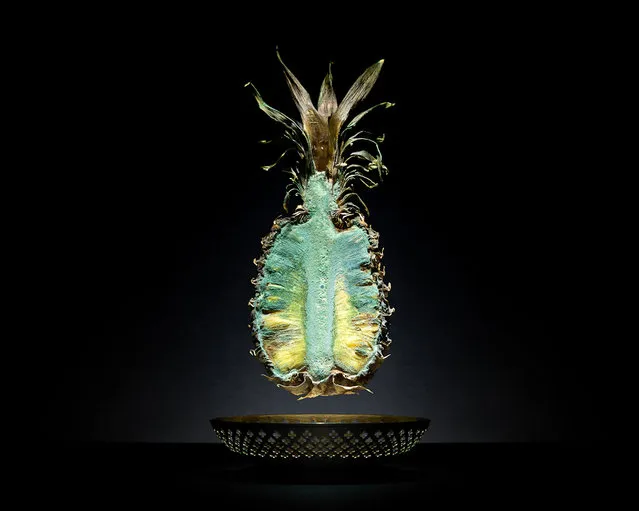
Pineapple

“One Third” – a project on food waste by an Austrian photography Klaus Pichler. According to a UN study one third of the world's food goes to waste – the largest part thereof in the industrialized nations of the global north. Equally, 925 million people around the world are threatened by starvation. The series “One Third” describes the connection between individual wastage of food and globalized food production.

Photo: Pineapple. Place of production: Guayaquil, Ecuador. Cultivation method: Outdoor plantation • Time of harvest: All- season. Transporting distance: 10.666 km (linear distance) • Means of transportation: Aircraft, truck. Carbon footprint (total) per kg: 11,94 kg • Water requirement (total) per kg: 360 l. Price: 2,10 € / kg. (Photo by Klaus Picher)
Details
02 May 2012 11:01:00
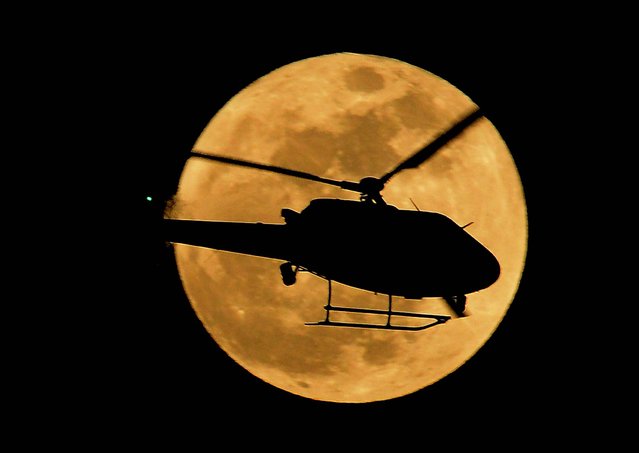
LAPD chopper flies in a foregraund of the Super Moon in Los Angeles, California on May 05, 2012

LAPD chopper flies in a foregraund of the Super Moon in Los Angeles, California on May 05, 2012. Tonight's moon is set to appear 14 percent larger and 30 percent brighter from our perspective on Earth. The Supermoon lines up much closely with perigee – the moon's closest point to Earth. The 2012 May full moon falls some six minutes after perigee, the moon's closest point to Earth for this month. At perigee, the moon lies only 221,802 miles (356,955 kilometers ) away. Later this month, on May 19, the moon will swing out to apogee – its farthest point for the month – at 252,555 miles (406,448 kilometers) distant. (Photo by AFP/File, Joe Klamar)
Details
08 May 2012 10:54:00
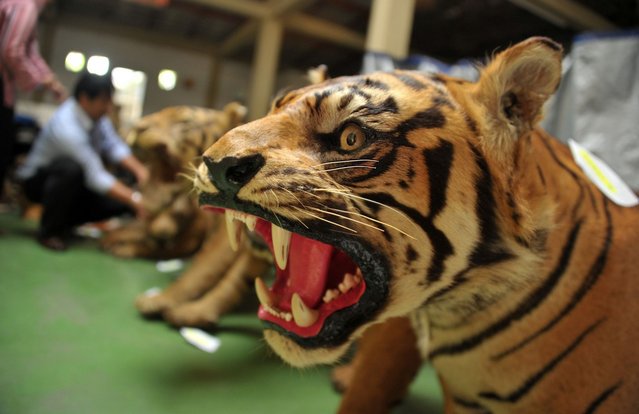
This photo taken on July 25, 2012 one of 14 preserved bodies of critically-endangered Sumatran tigers seized as members of the Indonesian national police and the special crime unit inspect the scene at a warehouse in Cibubur, south of Jakarta. Indonesian police seized 14 preserved bodies of critically-endangered Sumatran tigers in a raid on a house near Jakarta, a spokesman said on July 19. (Photo by Bay Ismoyo/AFP Photo)

“The Sumatran tiger (Panthera tigris sumatrae) is a rare tiger subspecies that inhabits the Indonesian island of Sumatra. It was classified as critically endangered by IUCN in 2008 as the population is projected to be 441 to 679 individuals, with no subpopulation having an effective population size larger than 50 individuals, with a declining trend”. – Wikipedia

This photo taken on July 25, 2012 one of 14 preserved bodies of critically-endangered Sumatran tigers seized as members of the Indonesian national police and the special crime unit inspect the scene at a warehouse in Cibubur, south of Jakarta. Indonesian police seized 14 preserved bodies of critically-endangered Sumatran tigers in a raid on a house near Jakarta, a spokesman said on July 19. (Photo by Bay Ismoyo/AFP Photo)
Details
04 Mar 2015 08:13:00
Human Barbie Doll Valeria Lukyanova aka Naamah From The Ukraine

This is a “swami” - Valeria Lukyanova (born August 23, 1985), from Odessa, Ukraine. Her other names: Naamah (Нахема; Na'amah (Hebrew: נעמה‎) – is a demonic legendary creature, the mother of divination), Amatue, Nagval and Goddess (бАгиня). She is fond of esoteric, believes that 2012 will be the end of the world, and waits for the planet Nibiru (I'm not kidding). This girl had amused the Russian-language Internet (because the Russians are cynical and heartless people). IMHO she is very beautiful (technical characteristics – Chest: 88cm (34,64 in; may be longer already); Waist: 47cm (18,5 in; may be lesser already) and Hips: 88cm (34,64 in)). Enjoy. (Photos by Valeria Lukyanova)
Details
06 Aug 2012 11:35:00
1948年3月,外滩,便衣警察棒打偷拿棉花的老太。 (In March 1948, the Bund, plainclothes police officers wreck stole cotton Granny)

Photos from 虹桥故事's photostream. Attention! From Chinese to English translated by Google!

Photo: 1948年3月,外滩,便衣警察棒打偷拿棉花的老太。 (In March 1948, the Bund, plainclothes police officers wreck stole cotton Granny)
Details
12 Aug 2012 08:41:00
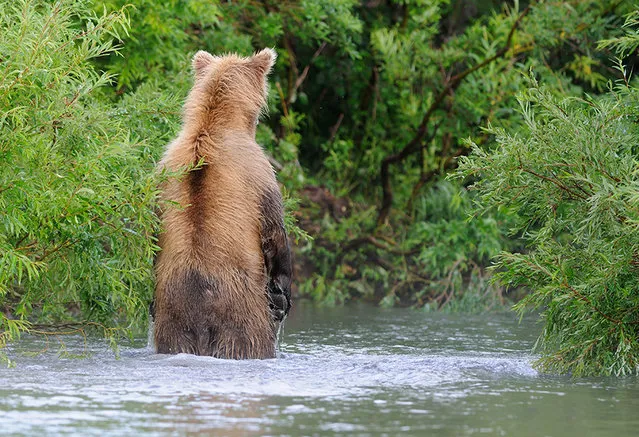
Where's the fish?/n. South Kamchatka Sanctuary<><>South Kamchatka Sanctuary; Kuril Lake; Kamchatka; bear; salmon; spawning

Igor Shpilenok works in the reserve at Kamchatka, Russia. Igor is a fellow of the International League of Conservation Photographers and a winner of the 2006 BBC Wildlife Photographer Competition. Igor’s work has been published in numerous international and Russian magazines, including Smithsonian, National Wildlife, Geo, and BBC Wildlife.

“How does a bear behave when encounter a human? In most cases he runs away. But before running he almost always would rise to stand on his rear feet. And this behavior does not indicate the attack, as many people think...” – Igor Shpilenok. (Photo by Igor Shpilenok via Wildlife Photo Russia)
Details
16 Sep 2012 12:54:00
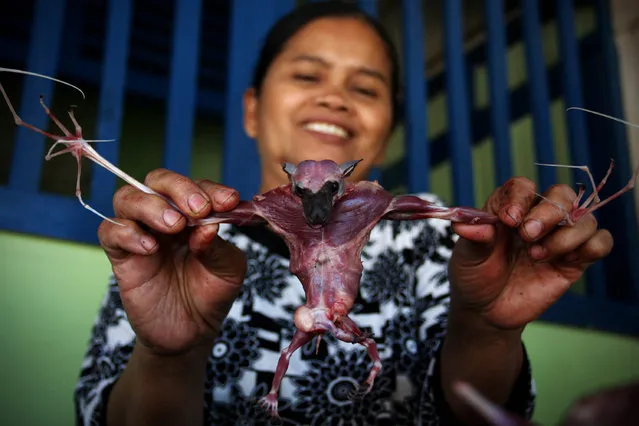
Bat seller Sukarwati shows a skinned bat on July 30, 2009 in Yogyakarta, Indonesia. Sukarwati and her family have hunted bats in the Imogiri region for generations, capturing more than 800 bats per month. The Sukarwati family believe that the meat from the bat heals asthma and respiratory problems and it is a great honour for them knowing that the meat that they provide will help ease people's health ailments

Bat seller Sukarwati shows a skinned bat on July 30, 2009 in Yogyakarta, Indonesia. Sukarwati and her family have hunted bats in the Imogiri region for generations, capturing more than 800 bats per month. The Sukarwati family believe that the meat from the bat heals asthma and respiratory problems and it is a great honour for them knowing that the meat that they provide will help ease people's health ailments. (Photo by Ulet Ifansasti)
Details
20 Sep 2012 08:57:00
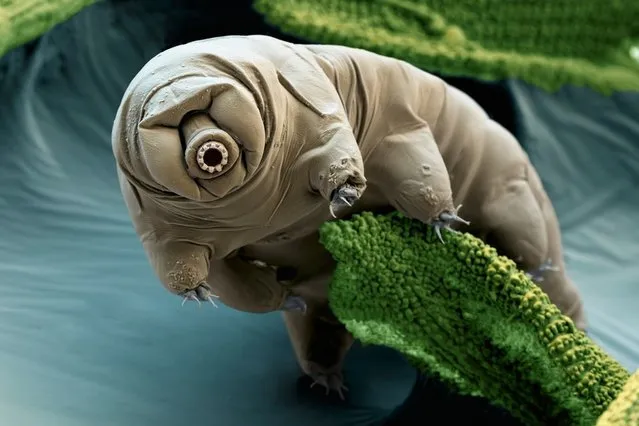
Tardigrades (commonly known as waterbears or moss piglets). (Photo by SPL/East News)

“Tardigrades (commonly known as waterbears or moss piglets) are small, water-dwelling, segmented animals with eight legs. Tardigrades were first discovered in 1773 by Johann August Ephraim Goeze, who called them kleiner Wasserbär, meaning “little water bear” in German. The name Tardigrada means “slow walker” and was given by Lazzaro Spallanzani in 1777. The name water bear comes from the way they walk, reminiscent of a bear's gait. The biggest adults may reach a body length of 1.5 millimetres (0.059 in), the smallest below 0.1 mm. Freshly hatched tardigrades may be smaller than 0.05 mm”. – Wikipedia. Photo: Tardigrades. (Photo by SPL/East News)
Details
26 Sep 2012 09:55:00