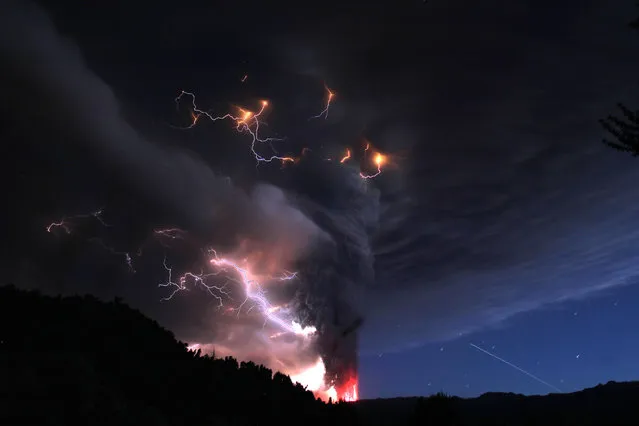
The Royal Observatory just announced its Astronomy Photographer Of The Year 2013 winners. Australian photographer Mark Gee was chosen among a thousand amateur and professional photographers around the globe to win the top title. His work is part of an exhibition of the winning photographers, which opened on Sept. 19 at the Royal Observatory Greenwich. The Royal Observatory shared with us the winners and notable mentions of the competition. Their descriptions of the prizewinners can be found below the images.
“Winter shapes, Moscow river”. Moscow river at this part is never covered by ice. When the temperature is very low it's possible to see a strong fog. Morning light and pipes of the oli factory creates a fantastic landscape. Photo location: Moscow, Russia. (Photo and caption by Sergey Rumyantsev/National Geographic Photo Contest)
People ride a prototype of a driverless vehicle as it is moves through a pedestrian area in Greenwich, east London, February 11, 2015. Britain has begun testing driverless cars in four cities, launching the first official trials ahead of a series of planned rule reviews to accommodate the new technology. (Photo by Suzanne Plunkett/Reuters)
Central Bangkok and the Chao Phraya River are seen from an abandoned skyscraper in Bangkok April 19, 2015. The abandoned building, known as Satorn Unique, dubbed the “ghost tower” was destined to become one of Bangkok's most luxurious residential addresses but construction was never completed as the Thai economy was hit during the 1997 Asian Financial Crisis. Now, many travellers visit and explore 49-storey skyscraper. (Photo by Athit Perawongmetha/Reuters)
Katjinga, a Rhodesian ridgeback dog who lives on a 20-acre farm in Germany, adopted an abandoned pot-bellied piglet in August 2009. The tiny black piglet, named Paulinchen, had been so small at birth that her mother likely overlooked it. Katjinga's owner, Roland Adam, found the piglet alone and cold and brought it to his 8-year-old dog. (Photo by Fame Pictures)
“The Lockheed SR-71 “Blackbird” was an advanced, long-range, Mach 3+ strategic reconnaissance aircraft. It was developed as a black project from the Lockheed A-12 reconnaissance aircraft in the 1960s by the Lockheed Skunk Works. Clarence “Kelly” Johnson was responsible for many of the design's innovative concepts. During reconnaissance missions the SR-71 operated at high speeds and altitudes to allow it to outrace threats. If a surface-to-air missile launch was detected, the standard evasive action was simply to accelerate and outrun the missile”. – Wikipedia
Photo: A U.S. Air Force SR-71A, also known as the “Blackbird”, is put through it's paces during a test flight over Beale Air Force Base in California. The aircraft is a strategic reconnaissance plane by Lockheed and is the world's fastest and highest flying operational aircraft. (Photo by Getty Images)