Loading...
Done
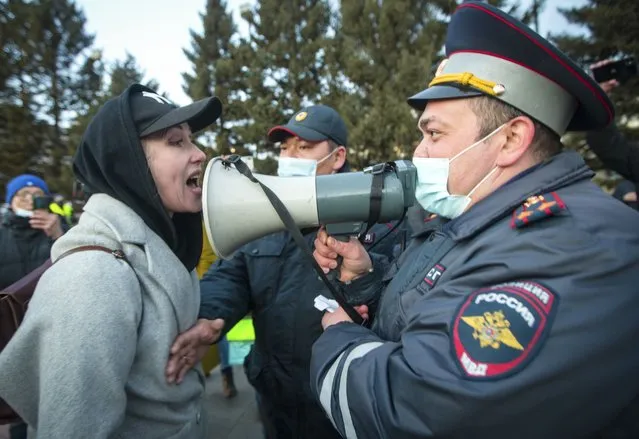
A woman argues with police officer during a protest in support of jailed opposition leader Alexei Navalny in Ulan-Ude, the regional capital of Buryatia, a region near the Russia-Mongolia border, Russia, Wednesday, April 21, 2021. Navalny's team has called for nationwide protests on Wednesday following reports that the politician's health was deteriorating in prison, where he has been on hunger strike since March 31. Russian authorities have stressed that the demonstrations were not authorized and warned against participating in them. (Photo by Anna Ogorodnik/AP Photo)

A woman argues with police officer during a protest in support of jailed opposition leader Alexei Navalny in Ulan-Ude, the regional capital of Buryatia, a region near the Russia-Mongolia border, Russia, Wednesday, April 21, 2021. Navalny's team has called for nationwide protests on Wednesday following reports that the politician's health was deteriorating in prison, where he has been on hunger strike since March 31. Russian authorities have stressed that the demonstrations were not authorized and warned against participating in them. (Photo by Anna Ogorodnik/AP Photo)

Details
22 Apr 2021 10:04:00

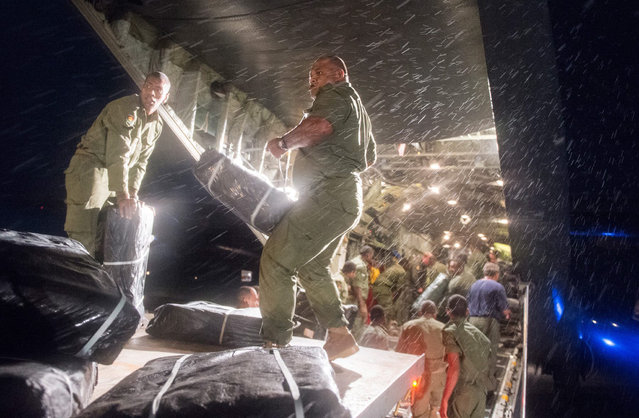
A handout image provided by the New Zealand Defence Force shows aid supplies being unloaded by Fijian soldiers from an Royal New Zealand Airforce C-130 Hercules plane in Suva, Fiji, 23 February 2016. Tool kits, generators, ration packs, water containers and chainsaws make up part of the New Zealand relief following Tropical Cyclone Winston. The death toll from the cyclone that hit Fiji over the weekend climbed to 29, local media reported ON 23 February. (Photo by Sam Shepherd/EPA/NZ Defence Force)

A handout image provided by the New Zealand Defence Force shows aid supplies being unloaded by Fijian soldiers from an Royal New Zealand Airforce C-130 Hercules plane in Suva, Fiji, 23 February 2016. Tool kits, generators, ration packs, water containers and chainsaws make up part of the New Zealand relief following Tropical Cyclone Winston. The death toll from the cyclone that hit Fiji over the weekend climbed to 29, local media reported ON 23 February. Cyclone Winston, the most powerful storm in Fiji's history, battered the country's main island of Viti Levu and other smaller surrounding islands on Saturday, the Fiji Broadcasting Corporation reported. (Photo by Sam Shepherd/EPA/NZ Defence Force)
Details
24 Feb 2016 12:56:00
A daredevil photographer is determined to capture London in a whole new light – by scaling the city’s many rooftops. Jacob Riglin, from Richmond Upon Thames, photographs the nation's capital from above – hanging from scaffolding, dangling his legs over the edge of buildings and looking down from perilous heights. Such images have gained the photographer, 20, an incredible fan base on Instagram, which has seen his follower count rise to more than 150,000. (Photo by Jacob Riglin/Caters News)

A daredevil photographer is determined to capture London in a whole new light – by scaling the city’s many rooftops. Jacob Riglin, from Richmond Upon Thames, photographs the nation's capital from above – hanging from scaffolding, dangling his legs over the edge of buildings and looking down from perilous heights. Such images have gained the photographer, 20, an incredible fan base on Instagram, which has seen his follower count rise to more than 150,000. He said, “I had always been interested climbing and getting that adrenaline rush from feeling on top of the world”. Here: Jacob looking out to the London skyline. (Photo by Jacob Riglin/Caters News)
Details
17 Oct 2015 08:05:00
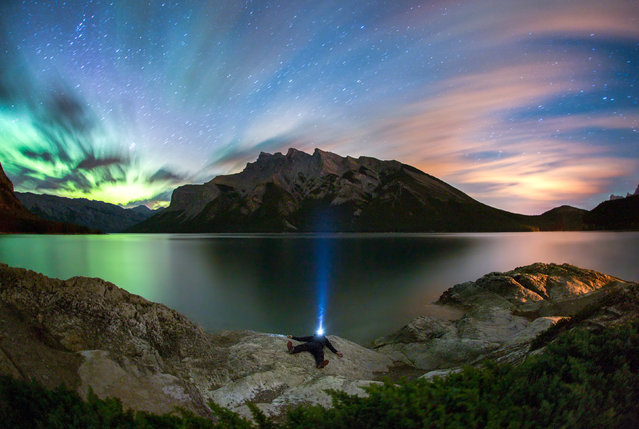
A photographer has shot this series of scenic selfies – scaling freezing mountain tops to snap himself in front of stunning scenery. Paul Zizkas breath-taking work features himself in front of beautiful backdrops such as shimmering lakes, snowy mountains and vibrant auroras. He has travelled to a number of different locations worldwide including Canada, New Zealand, Niue the South Pacific and French Polynesia. (Photo by Paul Zizkas/Caters News)

A photographer has shot this series of scenic selfies – scaling freezing mountain tops to snap himself in front of stunning scenery. Paul Zizkas breath-taking work features himself in front of beautiful backdrops such as shimmering lakes, snowy mountains and vibrant auroras. He has travelled to a number of different locations worldwide including Canada, New Zealand, Niue the South Pacific and French Polynesia. Explorer Paul, from Banff, Alberta, Canada, saw his selfies go viral early in 2014 – and has now unveiled his latest work. He said: I find that sometimes including a person in a landscape scene adds to the photograph – that it conveys a different story. Here: lake Minnewanka, Banff National Park, Alberta, Canada. (Photo by Paul Zizkas/Caters News)
Details
14 Dec 2014 12:18:00
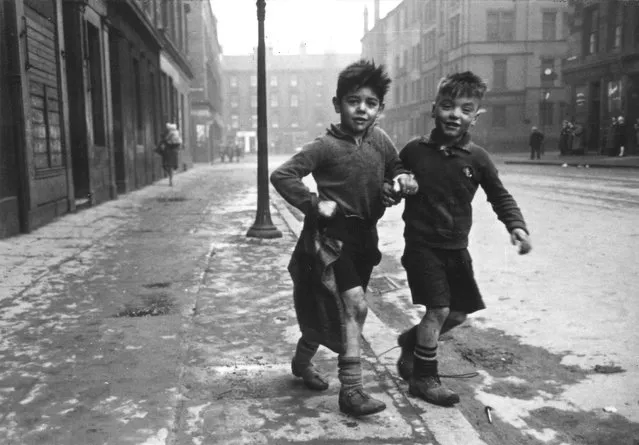
Two boys in the Gorbals area of Glasgow, UK on January 31, 1948. The Gorbals tenements were built quickly and cheaply in the 1840s, providing housing for Glasgow's burgeoning population of industrial workers. Conditions were appalling; overcrowding was standard and sewage and water facilities inadequate. The tenements housed about 40,000 people with up to eight family members sharing a single room, 30 residents sharing a toilet and 40 sharing a tap. By the time this photograph was taken 850 tenements had been demolished since 1920. Redevelopment of the area began in the late 1950s and the tenements were replaced with a modern tower block complex in the sixties. (Photo by Bert Hardy/Getty Images)

Two boys in the Gorbals area of Glasgow, UK on January 31, 1948. The Gorbals tenements were built quickly and cheaply in the 1840s, providing housing for Glasgow's burgeoning population of industrial workers. Conditions were appalling; overcrowding was standard and sewage and water facilities inadequate. The tenements housed about 40,000 people with up to eight family members sharing a single room, 30 residents sharing a toilet and 40 sharing a tap. By the time this photograph was taken 850 tenements had been demolished since 1920. Redevelopment of the area began in the late 1950s and the tenements were replaced with a modern tower block complex in the sixties. (Photo by Bert Hardy/Getty Images)
Details
09 Mar 2017 00:03:00
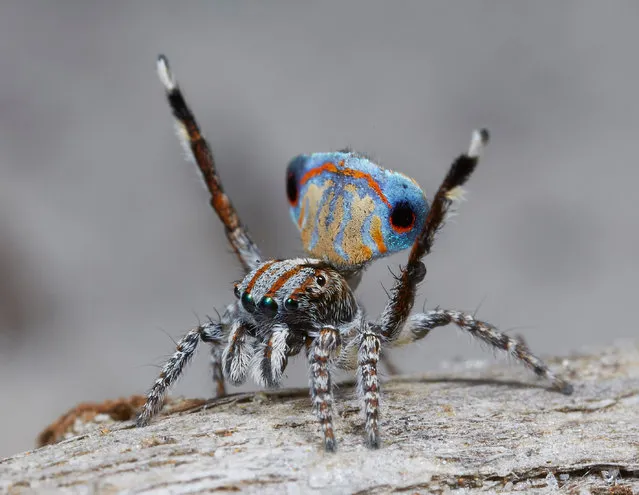
Several new species of peacock spider – just a few millimetres long and featuring extraordinary colours – have been discovered in Western Australia and South Australia. Jürgen Otto, a biologist from Sydney, has been researching the arachnids since 2005, and has gained a significant following online with his footage. He believes there are now 48 confirmed species of peacock spider within the Maratus genus, found across Australia but particularly in Western Australia – and many more awaiting confirmation. Here: Maratus Tasmanicus, one of seven new species of peacock spiders studied by the Sydney biologist Jürgen Otto. (Photo by Jürgen Otto)

Several new species of peacock spider – just a few millimetres long and featuring extraordinary colours – have been discovered in Western Australia and South Australia. Jürgen Otto, a biologist from Sydney, has been researching the arachnids since 2005, and has gained a significant following online with his footage. He believes there are now 48 confirmed species of peacock spider within the Maratus genus, found across Australia but particularly in Western Australia – and many more awaiting confirmation. Here: Maratus Tasmanicus, one of seven new species of peacock spiders studied by the Sydney biologist Jürgen Otto. (Photo by Jürgen Otto)
Details
30 May 2016 08:40:00
A woman looks across as a gay parade participant poses for pictures during Gay Pride parade in Madrid, Spain, Saturday, July 2, 2016. Hundreds of thousands of people defied high temperatures and relative security concerns and turned out in Madrid to march in Saturday's LGTB Pride parade, one of the biggest in Europe, along the streets of the Spanish capital, just three weeks after members of the gay, lesbian, bisexual and transgender community were tragically victimized in a shooting massacre at a United States nightclub. (Photo by Daniel Ochoa de Olza/AP Photo)

A woman looks across as a gay parade participant poses for pictures during Gay Pride parade in Madrid, Spain, Saturday, July 2, 2016. Hundreds of thousands of people defied high temperatures and relative security concerns and turned out in Madrid to march in Saturday's LGTB Pride parade, one of the biggest in Europe, along the streets of the Spanish capital, just three weeks after members of the gay, lesbian, bisexual and transgender community were tragically victimized in a shooting massacre at a United States nightclub. (Photo by Daniel Ochoa de Olza/AP Photo)
Details
03 Jul 2016 11:20:00
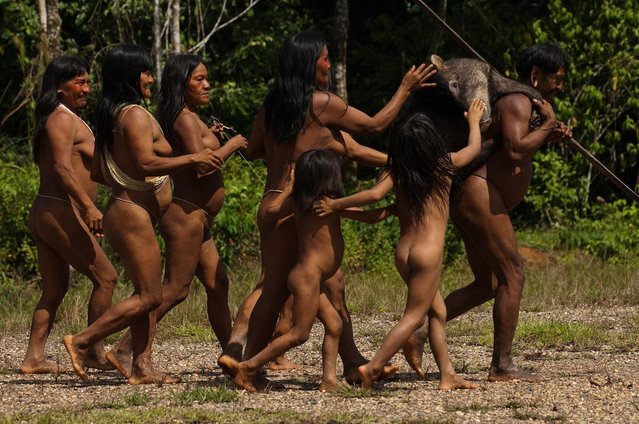
Spectacular images offering insight into the lives of the Huaorani people in the Ecuadorian Amazon have been revealed showing how they use traditional methods to hunt monkeys for food. The stunning pictures were taken by conservation photographer Pete Oxford from Torquay, Devon in the Ecuadorian Amazon. “The Huaorani Indians are a forest people highly in tune with their environment. Many are now totally acculturated since the 1950s by missionaries”, said Pete. “Today they face radical change to their culture to the proximity of oil exploration within their territory and the Yasuni National Park and Biosphere Reserve, they are vastly changed. Some still live very traditionally and for this shoot, through my Huaorani friend, a direct relative of those photographed he wanted to depict them as close to their original culture as possible. They still largely hunt with blow pipes and spears eating a lot of monkeys and peccaries”. The Huaorani are also known as the Waorani, Waodani or the Waos and are native Amerindians. Their lands are located between the Curaray and Napo rivers and speak the Huaorani language. Pete says that during his visit he was welcomed into the group and hopes that ancient cultures can be saved. Here: The tribe were seen celebrating after a hunter returned to camp with a wild pig. (Photo by Pete Oxford/Mediadrumworld.com)

Spectacular images offering insight into the lives of the Huaorani people in the Ecuadorian Amazon have been revealed showing how they use traditional methods to hunt monkeys for food. The stunning pictures were taken by conservation photographer Pete Oxford from Torquay, Devon in the Ecuadorian Amazon. Here: The tribe were seen celebrating after a hunter returned to camp with a wild pig. (Photo by Pete Oxford/Mediadrumworld.com)
Details
20 Jan 2017 07:58:00