Loading...
Done
Migrants, part of a caravan traveling en route to the United States, carry an anteater that was hit by a car, according to them, as they walk on the road that links Arriaga and Tapanatepec, near Arriaga, Mexico, November 5, 2018. (Photo by Carlos Garcia Rawlins/Reuters)

Migrants, part of a caravan traveling en route to the United States, carry an anteater that was hit by a car, according to them, as they walk on the road that links Arriaga and Tapanatepec, near Arriaga, Mexico, November 5, 2018. (Photo by Carlos Garcia Rawlins/Reuters)
Details
17 Nov 2019 00:03:00
A worker covers mounds of rice with a giant hat-shaped bamboo cone in a field in Brahmanbaria, Bangladesh on September 21, 2023 after they have been dried in the scoring sun. (Photo by Joy Saha/Rex Features/Shutterstock)

A worker covers mounds of rice with a giant hat-shaped bamboo cone in a field in Brahmanbaria, Bangladesh on September 21, 2023 after they have been dried in the scoring sun. (Photo by Joy Saha/Rex Features/Shutterstock)
Details
11 Oct 2023 04:17:00
Tourists visit the water forest by boat at a wetland park in Yangzhou City, east China's Jiangsu Province, 30 July, 2023. (Photo by Meng Delong/ImagineChina/Imaginechina via AFP Photo)

Tourists visit the water forest by boat at a wetland park in Yangzhou City, east China's Jiangsu Province, 30 July, 2023. (Photo by Meng Delong/ImagineChina/Imaginechina via AFP Photo)
Details
02 Nov 2023 05:18:00
People look at damaged trees after a tornado hit Funing on Thursday, in Yancheng, Jiangsu province, China June 24, 2016. (Photo by Aly Song/Reuters)

People look at damaged trees after a tornado hit Funing on Thursday, in Yancheng, Jiangsu province, China June 24, 2016. (Photo by Aly Song/Reuters)
Details
25 Jun 2016 11:48:00
A mudlark uses a torch to look for items on the bank of the River Thames in London, Britain June 06, 2016. Mudlarking is believed to trace its origins to the 18th and 19th century, when scavengers searched the Thames' shores for items to sell. These days, history and archaeology fans are the ones hoping to find old relics such as coins, ceramics, artifacts or everyday items from across centuries. They wait for the low tide and then scour specific areas of exposed shores. "If you're in a field you could be out all day long, with the river you're restricted to about two or three hours," mudlark Nick Stevens said. While many just use the naked eye for their searches, others rely on metal detectors for which a permit from the Port of London Authority is needed. Digging also requires consent. (Photo by Neil Hall/Reuters)

A mudlark uses a torch to look for items on the bank of the River Thames in London, Britain June 06, 2016. Mudlarking is believed to trace its origins to the 18th and 19th century, when scavengers searched the Thames' shores for items to sell. These days, history and archaeology fans are the ones hoping to find old relics such as coins, ceramics, artifacts or everyday items from across centuries. their finds with the Portable Antiquities Scheme. Any item over 300 years old must be recorded. (Photo by Neil Hall/Reuters)
Details
27 Aug 2016 10:43:00
A production department of a textile factory is seen abandoned in Kaduna, Nigeria November 3, 2016. (Photo by Afolabi Sotunde/Reuters)

A production department of a textile factory is seen abandoned in Kaduna, Nigeria November 3, 2016. President Muhammadu Buhari hopes to revive the once flourishing textile and leather industries in northern Nigeria to end the country's dependence on oil exports and diversify Africa's biggest economy. (Photo by Afolabi Sotunde/Reuters)
Details
17 Feb 2017 00:01:00
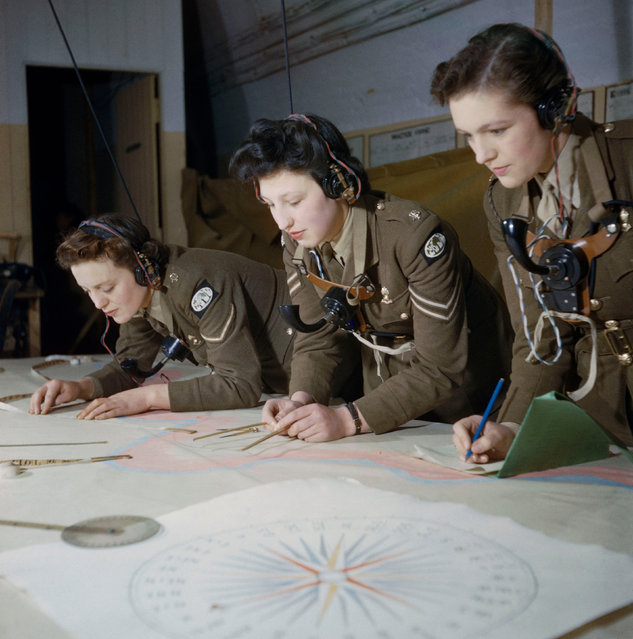
Auxiliary Territorial Service (ATS) plotters at work at Coastal Artillery Headquarters in Dover, December 1942. (Photo by Ted Dearberg/IWM/PA Wire)

Auxiliary Territorial Service (ATS) plotters at work at Coastal Artillery Headquarters in Dover, December 1942. The Auxiliary Territorial Service was the women's branch of the British Army during the Second World War. It was formed on 9 September 1938, initially as a women's voluntary service, and existed until 1 February 1949, when it was merged into the Women's Royal Army Corps. The ATS had its roots in the Women's Auxiliary Army Corps (WAAC), which was formed in 1917 as a voluntary service. During the First World War its members served in a number of jobs including clerks, cooks, telephonists and waitresses. The WAAC was disbanded after four years in 1921. (Photo by Ted Dearberg/IWM/PA Wire)
Details
13 Jul 2017 07:52:00
A woman photographs a Norwegian spruce Christmas tree from Oslo after it was lit at Trafalgar Square in central London, December 4, 2014. (Photo by Toby Melville/Reuters)

A woman photographs a Norwegian spruce Christmas tree from Oslo after it was lit at Trafalgar Square in central London, December 4, 2014. (Photo by Toby Melville/Reuters)
Details
16 Dec 2014 12:34:00