Loading...
Done
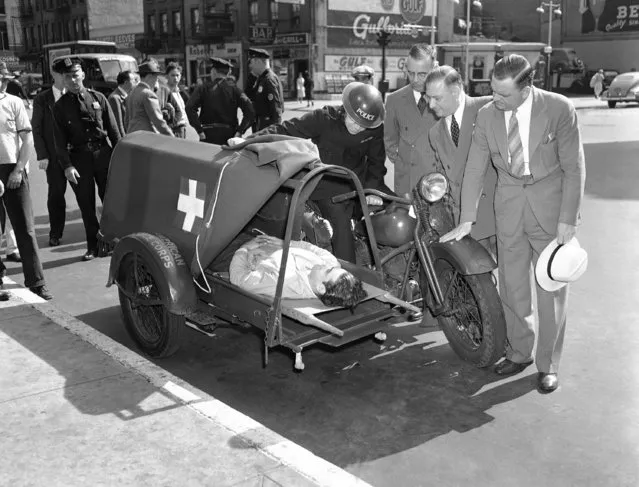
Developed for the British American Ambulance Corps, this new motorcycle ambulance is capable of speeding wounded soldiers 90 miles an hour from the front lines to field hospitals. Its springs are synchronized with the patient?s heartbeat to avoid increasing fever when traveling over various Terrain. Viewing it in New York  August 27, 1941, are left to right: constable Herbert Scott of England, driver; William E. Detlor, whose firm developed the vehicle; M. W. Stand, inspector-general of Civilian Defense, and Maj. Edward Riekert, also. (Photo by AP Photo)

Developed for the British American Ambulance Corps, this new motorcycle ambulance is capable of speeding wounded soldiers 90 miles an hour from the front lines to field hospitals. Its springs are synchronized with the patient's heartbeat to avoid increasing fever when traveling over various Terrain. Viewing it in New York August 27, 1941, are left to right: constable Herbert Scott of England, driver; William E. Detlor, whose firm developed the vehicle; M. W. Stand, inspector-general of Civilian Defense, and Maj. Edward Riekert, also. (Photo by AP Photo)
Details
28 Aug 2015 11:51:00
Women porters load bundles onto their back for transport across the El Tarajal boarder separating Morocco and Spain's North African enclave of Ceuta, in Ceuta on December 4, 2014. Unemployment among Ceuta and Melilla's native workforce is more than 30 percent – among the highest rates in Spain. Meanwhile, authorities say some 30,000 Moroccan traders and menial workers cross into each territory every day. (Photo by Jorge Guerrero/AFP Photo)

Women porters load bundles onto their back for transport across the El Tarajal boarder separating Morocco and Spain's North African enclave of Ceuta, in Ceuta on December 4, 2014. Unemployment among Ceuta and Melilla's native workforce is more than 30 percent – among the highest rates in Spain. Meanwhile, authorities say some 30,000 Moroccan traders and menial workers cross into each territory every day. (Photo by Jorge Guerrero/AFP Photo)
Details
29 Dec 2014 13:36:00
The moon is seen in its waxing gibbous stage as it rises behind the helicopter from the original Batman television show, which people can ride at the New Jersey State Fair, Saturday, June 22, 2013, in East Rutherford, N.J. The moon, which will reach its full stage on Sunday, is expected to be 13.5 percent closer to earth during a phenomenon known as supermoon. (Photo by Julio Cortez/AP Photo)

The moon is seen in its waxing gibbous stage as it rises behind the helicopter from the original Batman television show, which people can ride at the New Jersey State Fair, Saturday, June 22, 2013, in East Rutherford, N.J. The moon, which will reach its full stage on Sunday, is expected to be 13.5 percent closer to earth during a phenomenon known as supermoon. (Photo by Julio Cortez/AP Photo)
Details
24 Jun 2013 12:17:00
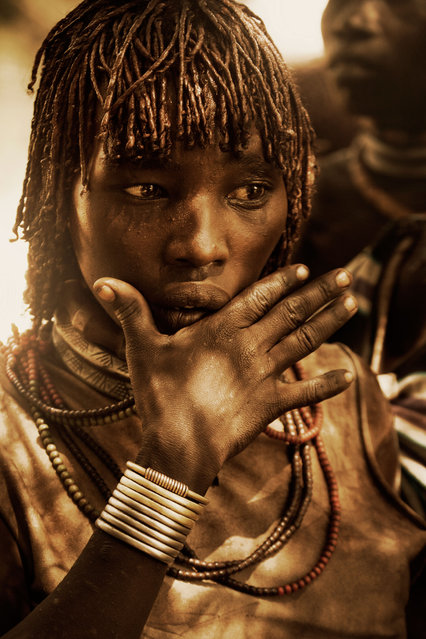
The Hamar people traditionally use red ocher clay to braid the hair of their women. (Photo by Diego Arroyo)

During his time in Ethiopia, New York-based art director and photographer Diego Arroyo spent time with the Hamar, Mursi, Dassanech, and Arbore Tribes. They, along with several others tribes, make up the 200,000 people situated in Africa’s Great Rift Valley. The people of the Omo Valley are still primarily herders and farmers, living an isolated and simple life. While they have yet to be truly touched by globalization, they could soon disappear. Their way of life is being threatened by a massive hydroelectric dam. (Photo by Diego Arroyo)
Details
13 Aug 2014 10:00:00
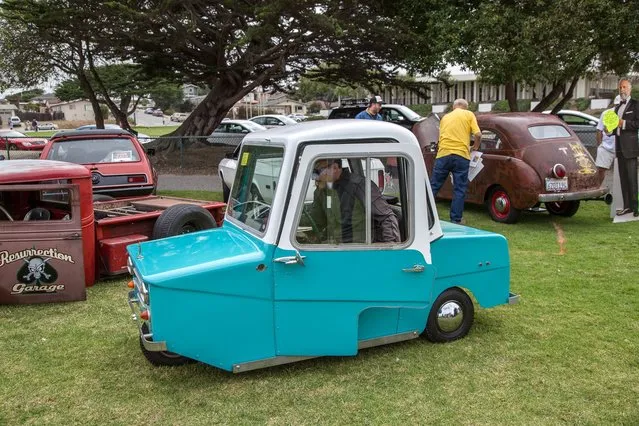
The 1973 Electra-King three-wheeler, the dead evolutionary branch of today's electric cars. (Photo by Robert Kerian/Yahoo Autos)

Far from the fancy throngs who gather at the Pebble Beach Concours d'Elegance every year, another collection of car enthusiasts strive to cough up the worst cars imaginable. The Concours d'Lemons gathers the Edsels, Yugos and Azteks of yesteryear to give the freaky and foul their day in the sun. Photo: The 1973 Electra-King three-wheeler, the dead evolutionary branch of today's electric cars. (Photo by Robert Kerian/Yahoo Autos)
Details
25 Aug 2014 10:41:00
In this October 14, 2013 photo, ecology professor Ricardo Freitas catches a broad-snouted caiman to examine, then release back into the water channel in the affluent Recreio dos Bandeirantes suburb of Rio de Janeiro, Brazil. (Photo by Felipe Dana/AP Photo)

In this October 14, 2013 photo, ecology professor Ricardo Freitas catches a broad-snouted caiman to examine, then release back into the water channel in the affluent Recreio dos Bandeirantes suburb of Rio de Janeiro, Brazil. Caimans are like tanks, a very old species with a remarkable capacity for renovation that allows them to survive under extreme conditions where others couldn't, said Freitas, who runs the Instituto Jacare, or the Caiman Institute, which aims to protect the reptiles. (Photo by Felipe Dana/AP Photo)
Details
18 Oct 2013 09:05:00
This piano was located in one of many rooms of a huge chateau in Poland. (Photo by Vincent Jansen)

Photographer Vincent Jansen travels throughout Europe, visiting beautiful abandoned places. He explores churches, factories, sanatoriums, mortuaries, villas and theaters, all quietly waiting for renovation or demolition. His photos show a unique perspective on what is happening behind the “no trespassing” signs: where nature is slowly gaining ground and the desolation, loneliness and decay leave their stunning traces. Photo: This piano was located in one of many rooms of a huge chateau in Poland. (Photo by Vincent Jansen)
Details
11 May 2014 12:10:00
A woman jumps over a puddle as she crosses a street after a torrential downpour in the South Beach part of Miami, July 18, 2014. (Photo by Carlo Allegri/Reuters)

A woman jumps over a puddle as she crosses a street after a torrential downpour in the South Beach part of Miami, July 18, 2014. (Photo by Carlo Allegri/Reuters)
Details
19 Jul 2014 11:15:00