Loading...
Done
Kenyan women protest for the right to wear whichever clothes they want, at a demonstration in downtown Nairobi, Kenya Monday, November 17, 2014. (Photo by Ben Curtis/AP Photo)

Kenyan women protest for the right to wear whichever clothes they want, at a demonstration in downtown Nairobi, Kenya Monday, November 17, 2014. A recent incident in which a mob of men surrounded a woman and tore her clothes off, leaving her naked on the street in front of a bus stop after alleging that she was improperly dressed, is one of several such videos that have surfaced online in recent days leading to a groundswell of anger that on Monday prompted around 1000 demonstrators, including a number of men supporting the women's cause, to march through the capital and protest online using the hashtag #MyDressMyChoice. (Photo by Ben Curtis/AP Photo)
Details
18 Nov 2014 11:50:00
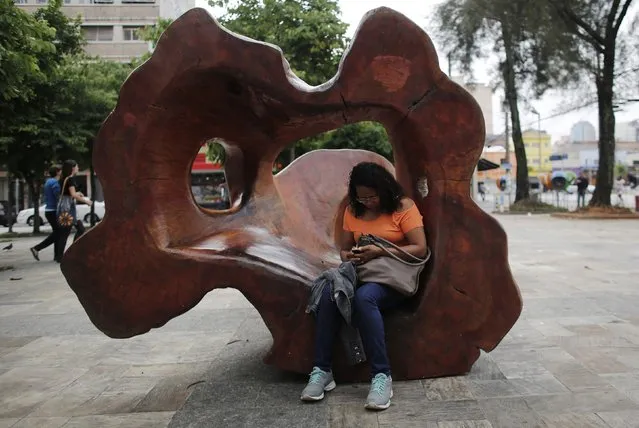
A resident types a text message on her mobile phone, as she sits on a bench made from a tree, which is a creation by Brazilian artist Hugo Franca at Largo da Batata square in Sao Paulo March 17, 2015. (Photo by Nacho Doce/Reuters)

A resident types a text message on her mobile phone, as she sits on a bench made from a tree, which is a creation by Brazilian artist Hugo Franca at Largo da Batata square in Sao Paulo March 17, 2015. Franca, a designer from Sao Paulo is working with the city to make use of fallen trees to turn them into sculpture furniture to line the city's parks, streets and plazas. Brazil's largest city was slammed by several strong storms this rainy season that brought with them heavy rain, lightning and winds as high as 90 kilometres (55 miles) per hour. (Photo by Nacho Doce/Reuters)
Details
20 Mar 2015 11:34:00
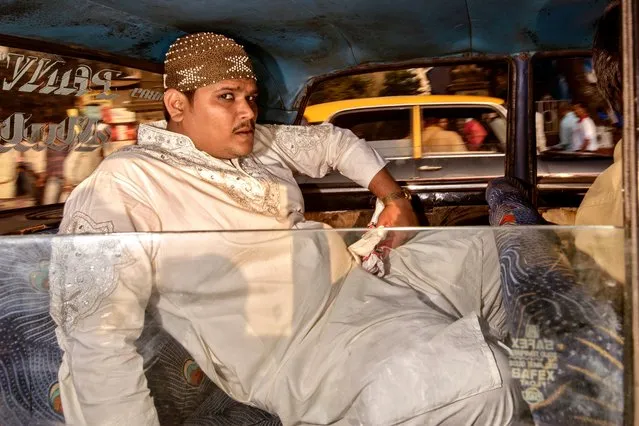
“I’m not scared of breaking the fourth wall”, Wallace has said of the photos where the subject is clearly aware of him taking the shot. “If they are looking at you in a photograph most photographers will think, oh, that’s not a good image. (But) people like to be involved and in the picture. You can see what they are thinking, see them talking”. (Photo by Dougie Wallace/The Guardian)

In Dougie Wallace’s photos of Mumbai taxis, the chatter, yelling, and constant horns of the city are almost audible. A selection of his images is on show at Gayfield Creative Spaces, Edinburgh, as part of the Retina photography festival until 30 July. For four years, the Glasgow-born Wallace focused his photos on one kind of taxi in particular: the Premier Padmini, a 1960s workhorse painted in black and yellow. Locally known as “Kaali-Peeli”, there were once more than 60,000 of them in the Indian city. But thanks to laws restricting pollution, the cars now are fast disappearing from Mumbai’s streets. (Photo by Dougie Wallace/The Guardian)
Details
13 Jul 2016 13:50:00
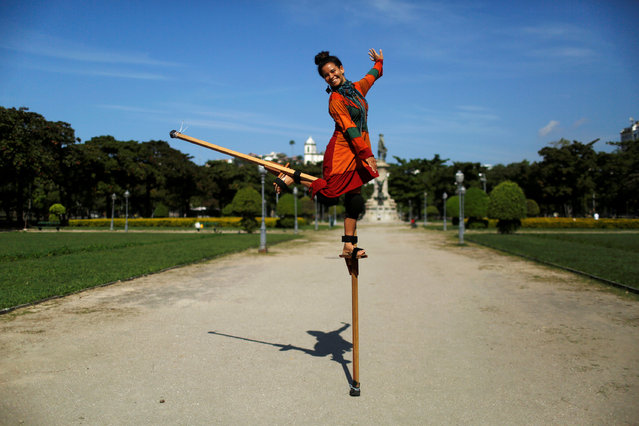
Raquel Poti, a 32-year-old street artist, poses at a park in Rio de Janeiro, Brazil, June 25, 2016. Raquel thinks the Olympics promotes a lifestyle that combines sports, culture and education. She is concerned about the large investment for the event while the population needs improvements in basic services. (Photo by Pilar Olivares/Reuters)

Just a week before Rio de Janeiro hosts South America's first Olympics, city residents expressed mixed feelings about the cost and security of the Games, while holding out hope they will bring joy to a nation facing economic and political crises. The conflicted thoughts mirror a recent survey by the Datafolha polling group showing that half of Brazilians were opposed to holding the Games, while 63 percent think the costs of hosting the event will outweigh benefits. (Photo by Pilar Olivares/Reuters)
Details
03 Aug 2016 11:51:00
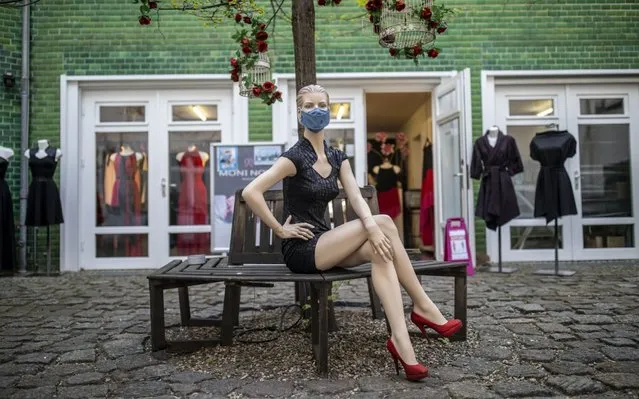
A store mannequin with a protective mask stands before a clothes store as they open for the first time since March during the novel coronavirus (COVID-19) pandemic on April 22, 2020 in Berlin, Germany. Small to midsized-shops are opening across Germany this week as state authorities follow a recommendation by the federal government to ease restrictions imposed in March meant to slow the spread of the coronavirus. Some schools are also planning to reopen soon, as are museums and hair salons in coming weeks. (Photo by Maja Hitij/Getty Images)

A store mannequin with a protective mask stands before a clothes store as they open for the first time since March during the novel coronavirus (COVID-19) pandemic on April 22, 2020 in Berlin, Germany. Small to midsized-shops are opening across Germany this week as state authorities follow a recommendation by the federal government to ease restrictions imposed in March meant to slow the spread of the coronavirus. Some schools are also planning to reopen soon, as are museums and hair salons in coming weeks. (Photo by Maja Hitij/Getty Images)
Details
08 Jan 2021 00:05:00
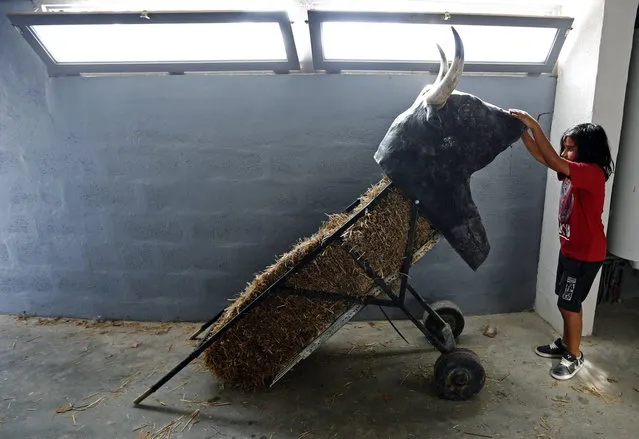
Nino, a ten-year-old toreador apprentice of the French Tauromachy Centre, nicknamed El Nino, touches a practice bull at the bullring of Garons, near Nimes, September 25, 2013. (Photo by Jean-Paul Pelissier/Reuters)

Nino, a ten-year-old toreador apprentice of the French Tauromachy Centre, nicknamed El Nino, touches a practice bull at the bullring of Garons, near Nimes, September 25, 2013. Since 1983, the French Tauromachy Centre in Nimes has trained some 1,000 youths in the art of bullfighting. Twenty of them have gone on to become professional matadors, facing fighting bulls in the arena. Twice a week, students take courses with a matador to learn the movements and gestures of the bullfighter in the ring, but without an animal present. Students train with calves in the surrounding fields during spring, and regularly participate in beginner's bullfights (becerradas) without killing calves. Solal has been taking courses for three years and Nino, for just a year now. Both are normally enrolled in French public schools, but have one thought in mind – bullfighting. They share a passion linked to the city of Nimes, famous for its ferias and bullring. (Photo by Jean-Paul Pelissier/Reuters)
Details
06 Nov 2013 10:12:00
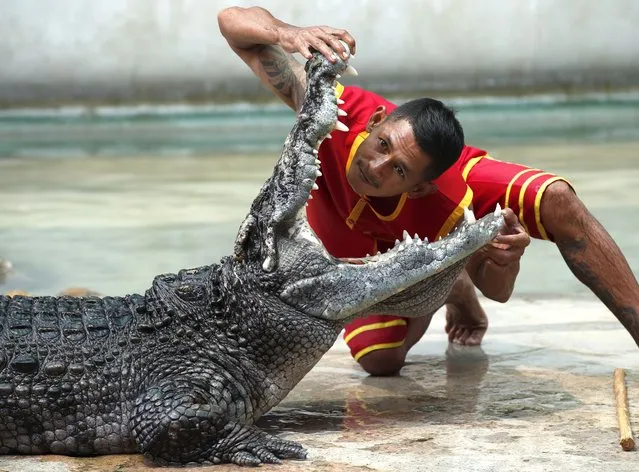
A Thai performer puts his head inside a crocodile's mouth during a media preview performance as part of preparation to reopen Samutprakarn Crocodile Farm and Zoo in Samut Prakan province, Thailand, 19 March 2024. Thailand's famous tourist attraction Samutprakan Crocodile Farm and Zoo is scheduled to reopen to welcome tourists on 01 April 2024 after a temporary closure in 2020 due to the loss of visitors caused by the COVID-19 pandemic which resulted in the zoo suffering financial loss and going into liquidation. The Samutprakan Crocodile Farm and Zoo established in 1950 claims to be Thailand's first and the world's largest crocodile farm with more than 60,000 freshwater and marine crocodiles offering crocodile shows to attract tourists as well as housing various other animal showcases including tigers, chimpanzees, elephants. (Photo by Rungroj Yongrit/EPA)

A Thai performer puts his head inside a crocodile's mouth during a media preview performance as part of preparation to reopen Samutprakarn Crocodile Farm and Zoo in Samut Prakan province, Thailand, 19 March 2024. (Photo by Rungroj Yongrit/EPA)
Details
06 Apr 2024 04:17:00
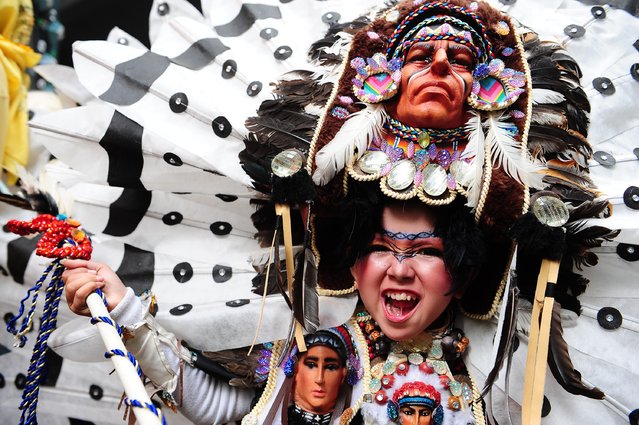
A model wears an Apache costume in the kids carnival during The 13th Jember Fashion Carnival 2014 on August 21, 2014 in Jember, Indonesia. (Photo by Robertus Pudyanto/Getty Images)

A model wears an Apache costume in the kids carnival during The 13th Jember Fashion Carnival 2014 on August 21, 2014 in Jember, Indonesia. The 13th Jember Fashion Carnival (JFC) 2014 theme is “Triangle, Dynamic in Harmony” and consists of ten parades which include Mahabharata, Tambora, Phoenix, Pine Forest, Apache, Borobudur, Flying Kite, Wild Deers, Stalagmite, and Chemistry. This street carnival is claimed to be one of the biggest in the world and comprises more than 850 performers parading along 3.6 km road used as the catwalk. (Photo by Robertus Pudyanto/Getty Images)
Details
24 Aug 2014 09:09:00