Loading...
Done
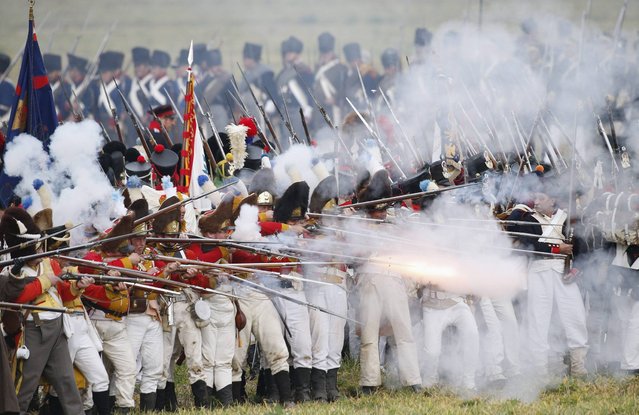
Performers wearing 19th century French military uniforms fire their weapons as they attack Allied forces during a reenactment of the Battle of the Nations, in a field in the village of Markkleeberg near Leipzig October 20, 2013. (Photo by Fabrizio Bensch/Reuters)

Performers wearing 19th century French military uniforms fire their weapons as they attack Allied forces during a reenactment of the Battle of the Nations, in a field in the village of Markkleeberg near Leipzig October 20, 2013. The east German city of Leipzig commemorated the 200th anniversary of the largest battle of the Napoleonic Wars on Sunday by reenacting the Battle of the Nations, with 6,000 military-historic association enthusiasts from all over Europe. The decisive encounter in which tens of thousands of soldiers were killed, took place from October 17-19, 1813, just outside of Leipzig. At the height of the hostilities Napoleon fielded more than 200,000 men against an Allied force of some 360,000 soldiers which included troops from Russia, Austria, Prussia and Sweden. (Photo by Fabrizio Bensch/Reuters)
Details
21 Oct 2013 11:19:00
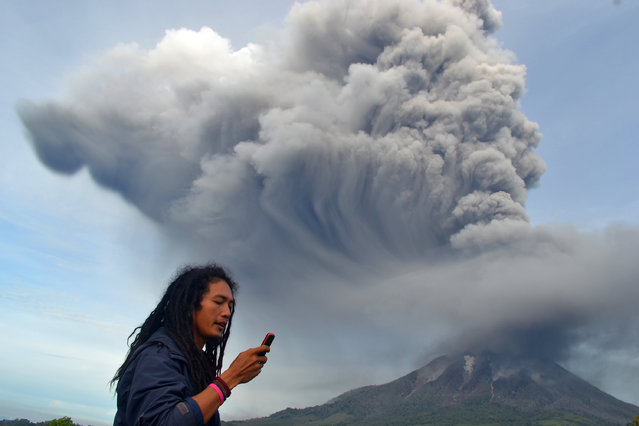
A man uses his mobile phone as Mount Sinabung continues to erupt, with hot smoke spewing from the volcano, in the Karo district on the north of Indonesia's Sumatra island on November 18, 2013. Officials said a week ago at more than 5,000 people had fled their homes since the volcano erupted early this month. (Photo by Sutanta Aditya/AFP Photo)

Starting in September, Indonesia's Mount Sinabung began erupting yet again. In the days that followed, ash and smoke were shot into the air multiple times. As a result, nearby towns turned gray from repeated blows by the volcano. Photo: A man uses his mobile phone as Mount Sinabung continues to erupt, with hot smoke spewing from the volcano, in the Karo district on the north of Indonesia's Sumatra island on November 18, 2013. Officials said a week ago at more than 5,000 people had fled their homes since the volcano erupted early this month. (Photo by Sutanta Aditya/AFP Photo)
Details
22 Nov 2013 08:08:00
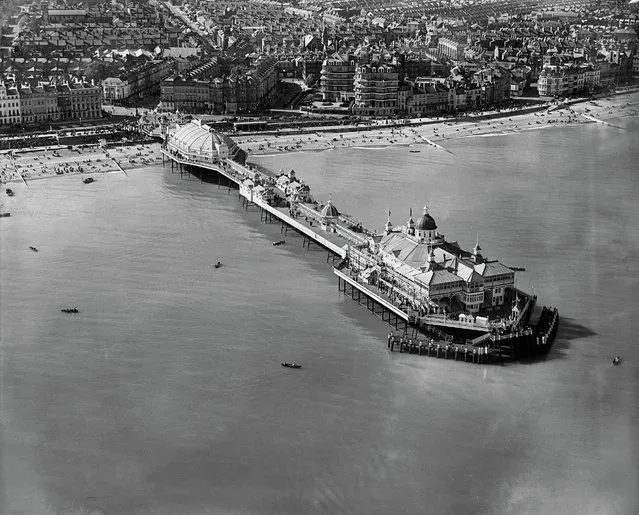
While the lido was described as bringing “modernism to the masses” on the British coast it was just the latest example of a trend that had been developing since Victorian times – transforming seaside towns into resorts for leisure and entertainment. In the latter half of the nineteenth century, the fashion was for local authorities to build great piers stretching from the promenade out into the sea

While the lido was described as bringing “modernism to the masses” on the British coast it was just the latest example of a trend that had been developing since Victorian times – transforming seaside towns into resorts for leisure and entertainment. In the latter half of the nineteenth century, the fashion was for local authorities to build great piers stretching from the promenade out into the sea. The Eastbourne Pier, pictured here in May 1931, was erected between 1866 and 1870 to an ingenious design by Eugenius Birch, which saw the structure sitting on special cups allowing the supporting struts to “move” in bad weather. Arranged on the pier's 1,000-foot length were kiosks, a theatre, a ballroom and a camera obscura. 1931. (Photo by Aerofilms Collection via “A History of Britain From Above”)
Details
25 Feb 2014 12:59:00
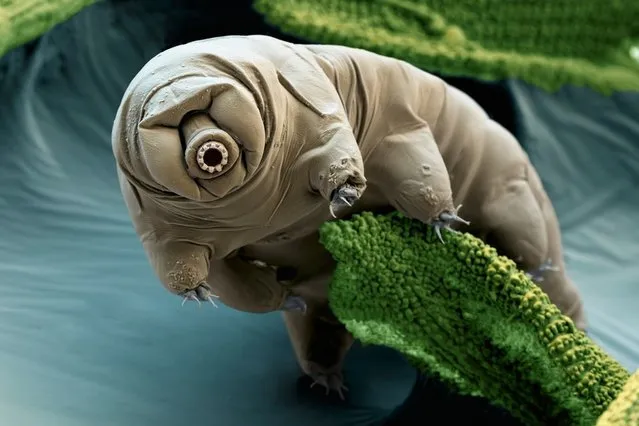
Tardigrades (commonly known as waterbears or moss piglets). (Photo by SPL/East News)

“Tardigrades (commonly known as waterbears or moss piglets) are small, water-dwelling, segmented animals with eight legs. Tardigrades were first discovered in 1773 by Johann August Ephraim Goeze, who called them kleiner Wasserbär, meaning “little water bear” in German. The name Tardigrada means “slow walker” and was given by Lazzaro Spallanzani in 1777. The name water bear comes from the way they walk, reminiscent of a bear's gait. The biggest adults may reach a body length of 1.5 millimetres (0.059 in), the smallest below 0.1 mm. Freshly hatched tardigrades may be smaller than 0.05 mm”. – Wikipedia. Photo: Tardigrades. (Photo by SPL/East News)
Details
26 Sep 2012 09:55:00
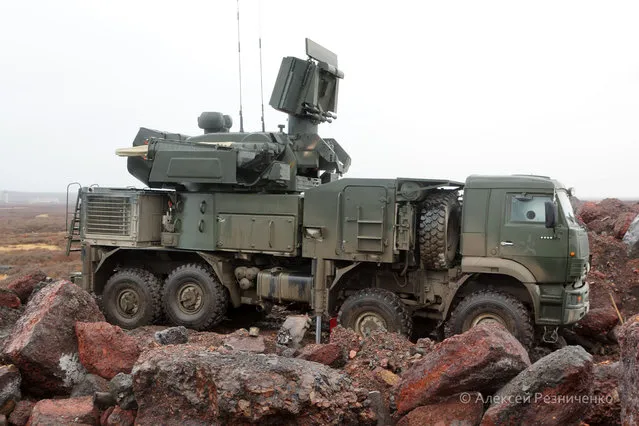
Test of the surface-to-air missile Pantsir-S rocket and gun system

“Pantsir-S1 (NATO reporting name SA-22 Greyhound) is a combined short to medium range surface-to-air missile and anti-aircraft artillery weapon system produced by KBP of Tula, Russia. The system is a further development of SA-19/SA-N-11 and represents the latest air defence technology by using phased-array radars for both target acquisition and tracking”. – Wikipedia

Photo: Test of the surface-to-air missile Pantsir-S rocket and gun system in the conditions of the Polar region on the range “Pemba” near Vorkuta, approximately on October 20 2012. According to the statement of military, during doctrines five cruise missiles from five were destroyed. (Photo by Alexey Reznichenko)

Details
28 Oct 2012 11:27:00


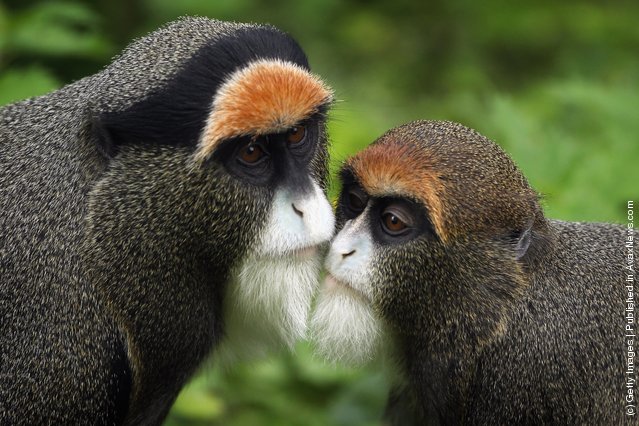
Two De Brazza's monkeys stand together at Port Lympne Wild Animal Park on June 21, 2011 in Hythe, England. Port Lympne has welcomed a host of new arrivals this year with wildebeest, colobus monkeys, gorillas and rhinos all adding to the current stock. Port Lympne and Howletts Wild Animal parks were set up by the late John Aspinall to protect and breed rare and endangered species and, where possible, return them to safe areas in the wild. The Aspinall Foundation which runs the parks also manages two gorilla rescue and rehabilitation projects in the central African countries of Gabon and Congo where they have successfully reintroduced over 50 gorillas to the wild. (Photo by Dan Kitwood/Getty Images)
Details
24 Jun 2011 10:12:00
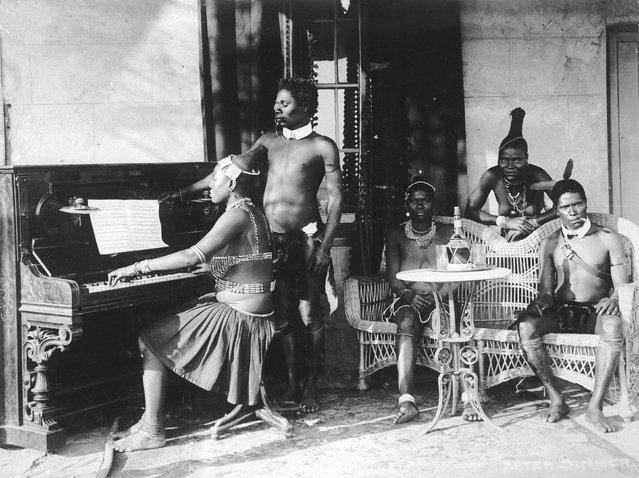
circa 1925:  A Zulu woman playing the piano while a group of others sit and listen.  (Photo by General Photographic Agency/Getty Images)

“The Zulu are the largest South African ethnic group, with an estimated 10–11 million people living mainly in the province of KwaZulu-Natal. Small numbers also live in Zimbabwe, Zambia, and Mozambique. Their language, Zulu, is a Bantu language; more specifically, part of the Nguni subgroup. The Zulu Kingdom played a major role in South African history during the 19th and 20th centuries. Under apartheid, Zulu people were classed as third-class citizens and suffered from state-sanctioned discrimination. They remain today the most numerous ethnic group in South Africa, and now have equal rights along with all other citizens”. – Wikipedia.

Photo: A Zulu woman playing the piano while a group of others sit and listen (to put it briefly, Englishmen scoff over Zulu). South Africa, circa 1925. (Photo by General Photographic Agency)

Details
03 Feb 2014 09:40:00
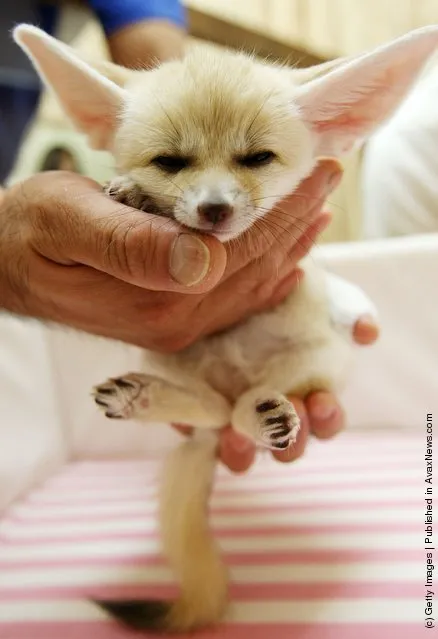
Baby Fennec Fox

“The fennec fox is a small nocturnal fox found in the Sahara of North Africa. Its most distinctive feature is unusually large ears. The name “fennec” comes from the Arabic word for fox, and the species name zerda has a Greek origin that refers to its habitat. The fennec is the smallest species of canid in the world; coat, ears and kidney functions have adapted to a high-temperature, low-water, desert environment. In addition, its hearing is sensitive enough to hear prey moving underground”. – Wikipedia

Photo: A Baby Fennec is seen at Sunshine International Aquarium on June 24, 2009 in Tokyo, Japan. The small nocturnal fox babies were born on May 17 2009. (Photo by Junko Kimura/Getty Images)
Details
16 Sep 2011 12:02:00