Loading...
Done
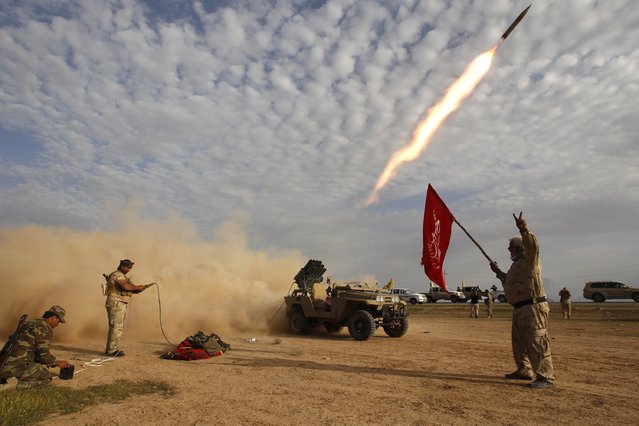
Shi'ite fighters launch a rocket during clashes with Islamic State militants on the outskirts of al-Alam March 8, 2015. Thaier Al-Sudani: “It was me and a few other Iraqi journalists working for local outlets. (Photo by Thaier Al-Sudani/Reuters)

Shi'ite fighters launch a rocket during clashes with Islamic State militants on the outskirts of al-Alam March 8, 2015. Thaier Al-Sudani: “It was me and a few other Iraqi journalists working for local outlets. We went to the frontlines in coordination with the Iraqi government forces and supporting militias. The press officer would come in the morning and take us to the frontline in a convoy. Whenever an area was won from Islamic State, the fighters would chant and pray and show victory signs. Most of the areas we were in didn't have residents, so after the battle they would resemble ghost towns; nothing but burnt cars and charred bodies of Islamic State fighters. Al-Alam was an exception as it had some residents who chanted for the government forces after their victory”. (Photo by Thaier Al-Sudani/Reuters)
Details
14 Mar 2015 14:33:00
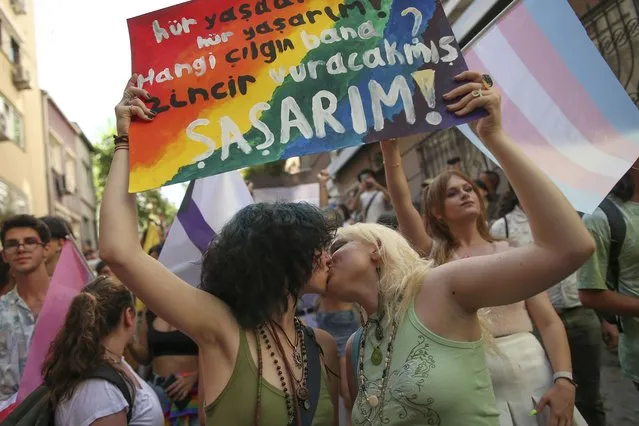
Two women kiss as they hold up a placard that reads in Turkish: “I live free. Who's the fool who will put me in chains? I would be shocked” during the LGBTQ Pride March in Istanbul, Turkey, Sunday, June 26, 2022. Dozens of people were detained in central Istanbul Sunday after city authorities banned a LGBTQ Pride March, organisers said. (Photo by Emrah Gurel/AP Photo)

Two women kiss as they hold up a placard that reads in Turkish: “I live free. Who's the fool who will put me in chains? I would be shocked” during the LGBTQ Pride March in Istanbul, Turkey, Sunday, June 26, 2022. Dozens of people were detained in central Istanbul Sunday after city authorities banned a LGBTQ Pride March, organisers said. (Photo by Emrah Gurel/AP Photo)
Details
27 Jun 2022 05:46:00
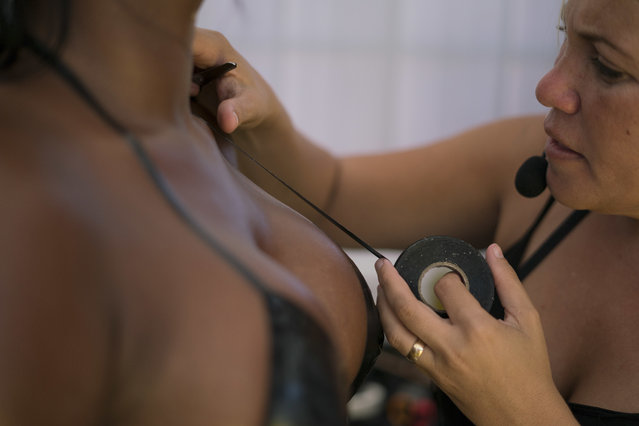
In this January 11, 2017 photo, Erika Martins uses black electrical tape to create a customer's bikini, in order to attain crisp tan lines, on her rooftop Erika Bronze salon in the suburb of Realengo in Rio de Janeiro, Brazil. Martins wears a microphone connected to an open speaker system in order to direct her assistants to clients who need more tanning lotion or a sprinkling of water on their skin. (Photo by Renata Brito/AP Photo)

In this January 11, 2017 photo, Erika Martins uses black electrical tape to create a customer's bikini, in order to attain crisp tan lines, on her rooftop Erika Bronze salon in the suburb of Realengo in Rio de Janeiro, Brazil. Martins wears a microphone connected to an open speaker system in order to direct her assistants to clients who need more tanning lotion or a sprinkling of water on their skin. (Photo by Renata Brito/AP Photo)
Details
25 Jan 2017 11:21:00
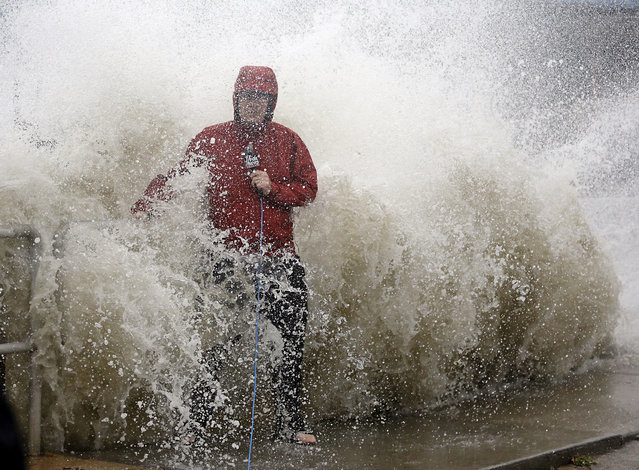
A news reporter doing a stand up near a sea wall in Cedar Key, Fla., is covered by an unexpected wave as Hurricane Hermine nears the Florida coast, Thursday, September 1, 2016. Hurricane Hermine gained new strength Thursday evening and roared ever closer to Florida's Gulf Coast, where rough surf began smashing against docks and boathouses and people braced for the first direct hit on the state from a hurricane in over a decade. (Photo by John Raoux/AP Photo)

A news reporter doing a stand up near a sea wall in Cedar Key, Fla., is covered by an unexpected wave as Hurricane Hermine nears the Florida coast, Thursday, September 1, 2016. Hurricane Hermine gained new strength Thursday evening and roared ever closer to Florida's Gulf Coast, where rough surf began smashing against docks and boathouses and people braced for the first direct hit on the state from a hurricane in over a decade. (Photo by John Raoux/AP Photo)
Details
02 Sep 2016 13:17:00
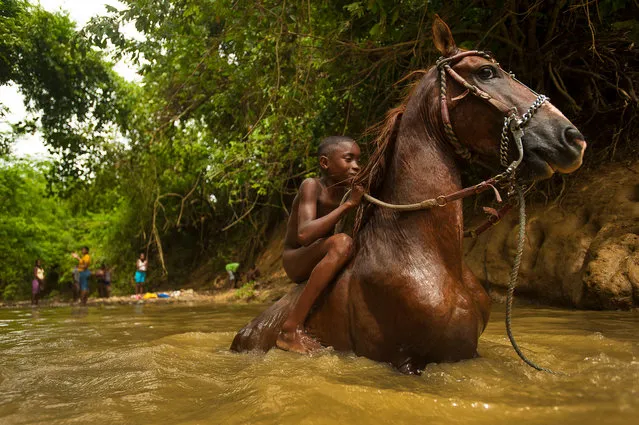
This image of a young bareback rider was taken in the village of Palenque de San Basilio, in Colombia’s Bolívar department. Founded by freed slaves in the 17th century, it became the first free town in the Americas, following a decree by the Spanish crown. Most of today’s inhabitants are direct descendants of those slaves and have preserved many of their customs, including their own language, Palenquero. (Photo by Sebastián Suki Beláustegui/The Guardian)

This image of a young bareback rider was taken in the village of Palenque de San Basilio, in Colombia’s Bolívar department. Founded by freed slaves in the 17th century, it became the first free town in the Americas, following a decree by the Spanish crown. Most of today’s inhabitants are direct descendants of those slaves and have preserved many of their customs, including their own language, Palenquero. (Photo by Sebastián Suki Beláustegui/The Guardian)
Details
07 Sep 2017 09:13:00
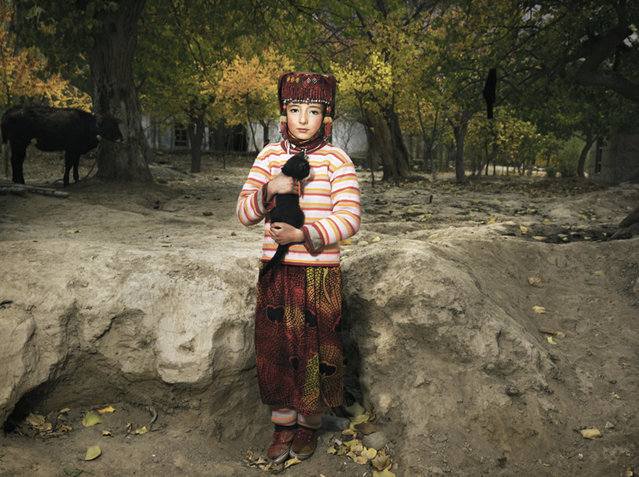
The Tashkurgan Tajik Autonomous County in Xinjiang Province People

“As a photographer, peregrinator and naturalist, I have been searching for the ultimate unworldly world. I've always been drawn to unusual travel destinations. For me, to lose myself in a different culture is a great way to find balance in my life...”. – Li Xinzhao. (Photo by Li Xinzhao)
Details
11 Feb 2013 11:26:00
“When I am there, it reminds me of when I was a child”. (Photo by Vladimir Ryabkov/Caters News Agency)

These stunning photographs really do show a land of fire and ice! The frozen landscape of the Olkhon Islands, Russia, appears to be ablaze in some of these pictures as the icy sheets of the glaciers reflect the early morning suns rays. (Photo by Vladimir Ryabkov/Caters News Agency)
Details
14 Apr 2018 00:03:00
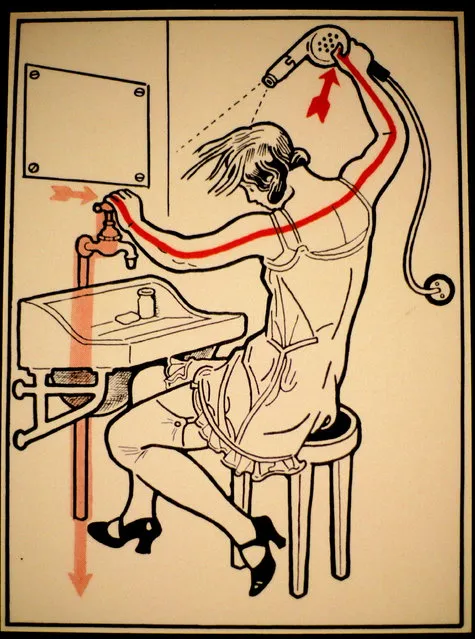
The book “Elektroschutz in 132 Bildern” (Electrical Protection in 132 Pictures) was published in Vienna in the early 1900s by a Viennese physician named Stefan Jellinek (1878-1968, a founder of the Electro-Pathological Museum). The pictures are nice and direct and unambiguous; they teach, graphically, that the surest way to kill yourself with electricity is to form a complete path from source (usually the bright red arrow) to ground (the screened back, pink arrow). Arrowheads provide the path for current flow. (Photo by The Vienna Technical Museum)

The book “Elektroschutz in 132 Bildern” (Electrical Protection in 132 Pictures) was published in Vienna in the early 1900s by a Viennese physician named Stefan Jellinek (1878-1968, a founder of the Electro-Pathological Museum). The pictures are nice and direct and unambiguous; they teach, graphically, that the surest way to kill yourself with electricity is to form a complete path from source (usually the bright red arrow) to ground (the screened back, pink arrow). Arrowheads provide the path for current flow. (Photo by The Vienna Technical Museum)
Details
11 Aug 2014 11:10:00