Loading...
Done
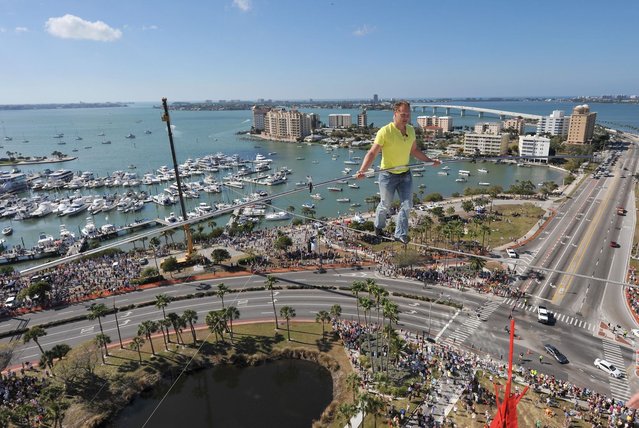
Nik Wallenda walks across a tightrope 200 feet above U.S. 41 on January 29, 2013 in Sarasota, Florida. (Photo by Tim Boyles/Getty Images)

The holder of half a dozen world records will walk across the Grand Canyon on a steel cable with nothing but the Little Colorado River 1,500 feet below on June 23. With no tethers or safety nets, the walk will be the highest tightrope attempt ever for the 34-year-old, at a height taller than the Empire State Building. Last year, Wallenda, a seventh-generation member of the “Flying Wallendas” family of acrobats, became the only person to walk a wire over the brink of Niagara Falls. Photo: Nik Wallenda walks across a tightrope 200 feet above U.S. 41 on January 29, 2013 in Sarasota, Florida. (Photo by Tim Boyles)
Details
18 Jun 2013 08:45:00
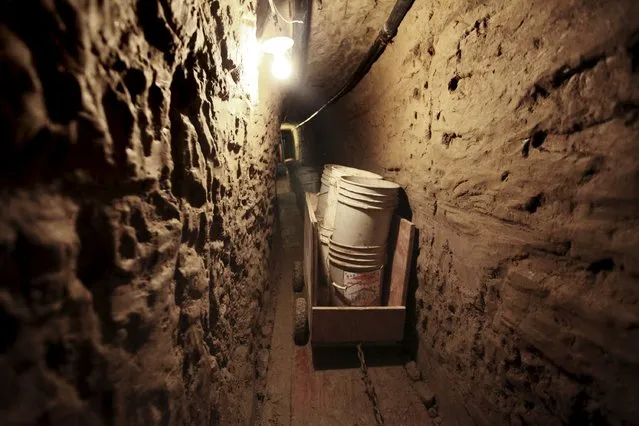
A makeshift cart with containers is seen at a suspected drug tunnel under construction during a media tour by Mexican Army in Tijuana April 7, 2015. Mexican soldiers foiled the construction of a suspected drug tunnel underneath a house near the U.S. border, arresting nine people and impounding a truck used to clear debris, the Army said on Tuesday. (Photo by Reuters/Stringer)

A makeshift cart with containers is seen at a suspected drug tunnel under construction during a media tour by Mexican Army in Tijuana April 7, 2015. Mexican soldiers foiled the construction of a suspected drug tunnel underneath a house near the U.S. border, arresting nine people and impounding a truck used to clear debris, the Army said on Tuesday. Wired with lights, the tunnel was being built next to the Tijuana border crossing, south of San Diego, California, and near a Mexican air force installation as well as a regional federal police facility. (Photo by Reuters/Stringer)
Details
09 Apr 2015 13:25:00
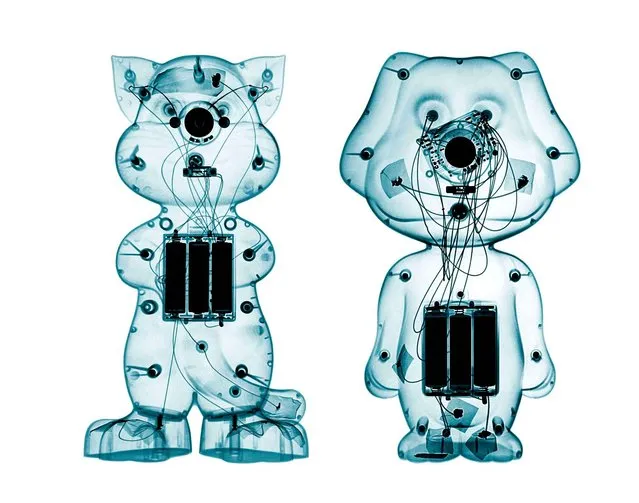
Australian photographer Brendan Fitzpatrick’s X-ray photographs expose the inner workings of toys. Fitzpatrick’s photographs are both whimsical and mechanical, evoking the curiosity of childhood and the desire to discover how things look and work from other perspectives. (Photo by Brendan Fitzpatrick)

Australian photographer Brendan Fitzpatrick’s X-ray photographs expose the inner workings of toys. Fitzpatrick’s photographs are both whimsical and mechanical, evoking the curiosity of childhood and the desire to discover how things look and work from other perspectives. The strategic placement of wires, batteries, and screws are revealed, the complexity of the inside contrasting with the seemingly simplistic design of the outside. Fitzpatrick uses chest X-ray and mammogram machines to photograph flowers, toys, and creatures, then enhances the color in the images in order to more effectively distinguish the various parts that have been exposed. This photographs are part of series he calls “Invisible Light”. (Photo by Brendan Fitzpatrick)
Details
08 Aug 2014 10:59:00
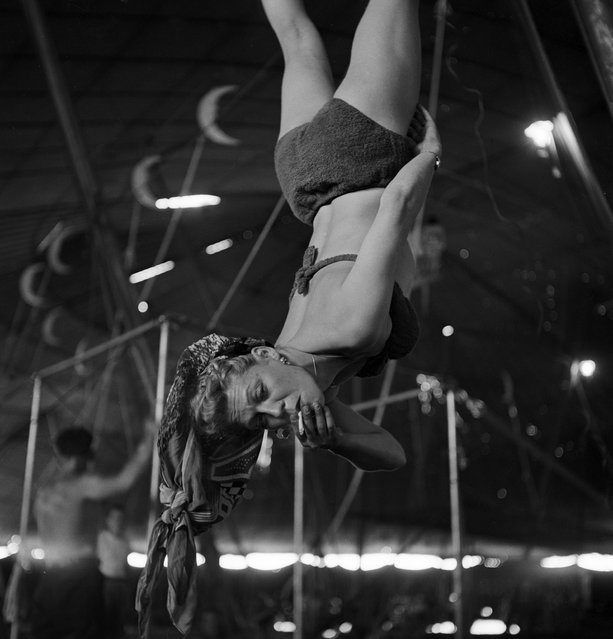
An aerialist smoking while rehearsing for the Ringling Bros. and Barnum & Bailey Circus in Sarasota, FL in 1949. (Photo By Nina Leen/Time Life Pictures/Getty Images)

In 1949, LIFE magazine sent famed photographer Nina Leen to document the daily life of a sassy troupe of young women who had run off and joined the famous Barnum & Bailey Circus in Sarasota, Fla. What developed was a portrait of a sisterhood formed over acrobatics that mixed high-flying wire acts with fashionable high-waisted shorts. Sarasota was once considered “the home of the American circus”. Here: an aerialist smoking while rehearsing for the Ringling Bros. and Barnum & Bailey Circus in Sarasota, FL in 1949. (Photo By Nina Leen/Time Life Pictures/Getty Images)
Details
06 Sep 2015 14:22:00
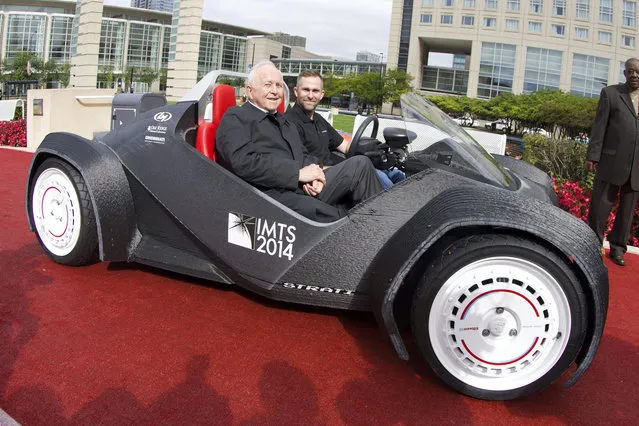
The world's first 3D printed car – the Stratti – was built in just 45 hours at the International Manufacturing Technology Show which took place between September 8 – 13, 2014. The Strati, which is Italian for layers, has a chassis body made of one solid piece and has a top speed of 40mph. (Photo by Barcroft Media/ABACAPress)

The world's first 3D printed car – the Stratti – was built in just 45 hours at the International Manufacturing Technology Show which took place between September 8 – 13, 2014. The Strati, which is Italian for layers, has a chassis body made of one solid piece and has a top speed of 40mph. The tyres, seats, wheels, battery, wiring, suspension, electric motor and window shield of the revolutionary vehicle were made using conventional methods. (Photo by Barcroft Media/ABACAPress)
Details
24 Oct 2014 12:44:00
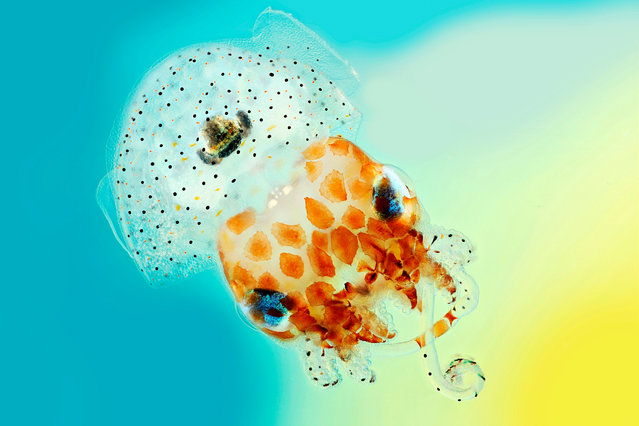
With its huge eyes, comical name and diminutive size, Mark R. Smith’s image of a baby Hawaiian bobtail squid can’t help but raise a smile. A curiously endearing creature, the cephalopod is just 1.5cm across, its mantle cavity bearing more than a passing resemblance to a rather natty shower cap. But it is also a beautiful example of symbiosis – nature’s version of “I’ll scratch your back if you scratch mine” – for on the underside of the squid is a light organ which houses bioluminescent bacteria. The squid offers the bacteria protection and food, while the bacteria emit a glow – a handy trait that the squid uses to offset its silhouette, helping it to evade predators in the depths below. Mark R. Smith’s entry combines several images of a Hawaiian bobtail squid with different focus lengths to create a final picture with greater depth of field than normal. (Photo by Mark R. Smith/Wellcome Images/Macroscopic Solutions)

With its huge eyes, comical name and diminutive size, Mark R. Smith’s image of a baby Hawaiian bobtail squid can’t help but raise a smile. A curiously endearing creature, the cephalopod is just 1.5cm across, its mantle cavity bearing more than a passing resemblance to a rather natty shower cap. But it is also a beautiful example of symbiosis – nature’s version of “I’ll scratch your back if you scratch mine” – for on the underside of the squid is a light organ which houses bioluminescent bacteria. The squid offers the bacteria protection and food, while the bacteria emit a glow – a handy trait that the squid uses to offset its silhouette, helping it to evade predators in the depths below. Mark R. Smith’s entry combines several images of a Hawaiian bobtail squid with different focus lengths to create a final picture with greater depth of field than normal. (Photo by Mark R. Smith/Wellcome Images/Macroscopic Solutions)
Details
08 Mar 2017 00:05:00
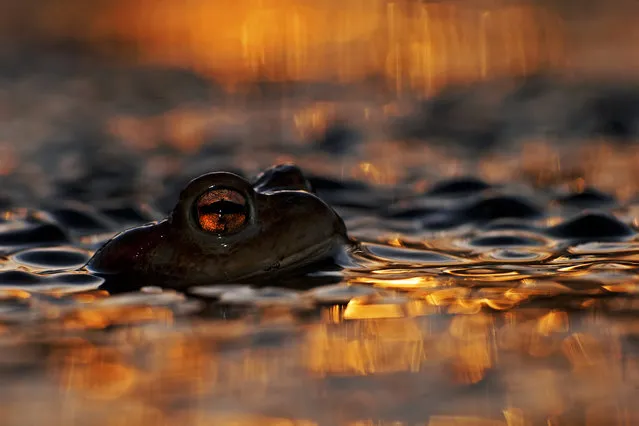
“Eye of a toad”. Animal Portraits, Łukasz Bożycki, Poland.  (Photo by Łukasz Bożycki)

“Eye of a toad”. Animal Portraits, Łukasz Bożycki, Poland. Early spring sees a pond near Łukasz’s home city of Warsaw, Poland, full of mating frogs and a few toads. On this March day, Łukasz shared the pond with them for an evening, sitting in the icy water in his chest-high waders, keeping as still as possible, despite the numbing cold, so that the amphibians could get used to him. “I wanted to find a fresh way of portraying the amphibians”, he says, “at water level”. Using a telephoto lens, he focused on one lone toad and waited for the sun to dip almost below the horizon before pressing the shutter, using flash to bring out the details in the shadow. His prize was “the glorious pool of sunset colour” and fiery glow of the toad’s eye. Nikon D80 + 70-300mm f4.5-5.6 lens + extension tube; 1/125 sec at f9 (-2.3 e/v); ISO 100; built-in flash. (Photo by Łukasz Bożycki)
Details
28 Aug 2013 11:45:00
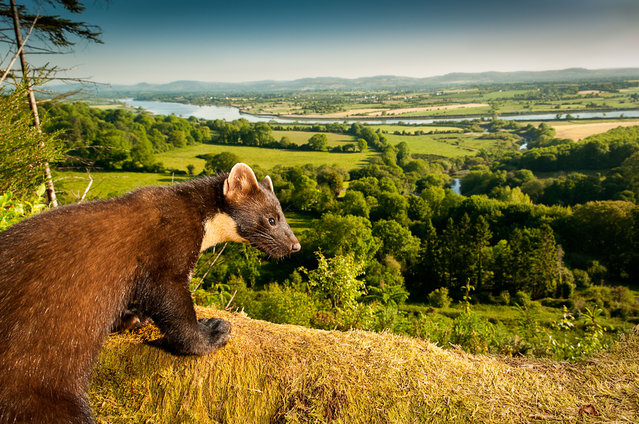
A pine marten – one of a few wild mammals doing well in Britain (although they number just 3,700). A fifth of the country’s wild mammals are at high risk of extinction, research shows. (Photo by Maurice Flynn/The Mammal Society)

A pine marten – one of a few wild mammals doing well in Britain (although they number just 3,700). A fifth of the country’s wild mammals are at high risk of extinction, research shows. (Photo by Maurice Flynn/The Mammal Society)
Details
08 Jul 2018 00:01:00