Loading...
Done
In advance of Fleet Week performances, the U.S. Navy Blue Angels and Team Oracle aerobatics pilot Sean D. Tucker fly over the San Francisco Bay during a photo flight on Thursday, October 5, 2017. (Photo by Noah Berger/AP Photo)

In advance of Fleet Week performances, the U.S. Navy Blue Angels and Team Oracle aerobatics pilot Sean D. Tucker fly over the San Francisco Bay during a photo flight on Thursday, October 5, 2017. (Photo by Noah Berger/AP Photo)
Details
08 Oct 2017 07:02:00
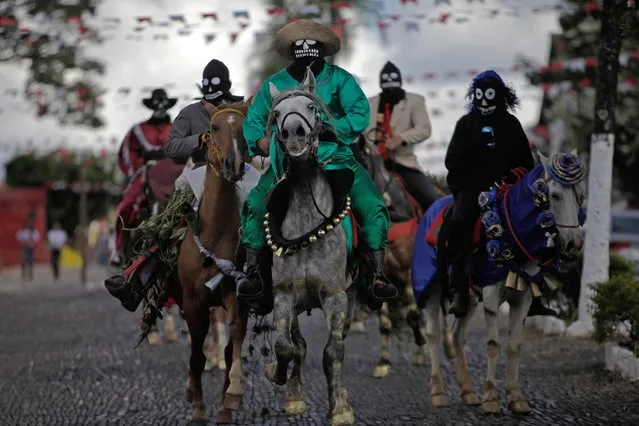
Masked men ride in a morning procession as part of the “Cavalhadas” festival in Pirenopolis, Brazil, Sunday, May 19, 2013. The popular festival is a tradition that was introduced in the 1800's by a Portuguese priest to mark the the ascension of Christ. The 3-day festival reenacts the Christian knights' medieval defeat of the Moors. (Photo by Eraldo Peres/AP Photo)

Masked men ride in a morning procession as part of the “Cavalhadas” festival in Pirenopolis, Brazil, Sunday, May 19, 2013. The popular festival is a tradition that was introduced in the 1800's by a Portuguese priest to mark the the ascension of Christ. The 3-day festival reenacts the Christian knights' medieval defeat of the Moors. (Photo by Eraldo Peres/AP Photo)
Details
22 May 2013 08:49:00
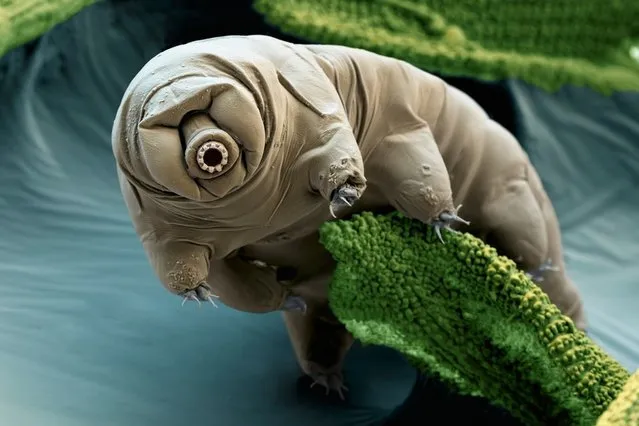
Tardigrades (commonly known as waterbears or moss piglets). (Photo by SPL/East News)

“Tardigrades (commonly known as waterbears or moss piglets) are small, water-dwelling, segmented animals with eight legs. Tardigrades were first discovered in 1773 by Johann August Ephraim Goeze, who called them kleiner Wasserbär, meaning “little water bear” in German. The name Tardigrada means “slow walker” and was given by Lazzaro Spallanzani in 1777. The name water bear comes from the way they walk, reminiscent of a bear's gait. The biggest adults may reach a body length of 1.5 millimetres (0.059 in), the smallest below 0.1 mm. Freshly hatched tardigrades may be smaller than 0.05 mm”. – Wikipedia. Photo: Tardigrades. (Photo by SPL/East News)
Details
26 Sep 2012 09:55:00
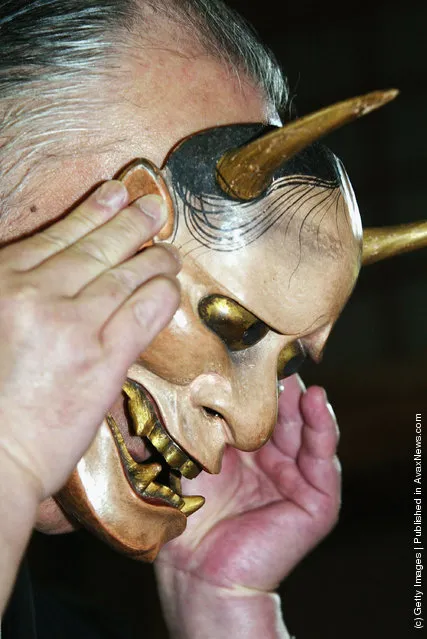
A renowned Noh actor, Otoshige Sakai, demostrates how to put on a Noh mask

“Noh, or Nogaku – derived from the Japanese word for “skill” or “talent” – is a major form of classical Japanese musical drama that has been performed since the 14th century. Many characters are masked, with men playing male and female roles. Traditionally, a Noh “performance day” lasts all day and consists of five Noh plays interspersed with shorter, humorous kyōgen pieces. However, present-day Noh performances often consist of two Noh plays with one Kyōgen play in between”. – Wikipedia

Photo: A renowned Noh actor, Otoshige Sakai, demostrates how to put on a Noh mask, on May 17, 2004 in Tokyo, Japan. (Photo by Koichi Kamoshida/Getty Images)

Details
02 Aug 2011 14:09:00
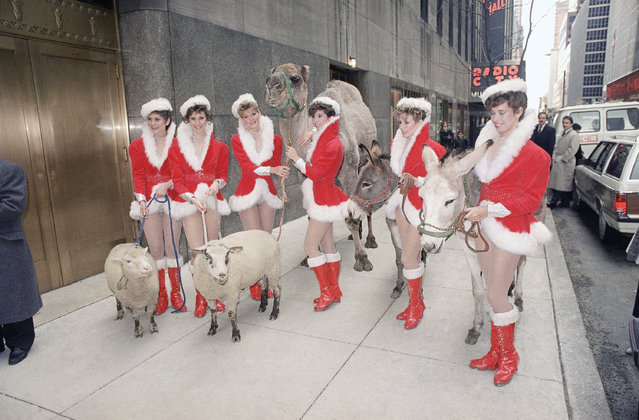
Animals destined for the stage of Radio City Music Hall in New York on November 13, 1986 are led to the stage door by their co-stars, the Rockettes dancers. A variety of animals, including camels, sheep and donkeys, will star in an annual Christmas production. (Photo by G. Paul Burnett/AP Photo)

Animals destined for the stage of Radio City Music Hall in New York on November 13, 1986 are led to the stage door by their co-stars, the Rockettes dancers. A variety of animals, including camels, sheep and donkeys, will star in an annual Christmas production. (Photo by G. Paul Burnett/AP Photo)
Details
22 Dec 2014 11:48:00
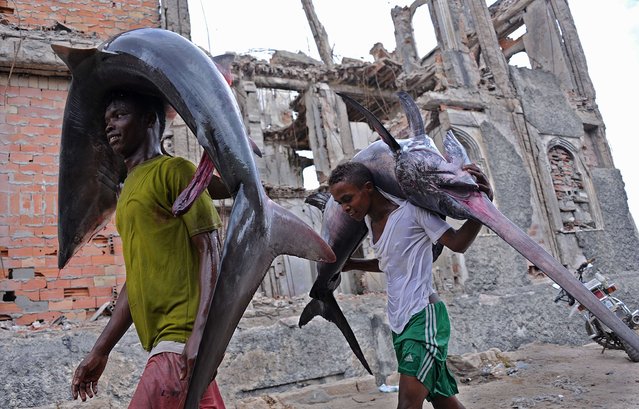
Porters carry the carcasses of a shark (L) and a Marlin (R) to the local market in Hamarweyne near the port of Mogadishu on the Indian Ocean coast on November 18, 2014 in the Somalia capital as fishermen bring in their catch. (Photo by Mohamed Abdiwahab/AFP Photo)

Porters carry the carcasses of a shark (L) and a Marlin (R) to the local market in Hamarweyne near the port of Mogadishu on the Indian Ocean coast on November 18, 2014 in the Somalia capital as fishermen bring in their catch. (Photo by Mohamed Abdiwahab/AFP Photo)
Details
22 Nov 2014 14:00:00
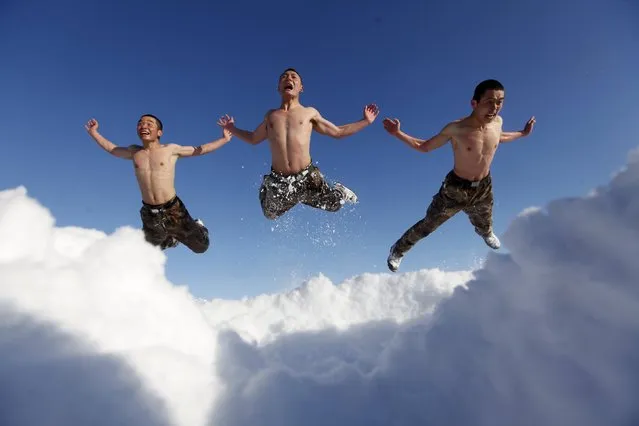
Soldiers of China's People's Liberation Army (PLA) jump as part of their winter training in  temperature of negative 26 degrees Celsius at China's border with Russia in Heihe, Heilongjiang province, December 14, 2015. (Photo by Reuters/Stringer)

Soldiers of China's People's Liberation Army (PLA) jump as part of their winter training in temperature of negative 26 degrees Celsius at China's border with Russia in Heihe, Heilongjiang province, December 14, 2015. (Photo by Reuters/Stringer)
Details
17 Dec 2015 12:44:00
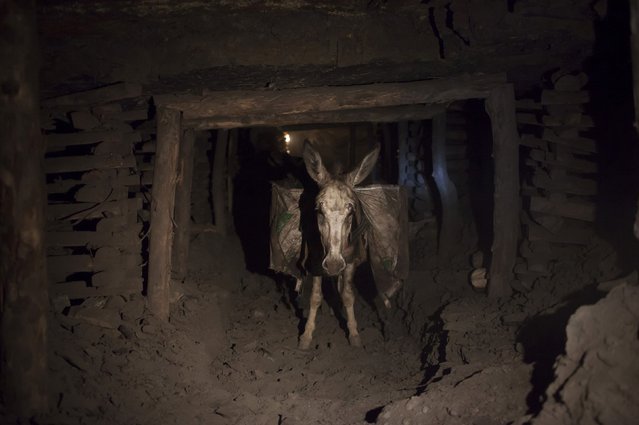
A donkey carrying sacks of coal walks through the narrow tunnels of a coal mine, in Choa Saidan Shah in Punjab province April 29, 2014. (Photo by Sara Farid/Reuters)

A donkey carrying sacks of coal walks through the narrow tunnels of a coal mine, in Choa Saidan Shah in Punjab province April 29, 2014. Coal miners in Chao Saidan Shah use donkeys to transport coal from the depths of the mines to the surface. (Photo by Sara Farid/Reuters)
Details
11 May 2014 12:03:00