Loading...
Done
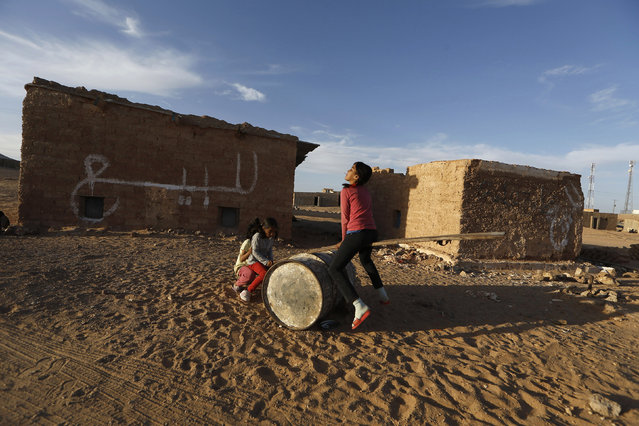
Indigenous Sahrawi girls play on an improvised see-saw at a refugee camp of Boudjdour in Tindouf, southern Algeria March 3, 2016. (Photo by Zohra Bensemra/Reuters)

Indigenous Sahrawi girls play on an improvised see-saw at a refugee camp of Boudjdour in Tindouf, southern Algeria March 3, 2016. UN Secretary General Ban Ki-moon is scheduled to visit the Sahrawi refugees in south-west Algeria's Tindouf region. (Photo by Zohra Bensemra/Reuters)
Details
04 Mar 2016 12:16:00
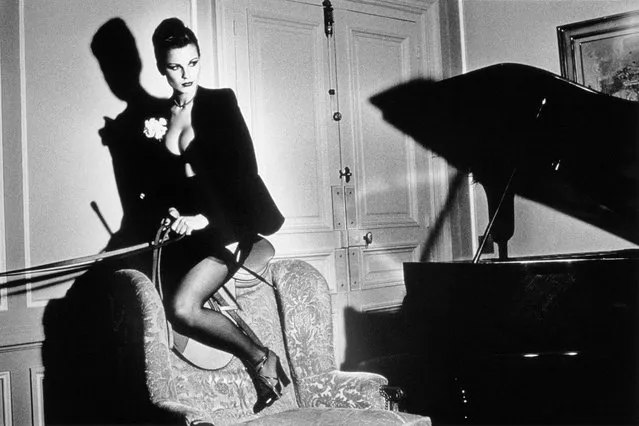
Saddle II. (Photo by Helmut Newton)

Vintage Newton, a pop-up exhibition of Helmut Newton prints from 1974-1984, opens in west London at the ONGallery. These prints, which feature Charlotte Rampling and Elsa Peretti, were produced from a series of transparencies that he considered his most provocative and important. Here: Saddle II. (Photo by Helmut Newton)
Details
26 Nov 2015 08:06:00
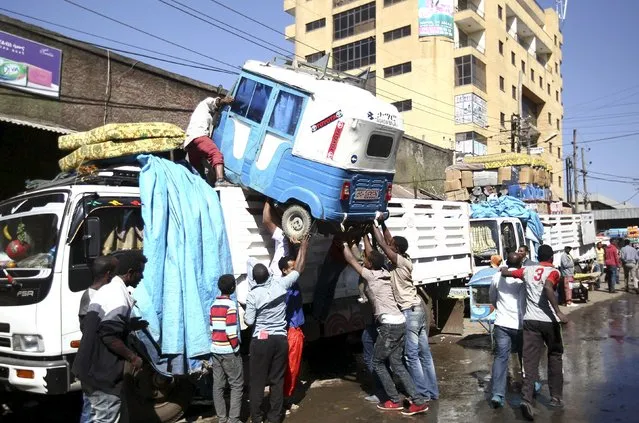
Labourers load a three-wheeled vehicle onto the back of a van at the Mercato market in Addis Ababa October 9, 2015. (Photo by Tiksa Negeri/Reuters)

Labourers load a three-wheeled vehicle onto the back of a van at the Mercato market in Addis Ababa October 9, 2015. Addis Ababa's “Mercato” – Italian for “market” – is reputedly the biggest open-air market in Africa, lying in the west of the capital. (Photo by Tiksa Negeri/Reuters)
Details
20 Dec 2015 08:06:00
A photographer in Somerset captured the mating rituals of toads as several males attempt to mate with one female all at once. (Photo by John Waters/NPL)

A photographer in Somerset, South West England captured the mating rituals of toads as several males attempt to mate with one female all at once. (Photo by John Waters/NPL)
Details
27 May 2018 00:03:00


“The Trabant is a car that was produced by former East German auto maker VEB Sachsenring Automobilwerke Zwickau in Zwickau, Sachsen. It was the most common vehicle in East Germany, and was also exported to countries both inside and outside the communist bloc. The main selling points was that it had room for four adults and luggage in a compact, light and durable shell and that it was fast (when introduced) and durable. With its mediocre performance, smoky two-stroke engine, and production shortages, the Trabant is often cited as an example of the disadvantages of centralized planning; on the other hand, it is regarded with derisive affection as a symbol of the failed former East Germany and of the fall of communism (in former West Germany, as many East Germans streamed into West Berlin and West Germany in their Trabants after the opening of the Berlin Wall in 1989). It was in production without any significant changes for nearly 30 years with 3,096,099 Trabants produced in total”. – Wikipedia

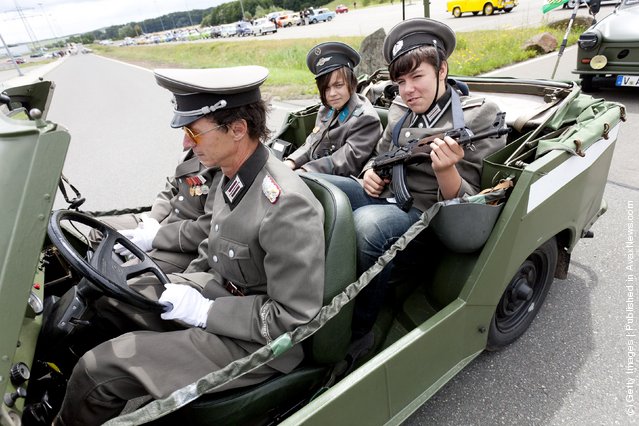
Photo: Enthusiasts weared in uniforms of the former eastern german army trive in a military Trabant car as fans and owners of East German-era Trabant cars gather at the 2011 International Trabantfahrer Treffen (International Trabant Drivers Meeting) on June 26, 2011 in Zwickau, Germany. The Trabant, also known as the Trabi, was among the main cars produced in communist East Germany and built by VEB Sachsenring Automobilwerke in Zwickau for 30 years until 1989. Today the car has cult status for many followers and one company, IndiKar, is even seeking to revive the brand in a modern, electric version. (Photo by Carsten Koall/Getty Images)

Details
27 Jun 2011 12:21:00
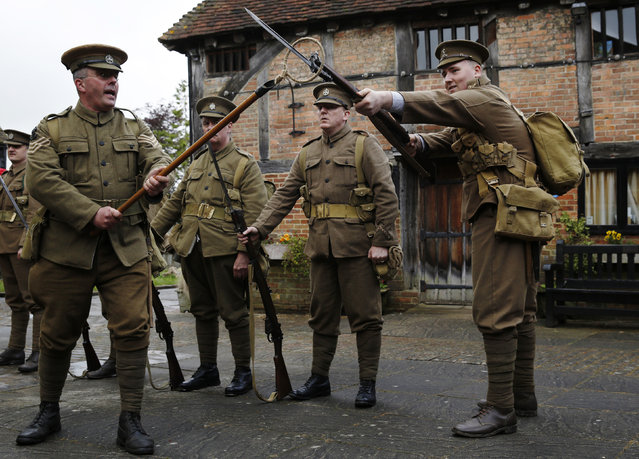
Factory landlord Lawrence Taylor (L), portraying a Colour Sergeant from the King's Royal Rifle Corps, part of the Rifles Living History Society, performs a drill with Connor Young (R) of the Queen's Own Royal West Kent Regiment Living History Group as they recreate the life of a First World War soldier at the Eden Valley Museum in Edenbridge in southeast England May 10, 2014. (Photo by Luke MacGregor/Reuters)

Factory landlord Lawrence Taylor (L), portraying a Colour Sergeant from the King's Royal Rifle Corps, part of the Rifles Living History Society, performs a drill with Connor Young (R) of the Queen's Own Royal West Kent Regiment Living History Group as they recreate the life of a First World War soldier at the Eden Valley Museum in Edenbridge in southeast England May 10, 2014. Lawrence has always had an interest in military history and specifically “The Rifles” – his veteran father's WWII regiment. When he became a re-enactor he chose not to re-enact WWII as many of the veterans are still alive, and he felt uncomfortable as he remembers his father would have flashbacks and nightmares about the war. United by a fascination with military history and a fondness for dressing up, groups such as the Rifles Living History Society and the Queen's Own Royal West Kent Regiment Living History Group get together to recreate aspects of life during the First World War. Reuters photographer Luke MacGregor photographed members of the groups, both as they took part in living history events and at their day jobs. (Photo by Luke MacGregor/Reuters)
Details
26 Aug 2014 10:12:00
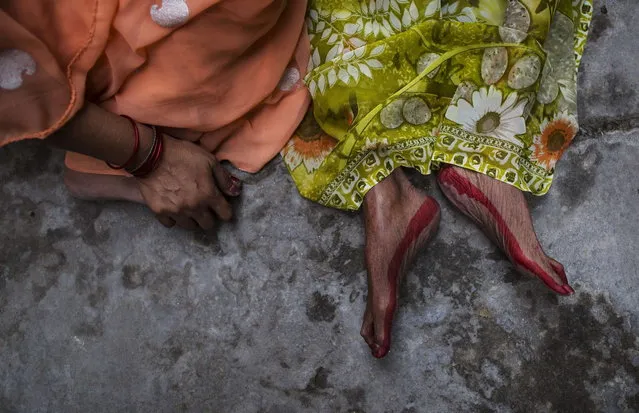
A relative (L) of Champa Devi, 88, sits next to her body, minutes after her death at Mukti Bhavan (Salvation House) at Varanasi, in the northern Indian state of Uttar Pradesh, June 21, 2014. (Photo by Danish Siddiqui/Reuters)

A relative (L) of Champa Devi, 88, sits next to her body, minutes after her death at Mukti Bhavan (Salvation House) at Varanasi, in the northern Indian state of Uttar Pradesh, June 21, 2014. The city of Varanasi, on the banks of the River Ganges, is widely considered Hinduism's holiest city and many Hindus believe that dying there and having their remains scattered in the Ganges allows their soul to escape a cycle of death and rebirth, attaining “moksha” or salvation. “Mukti Bhavan” or “Salvation House”, is a charity-run hostel that caters for people who wish to come to Varanasi to die. Guests can normally stay up to two weeks after which, if they haven't yet passed away, they are gently asked to leave. (Photo by Danish Siddiqui/Reuters)
Details
24 Jul 2014 12:32:00
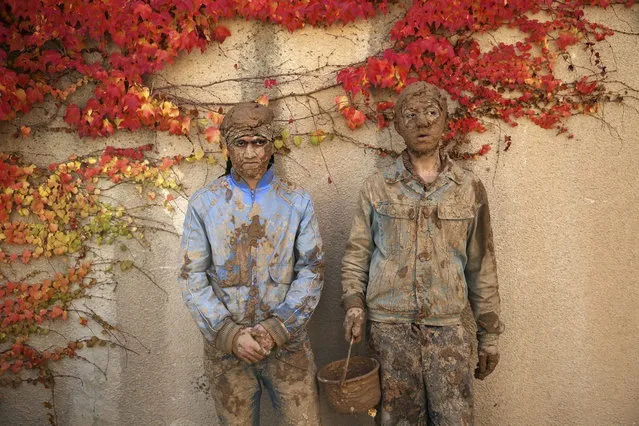
Iranian mourners cover themselves with mud during Ashoura, marking the death anniversary of Imam Hussein, the grandson of Islam's Prophet Muhammad, at the city of Bijar, west of the capital Tehran, Iran, Thursday, November 14, 2013. Hussein, one of Shiite Islam's most beloved saints, was killed in a 7th century battle at Karbala, Iraq. (Photo by Ebrahim Noroozi/AP Photo)

Iranian mourners cover themselves with mud during Ashoura, marking the death anniversary of Imam Hussein, the grandson of Islam's Prophet Muhammad, at the city of Bijar, west of the capital Tehran, Iran, Thursday, November 14, 2013. Hussein, one of Shiite Islam's most beloved saints, was killed in a 7th century battle at Karbala, Iraq. (Photo by Ebrahim Noroozi/AP Photo)
Details
18 Nov 2013 09:13:00