Loading...
Done
A car made from parts taken from used vehicles is shown in street Hefei, Anhui Province in China, on Oktober 21, 2013. The machine, which reaches 60 km/h, is the brainchild of self-taught inventor Zhu Runqiang. (Photo by Reuters/China Daily)

A car made from parts taken from used vehicles is shown in street Hefei, Anhui Province in China, on Oktober 21, 2013. The machine, which reaches 60 km/h, is the brainchild of self-taught inventor Zhu Runqiang. (Photo by Reuters/China Daily)

P.S. All pictures are presented in high resolution. To see Hi-Res images – just TWICE click on any picture. In other words, click small picture – opens the BIG picture. Click BIG picture – opens VERY BIG picture (if available; this principle works anywhere on the site AvaxNews)
Details
26 Oct 2013 11:41:00
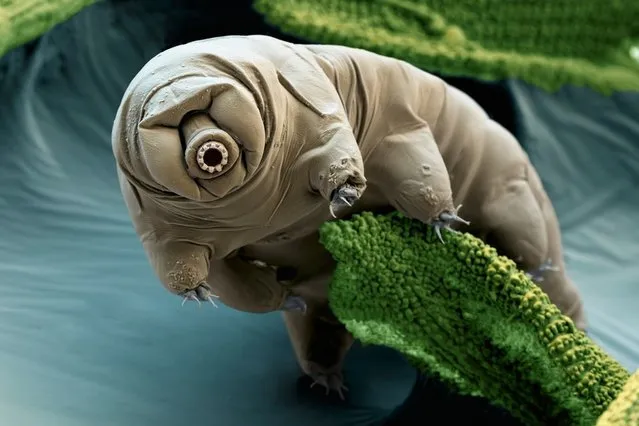
Tardigrades (commonly known as waterbears or moss piglets). (Photo by SPL/East News)

“Tardigrades (commonly known as waterbears or moss piglets) are small, water-dwelling, segmented animals with eight legs. Tardigrades were first discovered in 1773 by Johann August Ephraim Goeze, who called them kleiner Wasserbär, meaning “little water bear” in German. The name Tardigrada means “slow walker” and was given by Lazzaro Spallanzani in 1777. The name water bear comes from the way they walk, reminiscent of a bear's gait. The biggest adults may reach a body length of 1.5 millimetres (0.059 in), the smallest below 0.1 mm. Freshly hatched tardigrades may be smaller than 0.05 mm”. – Wikipedia. Photo: Tardigrades. (Photo by SPL/East News)
Details
26 Sep 2012 09:55:00
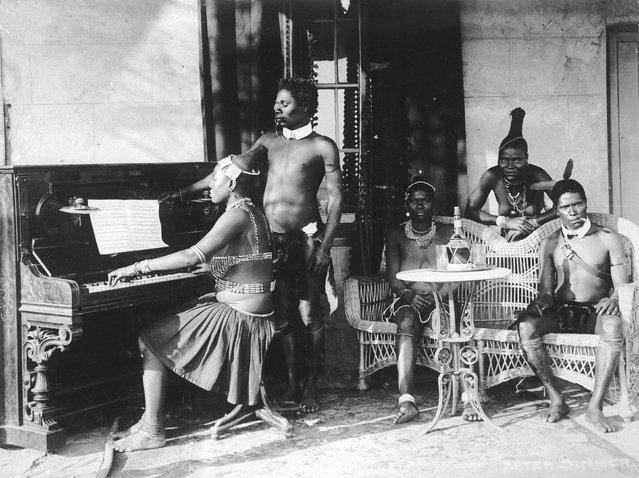
circa 1925:  A Zulu woman playing the piano while a group of others sit and listen.  (Photo by General Photographic Agency/Getty Images)

“The Zulu are the largest South African ethnic group, with an estimated 10–11 million people living mainly in the province of KwaZulu-Natal. Small numbers also live in Zimbabwe, Zambia, and Mozambique. Their language, Zulu, is a Bantu language; more specifically, part of the Nguni subgroup. The Zulu Kingdom played a major role in South African history during the 19th and 20th centuries. Under apartheid, Zulu people were classed as third-class citizens and suffered from state-sanctioned discrimination. They remain today the most numerous ethnic group in South Africa, and now have equal rights along with all other citizens”. – Wikipedia.

Photo: A Zulu woman playing the piano while a group of others sit and listen (to put it briefly, Englishmen scoff over Zulu). South Africa, circa 1925. (Photo by General Photographic Agency)

Details
03 Feb 2014 09:40:00
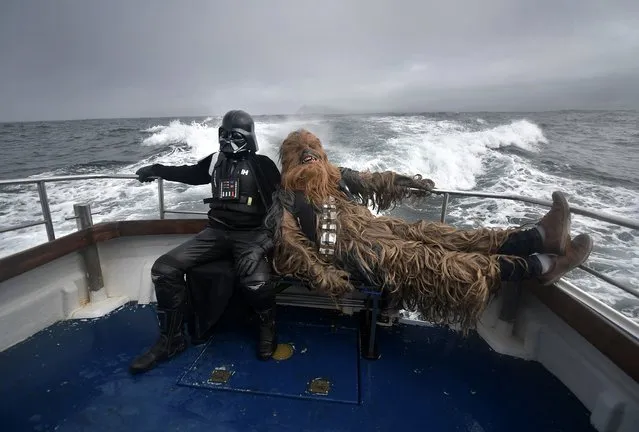
Fans dressed as Darth Vader and Chewbacca take a boat trip to the Skelligs on May 4, 2018 in Portmagee, Ireland. (Photo by Charles McQuillan/Getty Images)

Fans dressed as Darth Vader and Chewbacca take a boat trip to the Skelligs on May 4, 2018 in Portmagee, Ireland. The first ever Star Wars festival is taking place against the backdrop of the famous Skellig Michael island which was used extensively in Episode VII and Episode VIII of the popular science fiction saga. The small fishing village of Portmagee, which is closest to the location, has seen a boom in tourism following the latest films. The vilage will host a Star Wars drive-in and a Star Wars themed Irish dancing competition over the weekend. (Photo by Charles McQuillan/Getty Images)
Details
07 May 2018 00:05:00
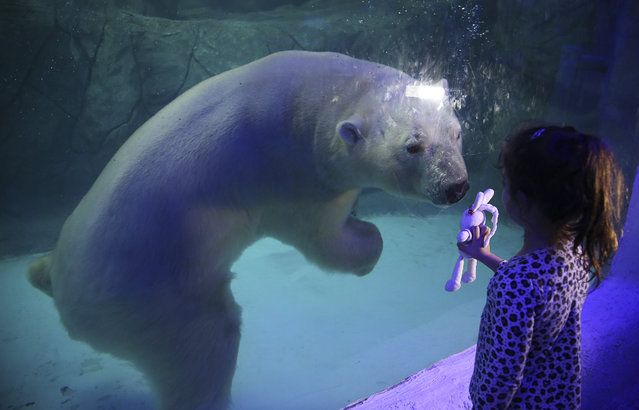
A visitor holds up her toy bunny to the aquarium glass in front of Aurora the Russian polar bear at the Sao Paulo Aquarium in Sao Paulo, Brazil, Thursday, April 16, 2015. (Photo by Andre Penner/AP Photo)

A visitor holds up her toy bunny to the aquarium glass in front of Aurora the Russian polar bear at the Sao Paulo Aquarium in Sao Paulo, Brazil, Thursday, April 16, 2015. (Photo by Andre Penner/AP Photo)
Details
21 Apr 2015 11:47:00
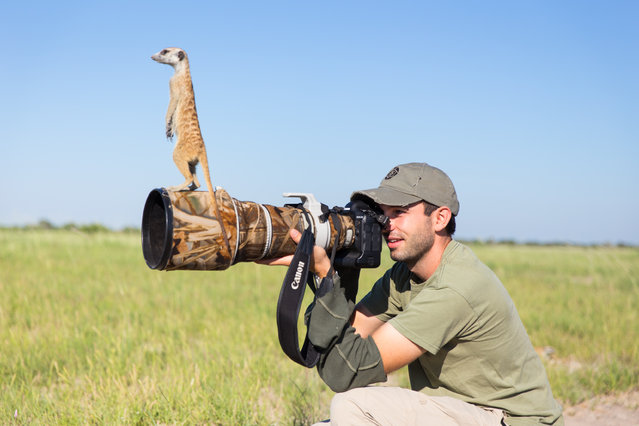
Will Burrard-Lucas takes a photo while a Meerkat perches on his lens on January 2014 in Makgadikgadi, Botswana. These adorable Meerkats used a photographer as a look out post before trying their hand at taking pictures. The beautiful images were caught by wildlife photographer Will Burrard-Lucas after he spent six days with the quirky new families in the Makgadikgadi region of Botswana. Will has photographed Meerkats in the past and was delighted when he realised he would be shooting new arrivals. (Photo by Will Burrard-Lucas/Barcroft Media)

Will Burrard-Lucas takes a photo while a Meerkat perches on his lens on January 2014 in Makgadikgadi, Botswana. These adorable Meerkats used a photographer as a look out post before trying their hand at taking pictures. The beautiful images were caught by wildlife photographer Will Burrard-Lucas after he spent six days with the quirky new families in the Makgadikgadi region of Botswana. Will has photographed Meerkats in the past and was delighted when he realised he would be shooting new arrivals. (Photo by Will Burrard-Lucas/Barcroft Media)

P.S. All pictures are presented in high resolution. To see Hi-Res images – just TWICE click on any picture. In other words, click small picture – opens the BIG picture. Click BIG picture – opens VERY BIG picture (if available; this principle works anywhere on the site AvaxNews)
Details
13 Apr 2014 08:42:00
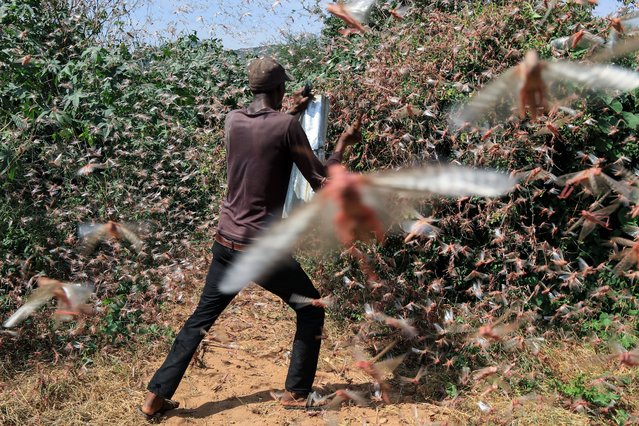
A man uses iron sheet to make noises, as a way of trying to disperse desert locusts that had invaded their farms during the second wave invasion in Kakongo village, in Nuu-Mwingi East, in Kitui, Kenya, 06 February 2021. The second wave invasion of the desert locusts in the country comes at a time where most famers are expecting to harvest their farm produce in the country. According to the United Nations Food and Agriculture Organization (FAO), on 04 February, warned numerous immature desert locust swarms persist in southern Ethiopia and Kenya. Some of the swarms are in community areas and therefore cannot be treated. In Kenya, immature swarms continue to spread westwards across northern and central counties where there are currently about 20 small swarms present, mostly about 50 hectares in size, it said. (Photo by Daniel Irungu/EPA/EFE)

A man uses iron sheet to make noises, as a way of trying to disperse desert locusts that had invaded their farms during the second wave invasion in Kakongo village, in Nuu-Mwingi East, in Kitui, Kenya, 06 February 2021. The second wave invasion of the desert locusts in the country comes at a time where most famers are expecting to harvest their farm produce in the country. (Photo by Daniel Irungu/EPA/EFE)
Details
25 Feb 2021 08:17:00
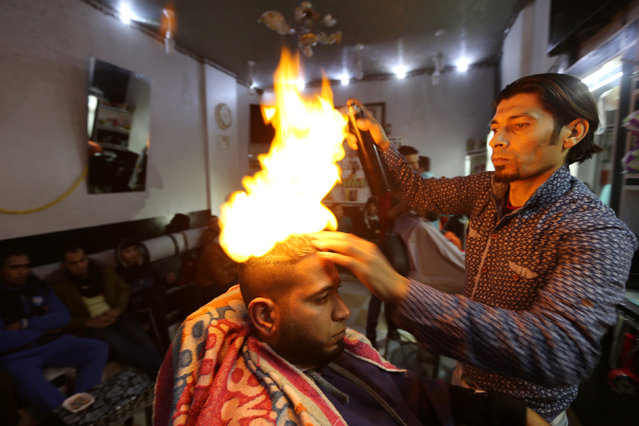
Palestinian barber Ramadan Odwan styles and straightens the hair of a customer with fire at his salon in Rafah, in the southern Gaza Strip February 2, 2017. In Ramadan Odwan's barbershop in Gaza, hair isn't just blow-dried, it's blowtorch-dried. “People have gone crazy about it, many people are curious to go through the experience and they are not afraid”, he told Reuters. “People here love adventures”. Odwan, 37, is not the first stylist in the world to use flame to straighten hair, but his craft is unique in the Gaza Strip. In his salon in the southern Gaza town of Rafah, Odwan applied what he described as a protective liquid coating to a customer's hair – he declined to disclose its contents – before aiming for the head and pressing the button on a small blowtorch. “I control how long I apply fire, I keep it on and off for 10 seconds or 15 seconds. It is completely safe and I have not encountered any accident since I started it two months ago”, Odwan added. Odwan charges 20 shekels ($5.20) for a haircut and fire-straightening. A barber for the past 18 years, he said part of the reason he uses the technique is to show that Palestinian barbers are as “professional as those out there around the world”. (Photo by Ibraheem Abu Mustafa/Reuters)

Palestinian barber Ramadan Odwan styles and straightens the hair of a customer with fire at his salon in Rafah, in the southern Gaza Strip February 2, 2017. In Ramadan Odwan's barbershop in Gaza, hair isn't just blow-dried, it's blowtorch-dried. “People have gone crazy about it, many people are curious to go through the experience and they are not afraid”, he told Reuters. “People here love adventures”. (Photo by Ibraheem Abu Mustafa/Reuters)
Details
11 Feb 2017 00:05:00