Loading...
Done
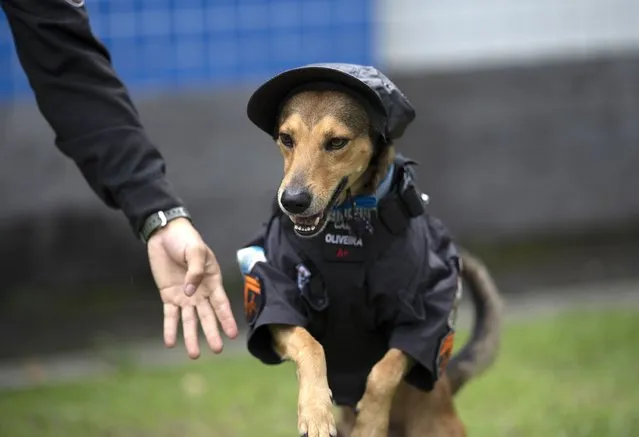
Police Cpl. Cristiano de Oliveira offers a hand to police dog “Corporal Oliveira”, at the 17 Military Police Battalion's station, in Rio de Janeiro, Brazil, Thursday, April 7, 2022. Oliveira is one of two rescue dogs that have turned into local mascots and budding online influencers after joining their rescuers' ranks. (Photo by Silvia Izquierdo/AP Photo)

Police Cpl. Cristiano de Oliveira offers a hand to police dog “Corporal Oliveira”, at the 17 Military Police Battalion's station, in Rio de Janeiro, Brazil, Thursday, April 7, 2022. Oliveira is one of two rescue dogs that have turned into local mascots and budding online influencers after joining their rescuers' ranks. (Photo by Silvia Izquierdo/AP Photo)
Details
14 Apr 2022 06:22:00
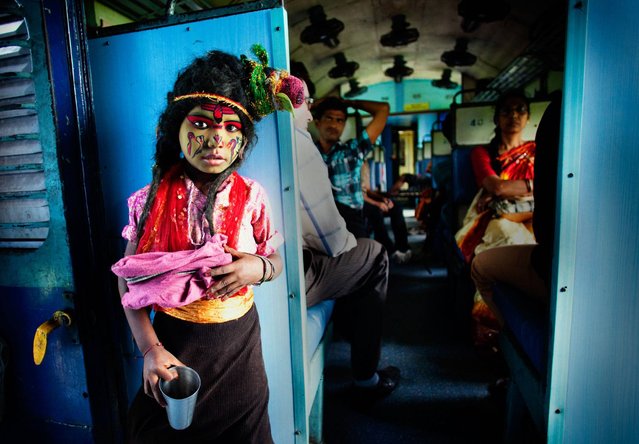
“I was on Durga Puja Festival vacation, travelling on a local train. A boy was singing devotional song and begging for alms. He was guised as a Hindu god, Lord Shiva. This is a common view in Indian trains but this boy was charming, bright and did have a melodious voice. My camera was ready hanging on my neck so I took a picture”. (Photo and caption by Arup Ghosh/2014 Sony World Photography Awards)

“I was on Durga Puja Festival vacation, travelling on a local train. A boy was singing devotional song and begging for alms. He was guised as a Hindu god, Lord Shiva. This is a common view in Indian trains but this boy was charming, bright and did have a melodious voice. My camera was ready hanging on my neck so I took a picture”. (Photo and caption by Arup Ghosh/2014 Sony World Photography Awards)
Details
18 Mar 2014 10:17:00
A British woman plays a piano designed especially for people who are confined to bed. Date: 1935. (Photo by Mary Evans Picture Library/Caters News)

A British woman plays a piano designed especially for people who are confined to bed. Date: 1935. (Photo by Mary Evans Picture Library/Caters News)
Details
20 Apr 2014 11:01:00
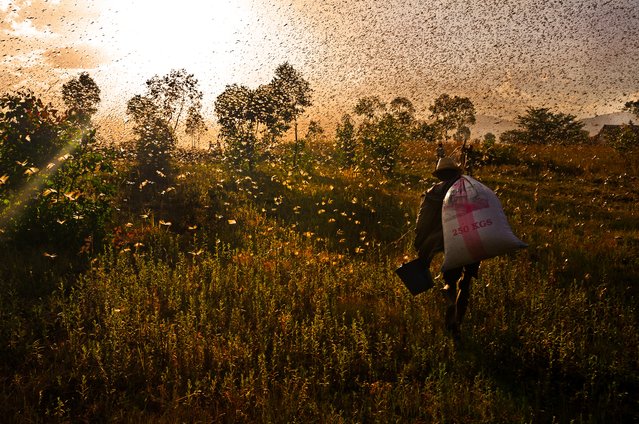
“Locusts & Men”. Oppression, interaction, collaboration. In the life cycle of nature nothing is lost, but the coexistence of different species is sometimes difficult. In Madagascar periodically returns the archaic antagonism between man and the migratory locust, in a circle of life where the two species are looking for space and food for their survival. Photo location: Madagascar, 2013. (Photo and caption by Michele Martinelli/National Geographic Photo Contest)

“Locusts & Men”. Oppression, interaction, collaboration. In the life cycle of nature nothing is lost, but the coexistence of different species is sometimes difficult. In Madagascar periodically returns the archaic antagonism between man and the migratory locust, in a circle of life where the two species are looking for space and food for their survival. At the end of the day a man walks home carrying on his shoulders the heavy bag which contains the locusts captured during the day. The insects provide nutritious meals for the man and his family. Photo location: Madagascar, 2013. (Photo and caption by Michele Martinelli/National Geographic Photo Contest)

ATTENTION! All pictures are presented in high resolution. To see Hi-Res images – just TWICE click on any picture. In other words, click small picture – opens the BIG picture. Click BIG picture – opens VERY BIG picture.
Details
03 Dec 2013 10:59:00
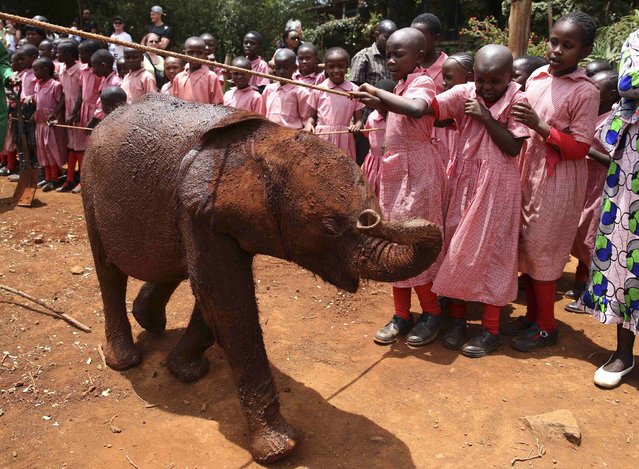
Pupils look at an orphaned baby elephant at the David Sheldrick Elephant Orphanage within the Nairobi National Park, near Kenya's capital Nairobi October 15, 2014. (Photo by Goran Tomasevic/Reuters)

Pupils look at an orphaned baby elephant at the David Sheldrick Elephant Orphanage within the Nairobi National Park, near Kenya's capital Nairobi October 15, 2014. The orphanage under the David Sheldrick Wildlife Trust is operated by Daphne Sheldrick, wife of late famous naturalist David William Sheldrick. The orphaned elephants raised by the trust will be returned to join the undomesticated elephant population in Tsavo National Park, where David was the founder warden from 1948 to 1976, when they mature, usually between eight to 10 years old. (Photo by Goran Tomasevic/Reuters)
Details
19 Oct 2014 12:47:00
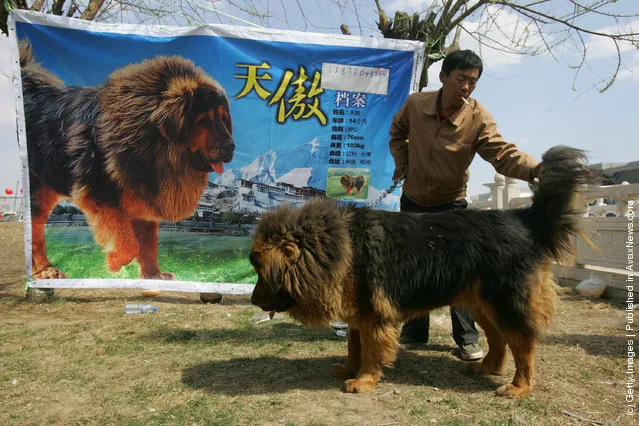
Tibetan Mastiff

“The Tibetan Mastiff also known as Do-khyi (variously translated as “home guard”, “door guard”, “dog which may be tied”, “dog which may be kept”), reflects its use as a guardian of herds, flocks, tents, villages, monasteries, and palaces, much as the old English ban-dog (also meaning tied dog) was a dog tied outside the home as a guardian. However, in nomad camps and in villages, the Do-khyi is traditionally allowed to run loose at night and woe be unto the stranger who walks abroad after dark”. – Wikipedia

Photo: A man displays a Tibetan Mastiff he raised during the Tibetan Mastiff exposition on April 7, 2007 in Langfang of Hebei Province, China. (Photo by China Photos/Getty Images)
Details
05 Oct 2011 14:27:00
A wedding couple poses for a photographer during a wedding photo shoot

A wedding couple poses for a photographer during a wedding photo shoot March 9, 2011 in Hanoi, Vietnam. Its is traditional for middle and upper class Vietnamese couples do a wedding fashion shoot posing for wedding portraits a few weeks before the wedding so that a wedding photo book is produced. (Photo by Paula Bronstein /Getty Images)
Details
22 Jan 2012 12:49:00
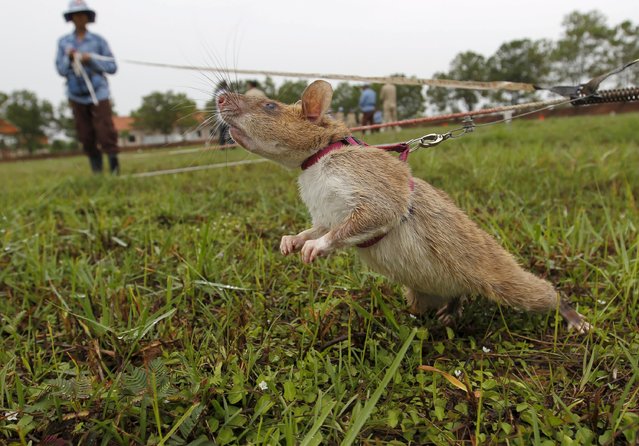
A rat being trained by the Cambodian Mine Action Centre (CMAC) is pictured on an inactive landmine field in Siem Reap province July 9, 2015. Gambian pouched rats were deployed to Cambodia from Tanzania in April by a Belgian non-profit organization, APOPO, to help clear mines. (Photo by Samrang Pring/Reuters)

A rat being trained by the Cambodian Mine Action Centre (CMAC) is pictured on an inactive landmine field in Siem Reap province July 9, 2015. Gambian pouched rats were deployed to Cambodia from Tanzania in April by a Belgian non-profit organization, APOPO, to help clear mines. They've been trained since they were 4 weeks old. Cambodia is still littered with landmines after emerging from decades of civil war, including the 1970s Khmer Rough “Killing Fields” genocide, leaving it with one of the world's highest disability rates. APOPO has used the rodents for mine-clearing projects in several countries, including Angola, Mozambique, Thailand, Laos, and Vietnam. (Photo by Samrang Pring/Reuters)
Details
14 Jul 2015 13:35:00