Loading...
Done
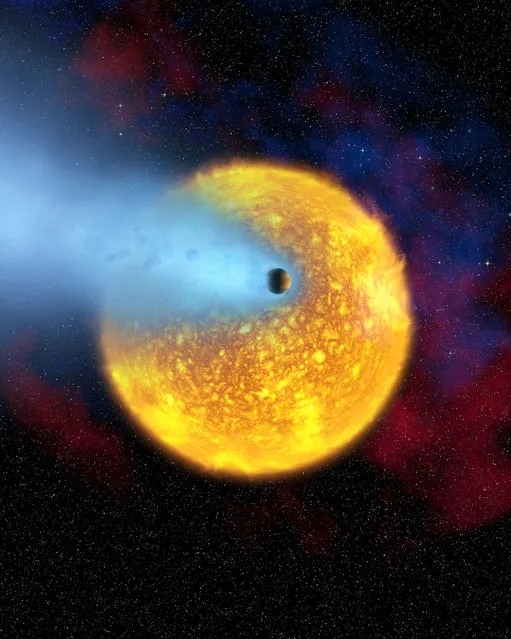
Dramatic changes spotted in HD 189733b exoplanet atmosphere

This artist's rendering illustrates the evaporation of HD 189733b's atmosphere in response to a powerful eruption from its host star. NASA's Hubble Space Telescope detected the escaping gases and NASA's Swift satellite caught the stellar flare. (Credit: NASA's Goddard Space Flight Center)
Details
29 Jun 2012 09:45:00
Retired Mongolian-born “yokozuna” wrestler Hakuho (far L), who now goes by the name Miyagino, watches as participants (R) try to push out Japanese wrestler Hakuoho (C) during a sumo class for youngsters on the sidelines of the 14th Hakuho Cup, a competition for young sumo wrestlers from elementary and middle school, at the Kokugikan arena in the Ryogoku area of Tokyo on February 12, 2024. (Photo by Richard A. Brooks/AFP Photo)

Retired Mongolian-born “yokozuna” wrestler Hakuho (far L), who now goes by the name Miyagino, watches as participants (R) try to push out Japanese wrestler Hakuoho (C) during a sumo class for youngsters on the sidelines of the 14th Hakuho Cup, a competition for young sumo wrestlers from elementary and middle school, at the Kokugikan arena in the Ryogoku area of Tokyo on February 12, 2024. (Photo by Richard A. Brooks/AFP Photo)
Details
28 Feb 2024 08:20:00
Sophia Loren gave the most legendary side-eye ever, shooting daggers at Jayne Mansfield in 1957. (Photo by Everett Collection)

Sophia Loren gave the most legendary side-eye ever, shooting daggers at Jayne Mansfield in 1957. (Photo by Everett Collection)
Details
11 Jul 2014 11:35:00

The most intrepid mountaineers haven't seen Mt. Everest quite like this. To showcase the majestic mountain, David Breashears of GlacierWorks has created a massive, zoomable image called a "gigapan," consisting of over one billion pixels
Details
26 Dec 2012 13:38:00
“Eye of a toad”. Animal Portraits, Łukasz Bożycki, Poland.  (Photo by Łukasz Bożycki)

“Eye of a toad”. Animal Portraits, Łukasz Bożycki, Poland. Early spring sees a pond near Łukasz’s home city of Warsaw, Poland, full of mating frogs and a few toads. On this March day, Łukasz shared the pond with them for an evening, sitting in the icy water in his chest-high waders, keeping as still as possible, despite the numbing cold, so that the amphibians could get used to him. “I wanted to find a fresh way of portraying the amphibians”, he says, “at water level”. Using a telephoto lens, he focused on one lone toad and waited for the sun to dip almost below the horizon before pressing the shutter, using flash to bring out the details in the shadow. His prize was “the glorious pool of sunset colour” and fiery glow of the toad’s eye. Nikon D80 + 70-300mm f4.5-5.6 lens + extension tube; 1/125 sec at f9 (-2.3 e/v); ISO 100; built-in flash. (Photo by Łukasz Bożycki)

Details
28 Aug 2013 11:45:00
Miss Lovely Legs competition at the Pick 'n Pay hypermarket in Boksburg, South Africa, 1980. (Photo by David Goldblatt/Museum of Contemporary Art Australia)

Miss Lovely Legs competition at the Pick 'n Pay hypermarket in Boksburg, South Africa, 1980. (Photo by David Goldblatt/Museum of Contemporary Art Australia)
Details
20 Oct 2018 00:05:00
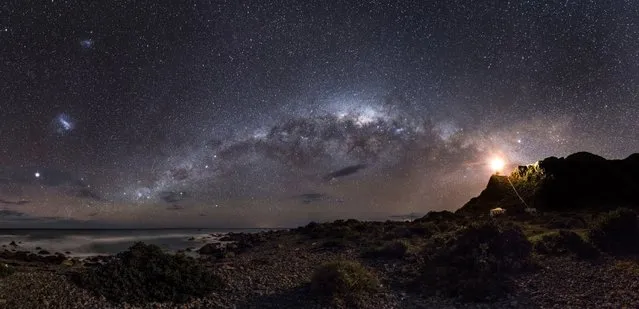
Astronomy Photographer Of The Year 2013 Part2

The Royal Observatory just announced its Astronomy Photographer Of The Year 2013 winners. Australian photographer Mark Gee was chosen among a thousand amateur and professional photographers around the globe to win the top title. His work is part of an exhibition of the winning photographers, which opened on Sept. 19 at the Royal Observatory Greenwich. The Royal Observatory shared with us the winners and notable mentions of the competition. Their descriptions of the prizewinners can be found below the images.
Details
05 Oct 2013 12:23:00
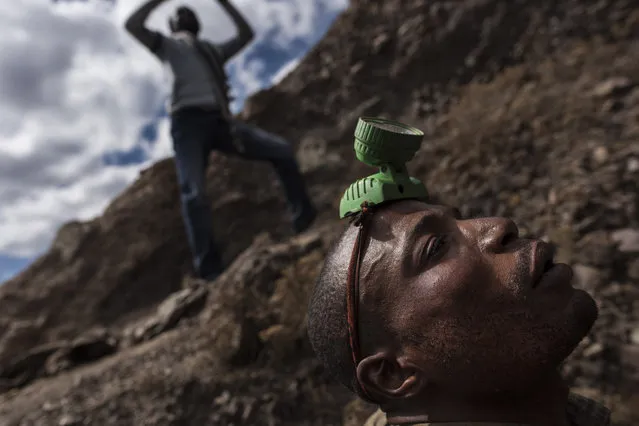
A “creuseur”, or digger, a plastic lantern on his head, readies to enter a copper and cobalt mine in Kawama, Democratic Republic of Congo on June 8, 2016. Cobalt is used in the batteries for electric cars and mobile phones. Working conditions are dangerous, often with no safety equipment or structural support for the tunnels. The diggers say they are paid on average US$2-3/day. (Photo by Michael Robinson Chavez/The Washington Post)

A “creuseur”, or digger, a plastic lantern on his head, readies to enter a copper and cobalt mine in Kawama, Democratic Republic of Congo on June 8, 2016. Cobalt is used in the batteries for electric cars and mobile phones. Working conditions are dangerous, often with no safety equipment or structural support for the tunnels. The diggers say they are paid on average US$2-3/day. (Photo by Michael Robinson Chavez/The Washington Post)
Details
30 Dec 2016 10:29:00