Balinese tries to see partial phase of hybrid solar eclipse using welding glass at Sanur Beach in Denpasar, Bali, Indonesia on April 20, 2023. Hybrid solar eclipse is when annular and total eclipse occurs on its path the across eastern Indonesian islands. However, in central and western part of Indonesia only partial eclipse phase can be observed. (Photo by Johannes P. Christo/Anadolu Agency via Getty Images)
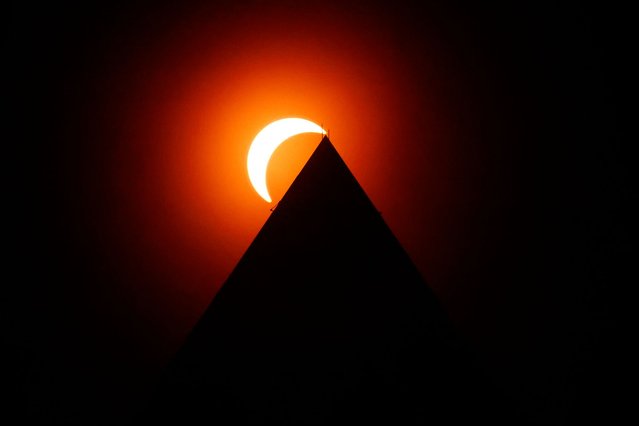
The solar eclipse is seen above the Washington Monument on April 08, 2024 in Washington, DC. People have traveled to areas across North America that are in the “path of totality” in order to experience the eclipse today. The next total solar eclipse that can be seen from a large part of North America won't happen until 2044. (Photo by Chip Somodevilla/Getty Images)
A boy plays with a toy plane on the eve of a solar eclipse, in La Higuera, Coquimbo Region, in the Atacama desert about 580 km north of Santiago, on July 1, 2019. A total solar eclipse will be visible from small parts of Chile and Argentina on July 2. (Photo by Martin Bernetti/AFP Photo)
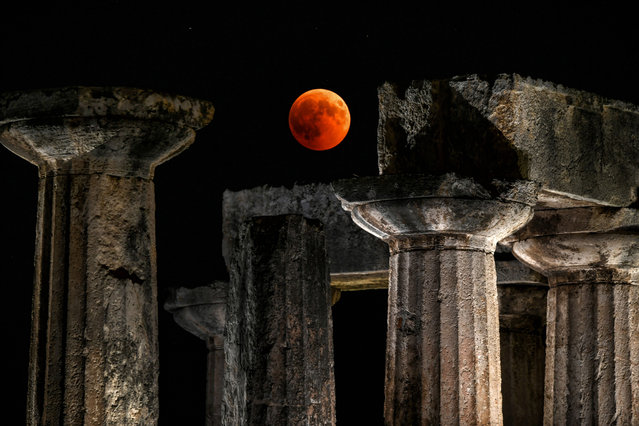
A picture shows the full moon during a “blood moon” eclipse over the temple of Apollo in Corinth on July 27, 2018. The longest “blood moon” eclipse this century began on July 27, coinciding with Mars' closest approach in 15 years to treat skygazers across the globe to a thrilling celestial spectacle. (Photo by Valerie Gache/AFP Photo)
Senate pages wear eclipse glasses as they view the moon partially covering the sun during a total solar eclipse, in front of the U.S. Senate on Capitol Hill, Monday, April 8, 2024, in Washington. (Photo by Alex Brandon/AP Photo)