Loading...
Done
Eton Wall Game

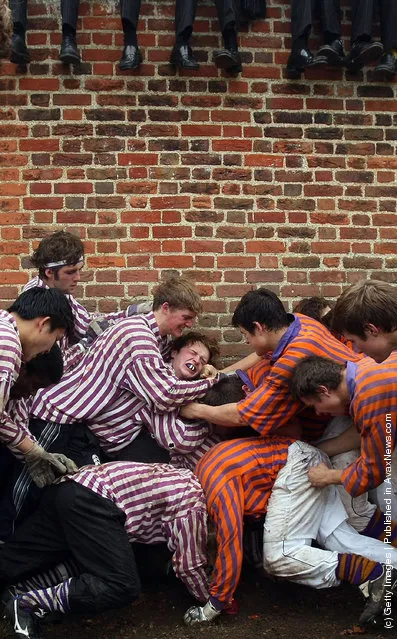
“The Eton wall game is a game similar to football and Rugby Union, that originated from and is still played at Eton College. It is played on a strip of ground 5 metres wide and 110 metres long next to a slightly curved brick wall, erected in 1717”. – Wikipedia

Photo: The “Collegers” and the “Oppidans” of Eton College take part in the “Wall Game” as boys in their traditional school uniform watch from on top of the wall on November 17, 2007 in Eton, near Windsor, Berkshire, England. The first recorded “Wall Game” took place in 1766 with competition between the two houses at the boarding school remaining as fierce as ever on the annual St. Andrew's day event. The object of the game is to get the ball to either end of the wall and score a goal, which has not happened since 1909. As well as scoring a goal the players can win points with a “shy”, where the ball is held against the wall and touched by the hand and awarded one point. (Photo by Christopher Furlong/Getty Images)
Details
22 Sep 2011 11:01:00


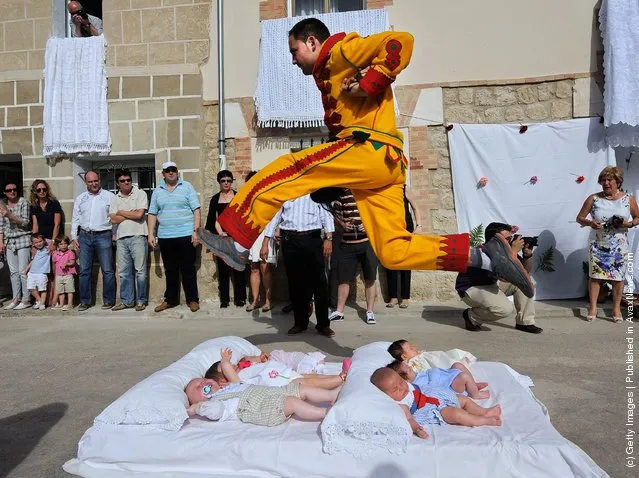
“Baby jumping (El Colacho) is a traditional Spanish practice dating back to 1620 that takes place annually to celebrate the Catholic feast of Corpus Christi in the village of Castrillo de Murcia near Burgos. During the act – known as El Salto del Colacho (the devil's jump) or simply El Colacho – men dressed as the Devil (known as the Colacho) jump over babies born during the previous twelve months of the year who lie on mattresses in the street. ... The festival has been rated as one of the most dangerous in the world”. – Wikipedia

Photo: A man representing the devil leaps over babies during the festival of El Colacho on June 26, 2011 in Castrillo de Murcia near Burgos, Spain. The festival, held on the first Sunday after Corpus Cristi, represents the devil taking away original sin from the newly born babies by leaping over them. (Photo by Denis Doyle/Getty Images)
Details
27 Jun 2011 09:20:00
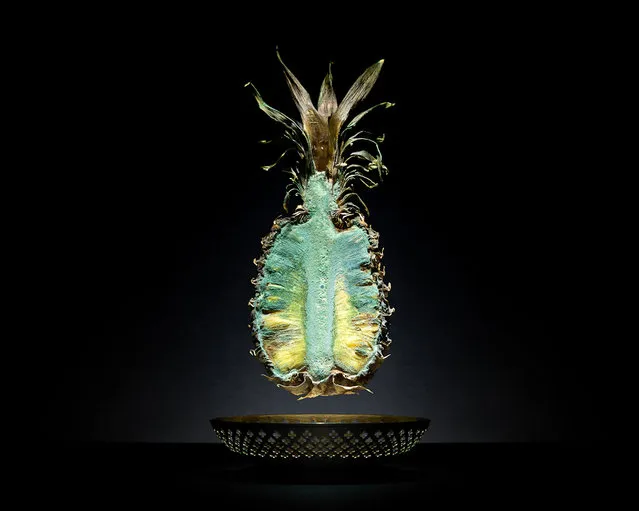
Pineapple

“One Third” – a project on food waste by an Austrian photography Klaus Pichler. According to a UN study one third of the world's food goes to waste – the largest part thereof in the industrialized nations of the global north. Equally, 925 million people around the world are threatened by starvation. The series “One Third” describes the connection between individual wastage of food and globalized food production.

Photo: Pineapple. Place of production: Guayaquil, Ecuador. Cultivation method: Outdoor plantation • Time of harvest: All- season. Transporting distance: 10.666 km (linear distance) • Means of transportation: Aircraft, truck. Carbon footprint (total) per kg: 11,94 kg • Water requirement (total) per kg: 360 l. Price: 2,10 € / kg. (Photo by Klaus Picher)
Details
02 May 2012 11:01:00
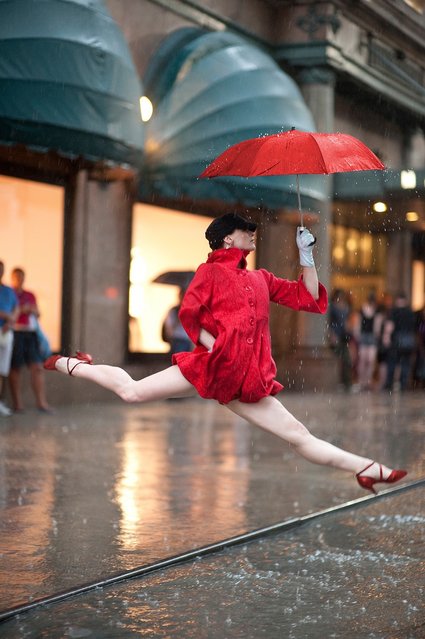
“Dancers Among Us”: Macys, NYC – Annmaria Mazzini. (Photo by Jordan Matter)

“The inspiration for this book came to me one afternoon as I watched my son, Hudson, playing with his toy bus. I was trying to keep pace with his three-year-old mind as he got deeper and deeper into a fantasy involving nothing more than a yellow plastic box and armless figurines. At least that’s what I saw. He saw frantic commuters rushing to catch the 77 local bus to Australia. He jumped in place, mouth open and slapping his knees, joyously reacting to a world I couldn’t see, but one powerfully present for him...”. – Jordan Matter

Photo: “Dancers Among Us”: Macys, NYC – Annmaria Mazzini. (Photo by Jordan Matter)
Details
12 Nov 2012 11:17:00
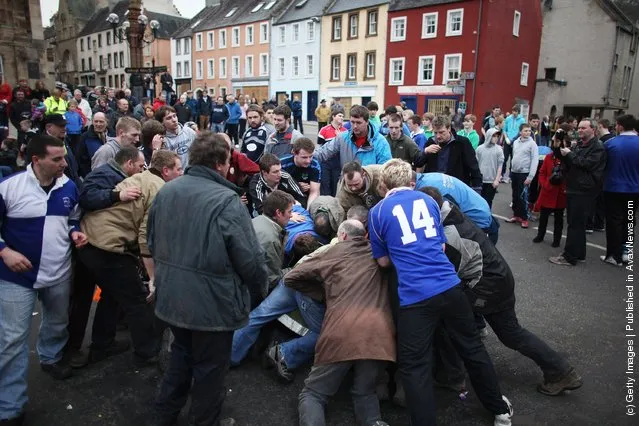
Youths tussle for the leather ball during the annual 'Fastern Eve Handba' event in Jedburgh's High Street in the Scottish Borders in Jedburgh

“Ba game is a version of medieval football played in Scotland, perhaps most notably in Orkney and the Scottish Borders, around Christmas and New Year”. – Wikipedia

Photo: Men tussle for the leather ball during the annual “Fastern Eve Handba” event in Jedburgh's High Street in the Scottish Borders on March 1, 2012 in Jedburgh, Scotland. The annual event, which started in the 1700's, takes place today and involves two teams, the Uppies (residents from the higher part of Jedburgh) and the Doonies (residents from the lower part of Jedburgh) getting the ball to either the top or bottom of the town. The ball, which is made of leather, stuffed with straw and decorated with ribbons is thrown into the crowd to begin the game. (Photo by Jeff J. Mitchell/Getty Images)
Details
02 Mar 2012 10:07:00
Cornish students (R) Nina Brooke, 21 and (L) Bonnie Mably, 20, laugh as they pose for a photograph as they try a Cornish pasty that has been baked as part of the World Cornish Pasty Championships at The Eden Project

“A Cornish pasty, sometimes known as a pastie or British pasty in the United States, is a filled pastry case, associated in particular with Cornwall in Great Britain. It is made by placing the uncooked filling on a flat pastry circle, and folding it to wrap the filling, crimping the edge at the side or top to form a seal. The result is a raised semicircular package”. – Wikipedia

Photo: Cornish students (R) Nina Brooke, 21 and (L) Bonnie Mably, 20, laugh as they pose for a photograph as they try a Cornish pasty that has been baked as part of the World Cornish Pasty Championships at The Eden Project on March 3, 2012 in St Austell, England. (Photo by Matt Cardy/Getty Images)
Details
04 Mar 2012 11:49:00
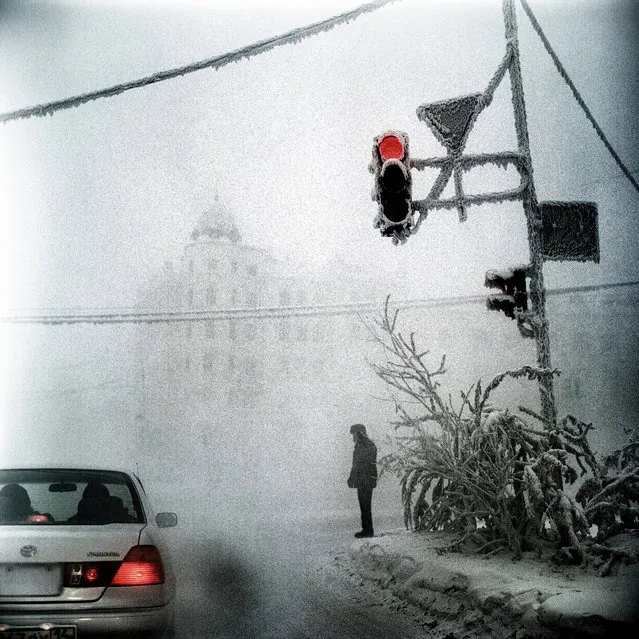
January 2013. A scene in Yakutsk, Siberia, the coldest city in the world. (Photo by Steeve Iuncker/Agence VU)

Yakutsk, a remote city in Eastern Siberia along the Lena River, is the coldest city in the world. Located 1840 km away from Irkoustk and 5000 km away from Moscow, this city founded in 1632 by the Cossacks imposes upon its inhabitants an extreme way of life. And yet, despite particularly harsh conditions, Yakutsk boasts a population of 270,000, or a quarter of the entire population of Siberia. No other place on the planet experiences the temperature extreme found here: in winter, the temperatures regularly fall to minus 40° (the coldest temperature recorded was –64°C) and in summer often reaches temperatures above 30°C. Photo: January 2013. A scene in Yakutsk, Siberia, the coldest city in the world. (Photo by Steeve Iuncker/Agence VU)
Details
29 Apr 2013 10:30:00
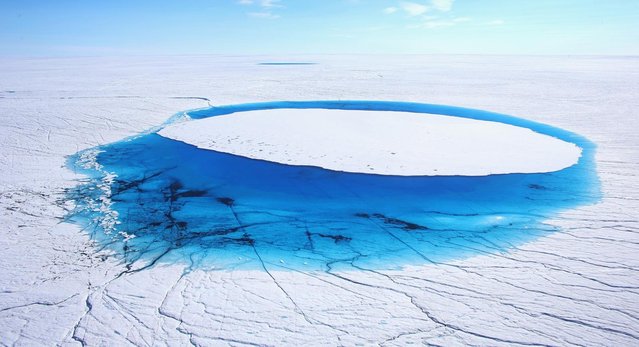
Water is seen on part of the glacial ice sheet that covers about 80 percent of the country is seen on July 17, 2013 on the Glacial Ice Sheet, Greenland. (Photo by Joe Raedle/Getty Images via The Atlantic)

Water is seen on part of the glacial ice sheet that covers about 80 percent of the country is seen on July 17, 2013 on the Glacial Ice Sheet, Greenland. As the sea levels around the globe rise, researchers affilitated with the National Science Foundation and other organizations are studying the phenomena of the melting glaciers and its long-term ramifications. The warmer temperatures that have had an effect on the glaciers in Greenland also have altered the ways in which the local populace farm, fish, hunt and even travel across land. In recent years, sea level rise in places such as Miami Beach has led to increased street flooding and prompted leaders such as New York City Mayor Michael Bloomberg to propose a $19.5 billion plan to boost the citys capacity to withstand future extreme weather events by, among other things, devising mechanisms to withstand flooding. (Photo by Joe Raedle)
Details
02 Aug 2013 10:51:00