Loading...
Done
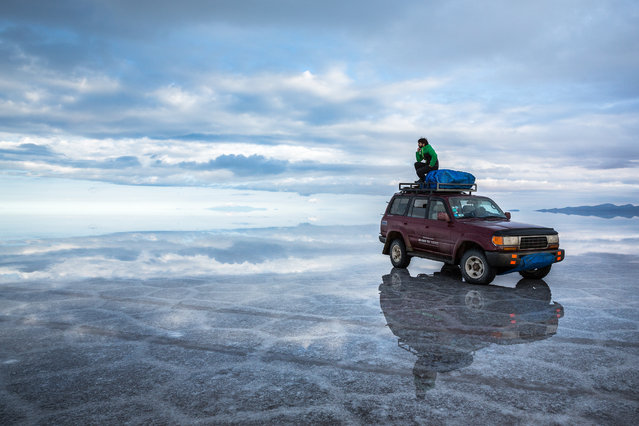
At 10,582 square kilometres, the Bolivian salt flats – otherwise known as Salar de Uyuni – are the largest on the planet and contain between 50 and 70% of the world’s lithium reserves. After exploring Chile and Argentina, photographer Joel Santos decided to travel to Bolivia in January 2017 to check the salt flats off his bucket list. With an electrical storm rolling in, Joel and his two travelling companions were the only souls left on the vast flats and captured the eerie flats without a person in sight. (Photo by Joel Santos/Barcroft Images)

At 10,582 square kilometres, the Bolivian salt flats – otherwise known as Salar de Uyuni – are the largest on the planet and contain between 50 and 70% of the world’s lithium reserves. After exploring Chile and Argentina, photographer Joel Santos decided to travel to Bolivia in January 2017 to check the salt flats off his bucket list. With an electrical storm rolling in, Joel and his two travelling companions were the only souls left on the vast flats and captured the eerie flats without a person in sight. (Photo by Joel Santos/Barcroft Images)
Details
12 Aug 2019 00:03:00
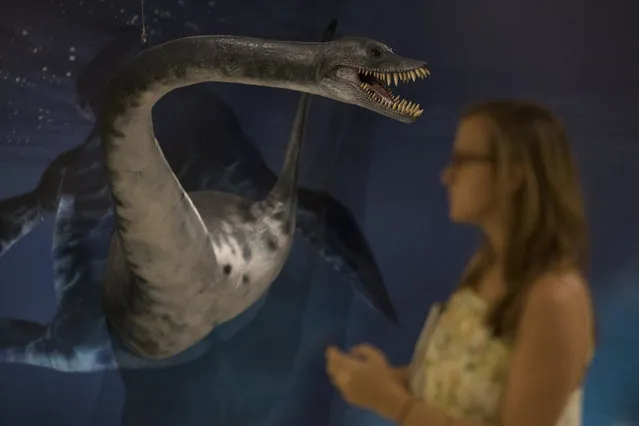
In this January 16, 2019 photo, a sculpture of a Plesiosaur is displayed at an exhibit about the studies of researchers from the National Museum made in Antartica, during a media presentation of the exhibit in Rio de Janeiro, Brazil. The National Museum will inaugurate on Jan. 17 their first exhibition after the fire, held at the building that houses the Cultural Center and Museum of Brazil's Mint. (Photo by Leo Correa/AP Photo)

In this January 16, 2019 photo, a sculpture of a Plesiosaur is displayed at an exhibit about the studies of researchers from the National Museum made in Antartica, during a media presentation of the exhibit in Rio de Janeiro, Brazil. The National Museum will inaugurate on Jan. 17 their first exhibition after the fire, held at the building that houses the Cultural Center and Museum of Brazil's Mint. (Photo by Leo Correa/AP Photo)
Details
18 Jan 2019 09:26:00
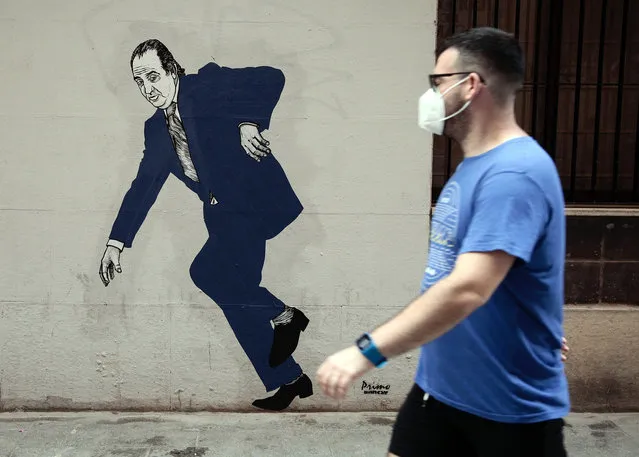
A person walks past graffiti by arstist selfnamed El Primo de Bansky (the cousin of Bansky) of former Spanish King Juan Carlos in Valencia, Spain, 05 August 2020. The Spanish Royal Household has announced that Emeritus King Juan Carlos I has proclaimed his intended decision to move abroad so as to not interfere in the image of the Spanish monarchy due to his alleged implication in a Swiss offshore account investigation. (Photo by Biel Aliño/EPA/EFE)

A person walks past graffiti by arstist selfnamed El Primo de Bansky (the cousin of Bansky) of former Spanish King Juan Carlos in Valencia, Spain, 05 August 2020. The Spanish Royal Household has announced that Emeritus King Juan Carlos I has proclaimed his intended decision to move abroad so as to not interfere in the image of the Spanish monarchy due to his alleged implication in a Swiss offshore account investigation. (Photo by Biel Aliño/EPA/EFE)
Details
07 Aug 2020 00:07:00
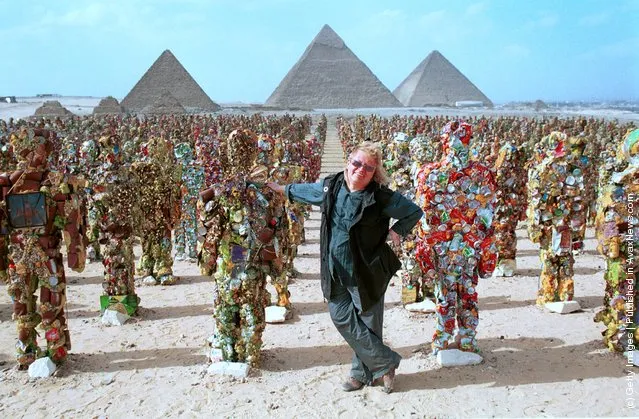
German artist Ha Schult stands with his trash people below the pyramids May 15, 2002 in Giza, Egypt

“HA Schult, born Hans-Jürgen Schult on June 24, 1939 in Parchim, Mecklenburg is a German installation, happening and conceptual artist known primarily for his object and performance art and more specifically his work with garbage”. – Wikipedia

Photo: German artist Ha Schult stands with his “trash people” below the pyramids May 15, 2002 in Giza, Egypt. Inspired by the statues of the terracotta army of Chinese Emperor Quin Shi Huangdi (247–206 B.C.), the thousand piece sulpture has stood in Red Square in Moscow, La Defense in Paris and the Great Wall in China. Schult, born in 1939 wants to bring the “trash war” to the world's attention beause trash is the greatest battle facing mankind. (Photo by Norbert Schiller/Getty Images)
Details
31 Jul 2011 13:37:00
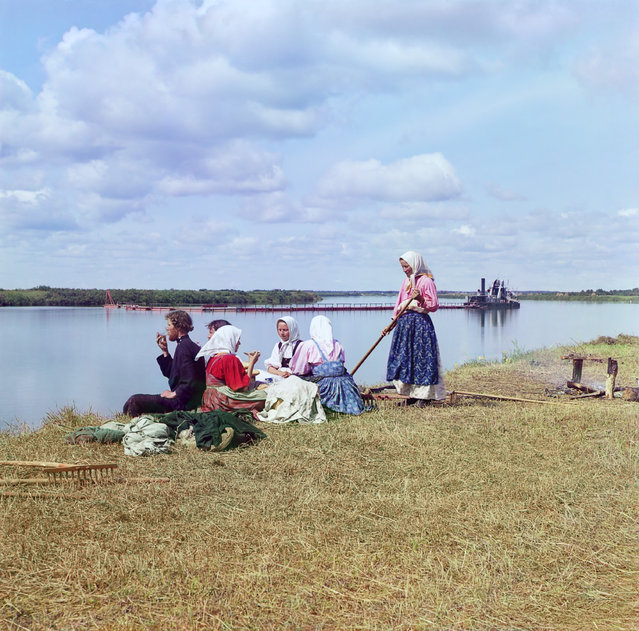
Photos by Sergey Prokudin-Gorsky. Dinner during haying. Russian Empire, Novgorod province, county Cherepovets, 1909

“Sergey Mikhaylovich Prokudin-Gorsky (August 30 1863 Russian Empire – September 27, 1944 Paris, France) was a Russian chemist and photographer. He is best known for his pioneering work in color photography of early 20th-century Russia”. – Wikipedia

Photo: Dinner during haying. Russian Empire, Novgorod province, county Cherepovets, 1909. (Photos by Sergey Prokudin-Gorsky via US Library of Congress and Prokudin-Gorsky.org)

P.S. All pictures are presented in high resolution. To see Hi-Res images – just TWICE click on any picture. In other words, click small picture – opens the BIG picture. Click BIG picture – opens VERY BIG picture (if available; this principle works anywhere on the site AvaxNews). Enjoy.
Details
24 Jul 2012 12:03:00
A woman poses for pictures with skulls made of cardboard placed on an altar next to the San Francisco church in Mexico City during the celebration of All Souls Day on November 2, 2015. (Photo by Yuri Cortez/AFP Photo)

A woman poses for pictures with skulls made of cardboard placed on an altar next to the San Francisco church in Mexico City during the celebration of All Souls Day on November 2, 2015. (Photo by Yuri Cortez/AFP Photo)
Details
05 Nov 2015 08:08:00
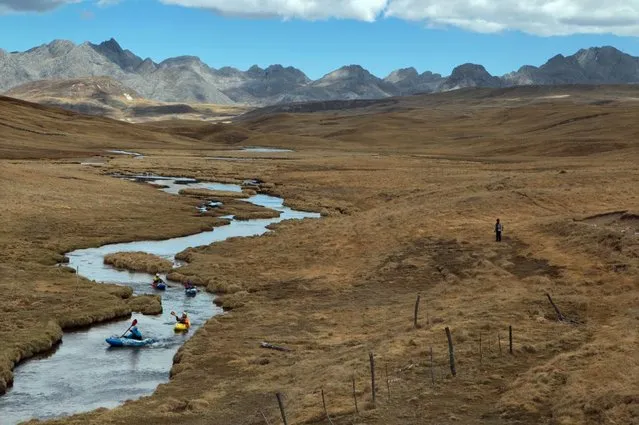
August 19, 2012 – Alpamarca, Peru – Amazon Express white water members Juan Antonio De Ugarte, of Peru, Rafael Ortiz, of Mexico, West Hansen, of the U.S., and Tino Specht, of the U.S., paddle down the Rio Gashan after leaving Lago Acucocha. Lago Acucocha is possibly the dry season source of the Amazon River. (Photo by Erich Schlegel/zReportage via ZUMA Press)

“The Amazon river has a newly discovered source. Completed last year and led by West Hansen and documented by award-winning freelance photographer Erich Schlegel, this is the first expedition to paddle from the furthest source of the earth's largest river to the ocean”. – zReportage. Photo: August 19, 2012 – Alpamarca, Peru – Amazon Express white water members Juan Antonio De Ugarte, of Peru, Rafael Ortiz, of Mexico, West Hansen, of the U.S., and Tino Specht, of the U.S., paddle down the Rio Gashan after leaving Lago Acucocha. Lago Acucocha is possibly the dry season source of the Amazon River. (Photo by Erich Schlegel/zReportage via ZUMA Press)
Details
29 Jul 2013 10:47:00
Wolfgang (L), member of World War One historical association “Darstellungsgruppe Suddeutsches Militar 1870-1918” (DSM 18), from Munich, Germany, and Florent, member of French association “Le Poilu de la Marne”, dressed in vintage army uniforms, visit the Bezonvaux bunker in the national forest of Verdun, eastern France, March 29, 2014. (Photo by Charles Platiau/Reuters)

Wolfgang (L), member of World War One historical association “Darstellungsgruppe Suddeutsches Militar 1870-1918” (DSM 18), from Munich, Germany, and Florent, member of French association “Le Poilu de la Marne”, dressed in vintage army uniforms, visit the Bezonvaux bunker in the national forest of Verdun, eastern France, March 29, 2014. Members of French and German historical associations, who gather annually, together visited the battlefield of Verdun in France, the site of a bloody World War One battle that dragged on for around 10 months in 1916, claiming hundreds of thousands of lives and destroying many villages. (Photo by Charles Platiau/Reuters)
Details
10 Apr 2014 10:49:00