Loading...
Done
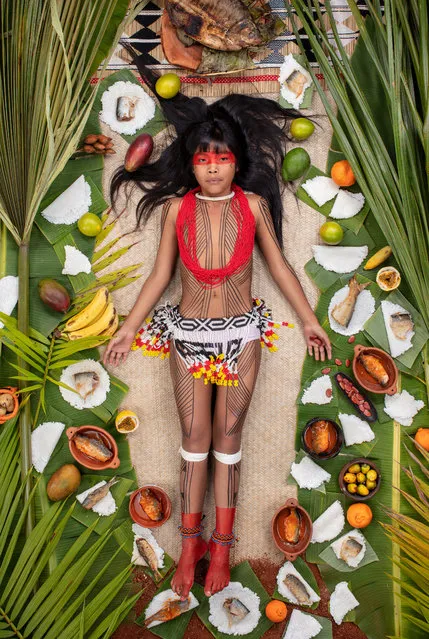
Kawakanih Yawalapiti, 9, Upper Xingu region of Mato Grosso, Brazil, 2018: Kawakanih lives with her tribe, the Yawalapiti, in Xingu national park, a preserve in the Amazon basin of Brazil. The Yawalapiti collect seeds to preserve species unique to their ecosystem, which lies between the rain forest and savannah. Kawakanih’s diet is simple, consisting mainly of fish, cassava, porridge, fruit and nuts. “It takes five minutes to catch dinner”, says Kawakanih. “When you’re hungry, you just go to the river with your net”. (Photo by Gregg Segal/The Guardian)

Photographer Gregg Segal travelled the world to document children and the food they eat in a week. Partly inspired by the increasing problems of childhood obesity, he tracked traditional regional diets as yet unaffected by globalisation, and ironically, found that the healthiest diets were often eaten by the least well off. (Photo by Gregg Segal/The Guardian)
Details
03 Jul 2019 00:03:00
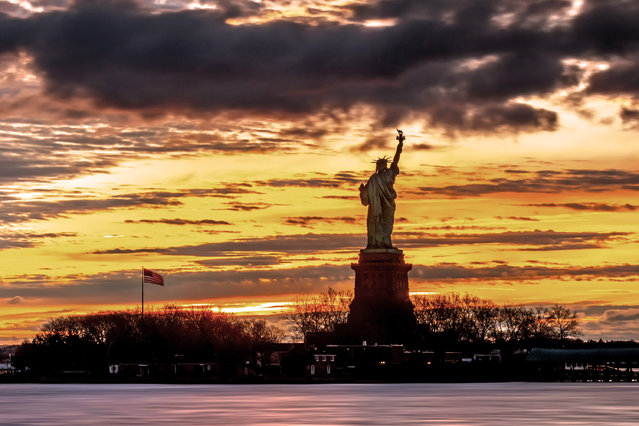
This photographer has a long love affair with lady liberty – and has captured it on film. The amazing pictures show the Statue of Liberty silhouetted against an array of beautiful backdrops, In some photographs she appears to be supporting the moon, in others celebrating with fireworks in the background. The pictures were taken by fine art photographer Peter Alessandria from New Jersey. He started taking the pictures of the statue in 2013 as part of his work capturing New Yorks famous landmarks. Here: The statue of liberty in New York City, New York. (Photo by Peter Alessandria/Caters News)

This photographer has a long love affair with lady liberty – and has captured it on film. The amazing pictures show the Statue of Liberty silhouetted against an array of beautiful backdrops. In some photographs she appears to be supporting the moon, in others celebrating with fireworks in the background. Here: The statue of liberty in New York City, New York. (Photo by Peter Alessandria/Caters News)
Details
31 Jan 2017 10:09:00
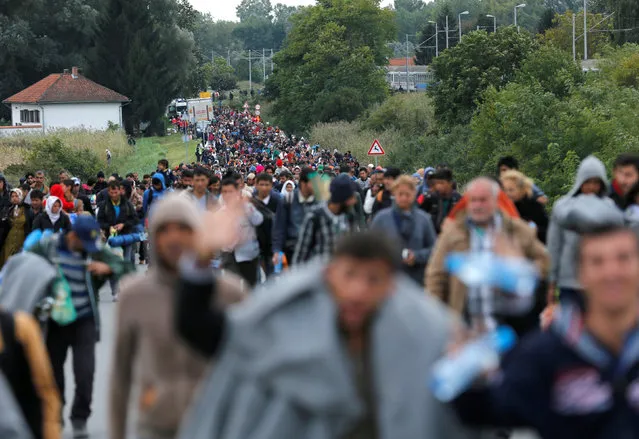
A year after hundreds of thousands of migrants and refugees snaked their way across southeastern Europe and onto television screens worldwide, the roads through the Balkans are now clear, depriving an arguably worsening tragedy of its poignant visibility. Europe's migrant crisis is at the very least numerically worse than it was last year. More people are arriving and more are dying. (Photo by Antonio Bronic/Reuters)

A year after hundreds of thousands of migrants and refugees snaked their way across southeastern Europe and onto television screens worldwide, the roads through the Balkans are now clear, depriving an arguably worsening tragedy of its poignant visibility. Reuters photographer, Antonio Bronic revisiting the people-packed locations where he and his colleagues captured last year's diaspora, found empty roads, unencumbered railway tracks and bucolic countryside. (Photo by Antonio Bronic/Reuters)


Details
12 Aug 2016 12:10:00


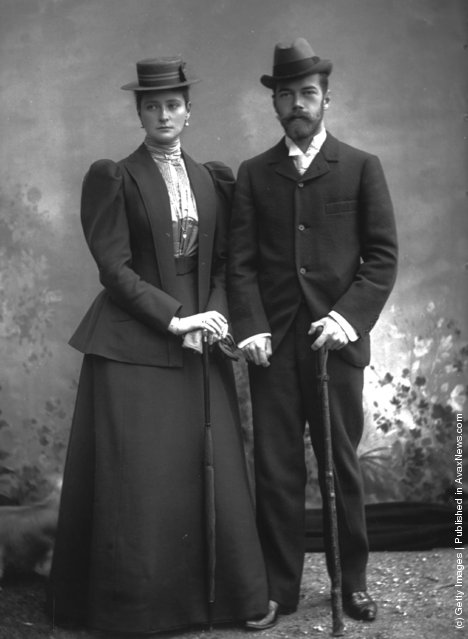
“Nicholas II (Russian: Николай II, Николай Александрович Романов, tr. Nikolay II, Nikolay Alexandrovich Romanov) (18 May [O.S. 6 May] 1868 – 17 July 1918) was the last Emperor of Russia, Grand Prince of Finland, and titular King of Poland. His official title was Nicholas II, Emperor and Autocrat of All the Russias and he is known as Saint Nicholas the Passion-Bearer by the Russian Orthodox Church. Nicholas II, his wife, his son, his four daughters, the family's medical doctor, the Tsar's valet, the Empress' lady-in-waiting and the family's cook were murdered in the same room by the Bolsheviks on the night of 16/17 July 1918”. – Wikipedia

Photo: Tsar Nicholas II (1868–1918) with his wife. (Photo by W. & D. Downey/Getty Images). Circa 1900
Details
12 May 2011 07:26:00


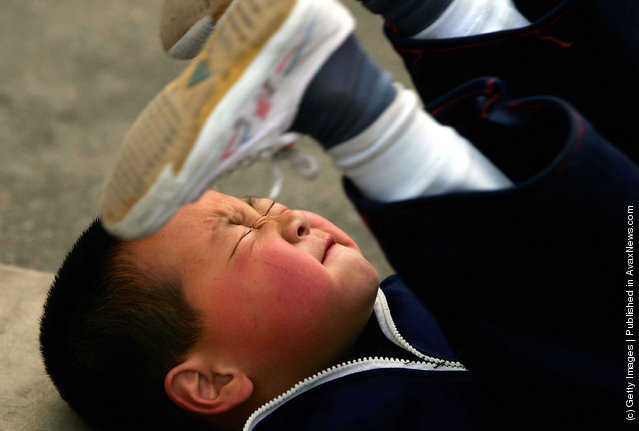
Wang Zeyu, 4, a fee-paying enthusiast of kung fu, practises during a training class at a kung fu school near the Shaolin Temple April 10, 2005 in Dengfeng, Henan Province, China. Zeyu's father sent him to the school from his home in Jiangsu Province, thousands kilometres away from Dengfeng, when he was just 3 years old. And his father must pay 9,800 yuan (US$1195) for one year's tuition at the school, a huge amount for most Chinese. There are more than 80 kung fu schools that line the road from the city of Dengfeng to the Shaolin Temple with hundreds and thousands of young kung-fu lovers from all over the country and beyond studying here. All the schools use the Shaolin name to attract students as the Shaolin Temple is the birthplace of Chinese Kung Fu. (Photo by Cancan Chu/Getty Images)
Details
06 Jul 2011 11:21:00
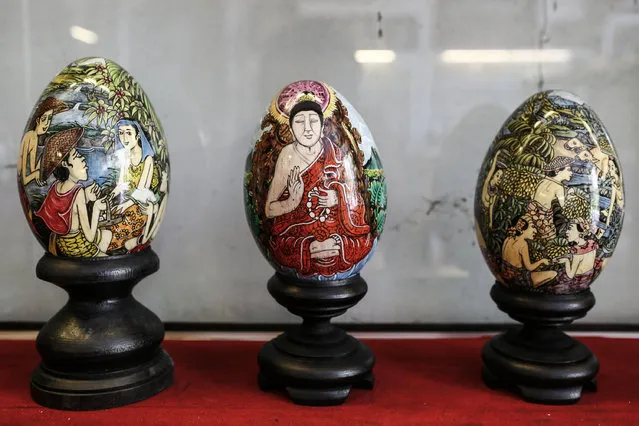
Painted eggshell displayed at Wayan Sadra's workshop on April 14, 2014 in Sukawati, Gianyar, Bali, Indonesia. (Photo by Putu Sayoga/Getty Images)

Painted eggshell displayed at Wayan Sadra's workshop on April 14, 2014 in Sukawati, Gianyar, Bali, Indonesia. 50-year-old Wayan Sadra got the idea to start his eggshell painting business, after his niece who worked in a five star hotel asked for his help to paint on an egg for an Easter egg competition. Now the business he started in 1997 attracts customers for his painted eggs from Germany, France, Italy, and the Netherlands. Sadra usually experiences a surge in sales ahead of Easter. (Photo by Putu Sayoga/Getty Images)
Details
15 Apr 2014 10:40:00
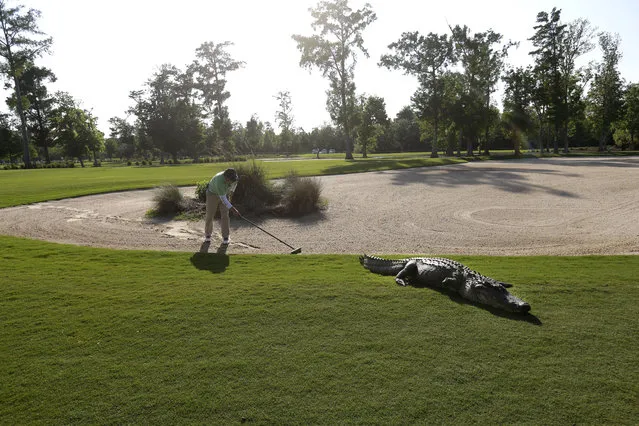
A worker grooms away tracks after an alligator crossed through a sand trap on the 14th hole during the first round of the PGA Tour Zurich Classic golf tournament at TPC Louisiana in Avondale, La., Thursday, April 25, 2013. (Photo by Gerald Herbert/AP Photo)

Gerald Herbert is a staff photographer for the AP based in New Orleans, Louisiana. Before that he was a staff photographer for the Washington Times, the New York Daily News and a freelancer for the AP in New Orleans, Boston and New York. Photo: A worker grooms away tracks after an alligator crossed through a sand trap on the 14th hole during the first round of the PGA Tour Zurich Classic golf tournament at TPC Louisiana in Avondale, La., Thursday, April 25, 2013. (Photo by Gerald Herbert/AP Photo)
Details
23 Apr 2014 10:41:00
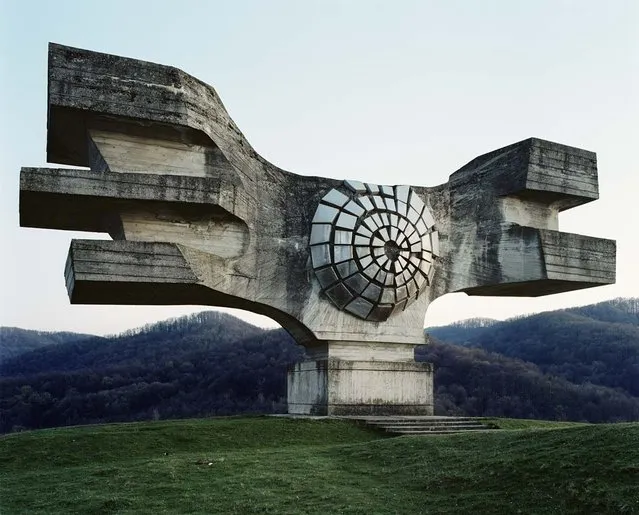
The monument of Ilirska Bistrica was designed by Janez Lenassi and built in 1965. It is dedicated to Slovenian soldiers that fell in World War II. (Photo by Jan Kempenaers)

The brutalist war memorials found throughout the former Yugoslavia were weird enough when they were built in the 1960s and 70s. Today, separated by the end of an architectural movement and the disintegration of the country, they seem almost alien. Belgian photographer Jan Kempenaers treats them purely as artistic objects in his book, “Spomenik”, named for the Serb-Croat word for monument. Known for photographing geographical oddities, Kempenaers was captivated by the spomenik after seeing them in an art encyclopedia. After hearing that many had been destroyed or abandoned, he set out to record what was left. (Photo by Jan Kempenaers)
Details
18 Aug 2014 09:07:00