Loading...
Done
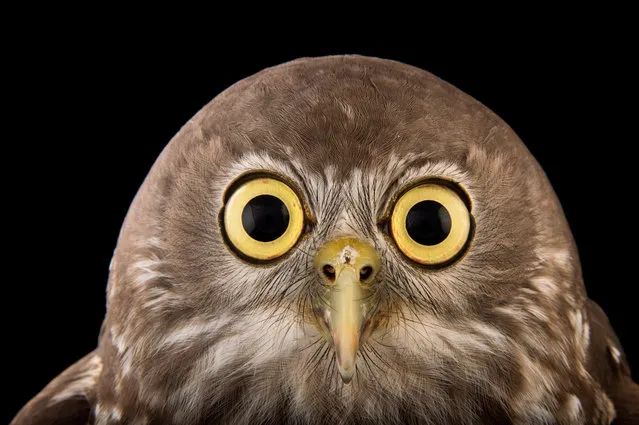
The National Geographic Photo Ark is a travelling exhibition of photographer Joel Sartore’s quest to create a photo archive of biodiversity around the world. So far, Sartore has captured studio portraits of more than 6,000 species – a number that he hopes to double. On 1 July, the ark will open at Melbourne zoo – the first time it has been exhibited in the southern hemisphere. More than 50 portraits will be on display, including many of Australian endangered animals being protected by programs at the zoo itself. These captions have been edited from text supplied by Melbourne zoo. Here: Barking owl. So-named because its call sounds like a barking dog, these birds are native to Australia, Indonesia and Papua New Guinea. In Victoria they are listed as an endangered species, and in 2003 there were estimated to be fewer than 50 breeding pairs. The main threat to the species in Victoria is loss of habitat, especially large trees with hollows in which they can nest and on which many of their prey depend. Apart from a bark, they may utter a chilling scream when they feel threatened. (Photo by Joel Sartore/National Geographic Photo Ark/The Guardian)

The National Geographic Photo Ark is a travelling exhibition of photographer Joel Sartore’s quest to create a photo archive of biodiversity around the world. So far, Sartore has captured studio portraits of more than 6,000 species – a number that he hopes to double. On 1 July, the ark will open at Melbourne zoo – the first time it has been exhibited in the southern hemisphere. More than 50 portraits will be on display, including many of Australian endangered animals being protected by programs at the zoo itself. These captions have been edited from text supplied by Melbourne zoo. Here: Barking owl. (Photo by Joel Sartore/National Geographic Photo Ark/The Guardian)
Details
01 Jul 2017 07:45:00
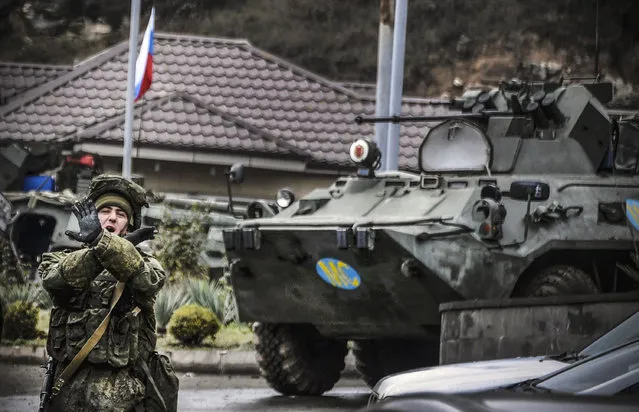
A Russian peacekeeper shouts “No pictures!” at a checkpoint outside the city of Stepanakert on November 13, 2020, during a ceasefire in the military conflict between Armenia and Azerbaijan over the breakaway region of Nagorno-Karabakh. Russian began deploying 2,000 peacekeepers to Nagorno-Karabakh on November 10 after Armenia and Azerbaijan agreed a peace deal to end weeks of fierce fighting over the disputed region. The Moscow-brokered agreement came after a string of Azerbaijani victories in its fight to retake the ethnic Armenian enclave. It sparked celebrations in Azerbaijan but fury in Armenia, where protesters took to the streets to denounce their leaders for losses in the territory, which broke from Azerbaijan's control during a war in the early 1990s. (Photo by Alexander Nemenov/AFP Photo)

A Russian peacekeeper shouts “No pictures!” at a checkpoint outside the city of Stepanakert on November 13, 2020, during a ceasefire in the military conflict between Armenia and Azerbaijan over the breakaway region of Nagorno-Karabakh. Russian began deploying 2,000 peacekeepers to Nagorno-Karabakh on November 10 after Armenia and Azerbaijan agreed a peace deal to end weeks of fierce fighting over the disputed region. (Photo by Alexander Nemenov/AFP Photo)
Details
15 Nov 2020 00:07:00
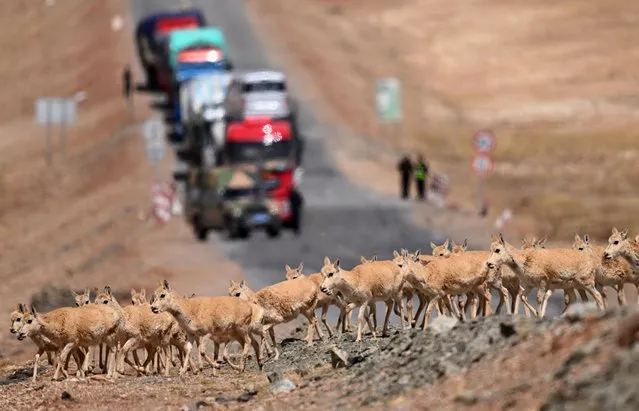
Pregnant Tibetan antelopes move across the Qinghai-Tibet highway in Hoh Xil, northwest China's Qinghai Province, May 29, 2023. A growing number of pregnant Tibetan antelopes are migrating to the heart of northwest China's Hoh Xil National Nature Reserve to give birth, according to the reserve's management office. Every year, tens of thousands of pregnant Tibetan antelopes start their migration to Hoh Xil in around May to give birth and leave with their offspring in late July. Under the first-class state protection in China, the once-endangered species is found in Tibet Autonomous Region, Qinghai Province, and Xinjiang Uygur Autonomous Region. Their population has increased over the past three decades thanks to the ban on illegal hunting and other measures implemented to improve its habitat. (Photo by Xinhua News Agency/Rex Features/Shutterstock)

Pregnant Tibetan antelopes move across the Qinghai-Tibet highway in Hoh Xil, northwest China's Qinghai Province, May 29, 2023. A growing number of pregnant Tibetan antelopes are migrating to the heart of northwest China's Hoh Xil National Nature Reserve to give birth, according to the reserve's management office. Every year, tens of thousands of pregnant Tibetan antelopes start their migration to Hoh Xil in around May to give birth and leave with their offspring in late July. (Photo by Xinhua News Agency/Rex Features/Shutterstock)
Details
08 Jun 2023 02:20:00
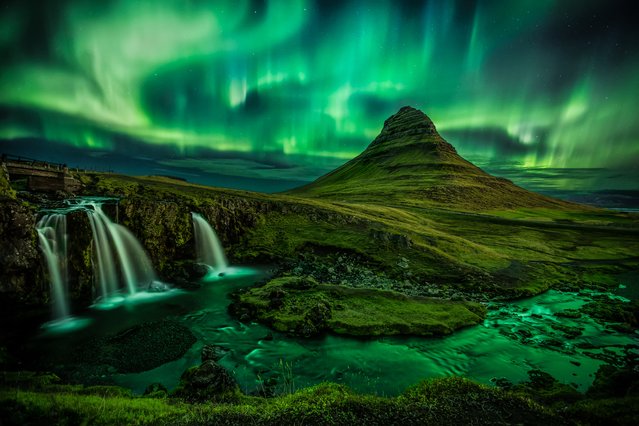
“A burst of the aurora borealis over Kirkjufell, taken in September 2016. This shot has been a holy grail for me and was finally captured after many trips”. MICK RYAN, JUDGE: Iceland is a hotspot for aurora photography and this composition of the symmetric, free-standing Kirkjufell and the trident waterfall is much-sought after. If you can time your visit when the aurora “kp” index is high and know the settings for nighttime aurora images, you may end up with a beautiful photograph like this. (Photo by DB/The Guardian)"

October winner. “A burst of the aurora borealis over Kirkjufell, taken in September 2016. This shot has been a holy grail for me and was finally captured after many trips”. MICK RYAN, JUDGE: Iceland is a hotspot for aurora photography and this composition of the symmetric, free-standing Kirkjufell and the trident waterfall is much-sought after. If you can time your visit when the aurora “kp” index is high and know the settings for nighttime aurora images, you may end up with a beautiful photograph like this. (Photo by DВ/The Guardian)
Details
26 Dec 2016 07:33:00
A model holds a 18,18 carat pink diamond called “Fortune Pink” that could fetch 30 million U.S. dollars during a preview at Christie’s before the auction sale in Geneva, Switzerland on November 2, 2022. (Photo by Denis Balibouse/Reuters)

A model holds a 18,18 carat pink diamond called “Fortune Pink” that could fetch 30 million U.S. dollars during a preview at Christie’s before the auction sale in Geneva, Switzerland on November 2, 2022. (Photo by Denis Balibouse/Reuters)
Details
27 Dec 2023 20:16:00
An aerial view shows a sinkhole 3.5 km (2 miles) to the east of Solikamsk-2 mine in Perm region, November 20, 2014. Shares in Russia's Uralkali, the world's top potash producer, fell sharply for a second day on Wednesday after a mine accident that could reduce global supplies and push up prices of the crop nutrient worldwide. (Photo by Reuters/Press service of Uralkali company)

An aerial view shows a sinkhole 3.5 km (2 miles) to the east of Solikamsk-2 mine in Perm region, November 20, 2014. Shares in Russia's Uralkali, the world's top potash producer, fell sharply for a second day on Wednesday after a mine accident that could reduce global supplies and push up prices of the crop nutrient worldwide. Uralkali shares have fallen 28 percent since Tuesday when it suspended work at its Solikamsk-2 mine, which accounts for a fifth of the company's output and 3.5 percent of global capacity, following an inflow of water. A sinkhole, stretching 30 by 40 metres (yards), found at an abandoned mine 3.5 km (2 miles) to the east, increased concern about the future of the mine because an inflow of water and the resulting sinkhole in 2006 forced another Uralkali operation to shut permanently. (Photo by Reuters/Press service of Uralkali company)
Details
22 Nov 2014 13:51:00
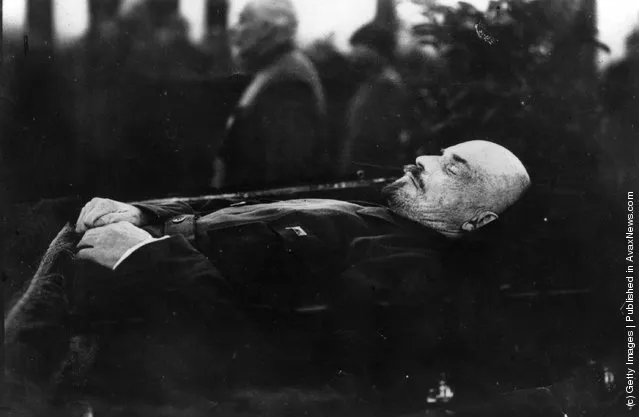
1924:  Vladimir Ilyich Lenin lying in state in the Kremlin

Photo: Vladimir Ilyich Lenin (1870 – 1924) lying in state in the Kremlin. (Photo by Hulton Archive/Getty Images). 1924

Important! For the same article in Russian language click here.

Something quite intriguing is happening within Russian-speaking internet during the last few – should you type a fully academic inquiry (at least, according to Russian academic requirements) in national search engines for "Lenin's mausoleum" – the first thing you get (even in top 10 searches) is website pages talking about black magic and occult. Website authors view this construction differently, but unconditionally agree on one thing: the mausoleum of the "leader of the world proletariat” – the essence of a magical artifact, a sort of “energy vampire”. It was built with a certain purpose: to drain the energy out of miserable Soviet citizens on one hand; and to poison the anthroposphere of one-sixth part of the earth with its vibes (the exact territory that was occupied by the former Soviet Union), depriving the Russian people of will to resist on the other hand. Complete nonsense? No doubt. Nevertheless, an intriguing one. Well, probably because some oddities do exist in mausoleum's history. These oddities are the thing we are going to discuss this time. First, let me refresh you memory on the subject.
Details
16 Oct 2011 11:27:00
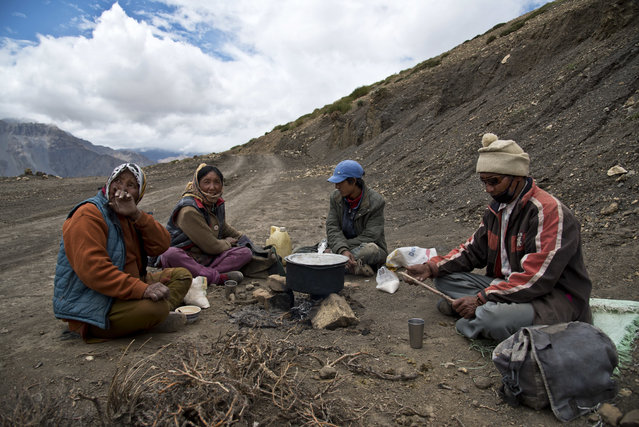
In this August 17, 2016, photo, from left to right, Chhering Chodom, 60, Tashi Yangzom, 50, Lobsang Chhering, 27, and Dorje Tandup, 58, drink milk tea on the side of the road. For centuries, the sleepy valley nestled in the Indian Himalayas remained a hidden Buddhist enclave forbidden to outsiders. Enduring the harsh year-round conditions of the high mountain desert, the people of Spiti Valley lived by a simple communal code – share the Earth's bounty, be hospitable to neighbors, and eschew greed and temptation at all turns. That's all starting to change, for better or worse. Since India began allowing its own citizens as well as outsiders to visit the valley in the early 1990s, tourism and trade have boomed. And the marks of modernization, such as solar panels, asphalt roads and concrete buildings, have begun to appear around some of the villages that dot the remote landscape at altitudes above 4,000 meters (13,000 feet). (Photo by Thomas Cytrynowicz/AP Photo)

In this August 17, 2016, photo, from left to right, Chhering Chodom, 60, Tashi Yangzom, 50, Lobsang Chhering, 27, and Dorje Tandup, 58, drink milk tea on the side of the road. For centuries, the sleepy valley nestled in the Indian Himalayas remained a hidden Buddhist enclave forbidden to outsiders. Enduring the harsh year-round conditions of the high mountain desert, the people of Spiti Valley lived by a simple communal code – share the Earth's bounty, be hospitable to neighbors, and eschew greed and temptation at all turns. That's all starting to change, for better or worse. (Photo by Thomas Cytrynowicz/AP Photo)
Details
15 Sep 2016 09:22:00