Loading...
Done
Roof-topping enthusiast Daniel Lau takes a selfie with high-rise buildings down below as he stands on the top of a skyscraper in Hong Kong, China on August 15, 2017. Welcome to “roof-topping”, where daredevils take pictures of themselves standing on the tops of tall buildings, or in some cases even dangling from them, without any safety equipment. A craze that began in Russia has now taken hold in Hong Kong, one of the world's most vertical cities, with dramatic results. “I'm an explorer”, said Daniel Lau, one of the three who climbed to the top of The Center. A student, he said roof-topping was “a getaway from my structured life”. “Before doing this, I lived like an ordinary person, having a boring life”, he said. “I wanted to do something special, something memorable. I want to let people see Hong Kong, the place they are living, from a new perspective”. Mr Lau said he had been inspired by Russian climbers and that he was unafraid of the vertiginous heights he scales. (Photo by ImagineChina/Rex Features/Shutterstock)

Roof-topping enthusiast Daniel Lau takes a selfie with high-rise buildings down below as he stands on the top of a skyscraper in Hong Kong, China on August 15, 2017. A craze that began in Russia has now taken hold in Hong Kong, one of the world's most vertical cities. Mr Lau said he had been inspired by Russian climbers and that he was unafraid of the vertiginous heights he scales. (Photo by ImagineChina/Rex Features/Shutterstock)
Details
16 Aug 2017 07:23:00
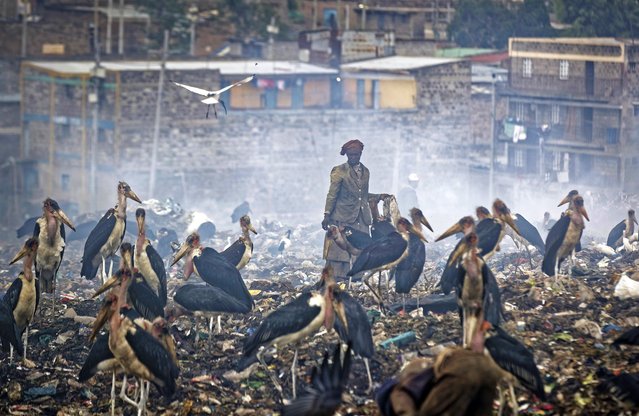
In this photo taken Wednesday, December 5, 2018, a woman who scavenges recyclable materials from garbage for a living is seen through a cloud of smoke from burning trash, surrounded by Marabou storks who feed on the garbage, at the dump in the Dandora slum of Nairobi, Kenya. As the world meets again to tackle the growing threat of climate change, how the continent tackles the growing solid waste produced by its more than 1.2 billion residents, many of them eager consumers in growing economies, is a major question in the fight against climate change. (Photo by Ben Curtis/AP Photo)

In this photo taken Wednesday, December 5, 2018, a woman who scavenges recyclable materials from garbage for a living is seen through a cloud of smoke from burning trash, surrounded by Marabou storks who feed on the garbage, at the dump in the Dandora slum of Nairobi, Kenya. As the world meets again to tackle the growing threat of climate change, how the continent tackles the growing solid waste produced by its more than 1.2 billion residents, many of them eager consumers in growing economies, is a major question in the fight against climate change. (Photo by Ben Curtis/AP Photo)
Details
14 Jan 2019 00:01:00
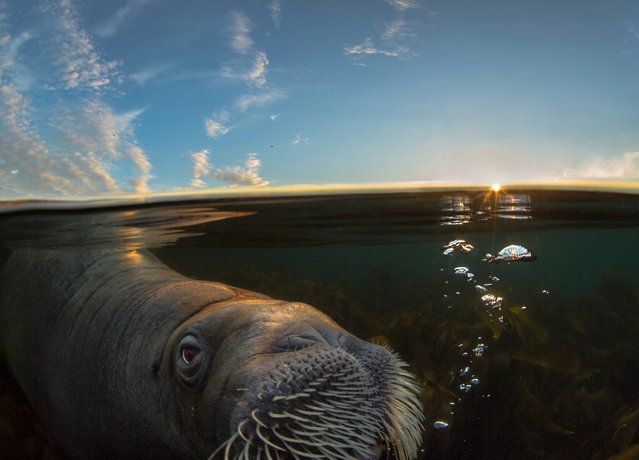
The Wildscreen festival is the world’s biggest celebration of screen-based natural history storytelling which takes place every two years in Bristol. Here: “Walrus in Midnight Sun”. Walrus feed mostly on bivalves in productive, shallow and often sandy habitats in the Arctic. This individual, though, arrived on a beach outside Tromsø, northern Norway, and found comfort on a stranded dead sperm whale. After two weeks he approached Audun, and only half a metre away he stretched his tusk forward and touched his hand gently. “This was one of the most memorable moments of my life”, Rikardsen says. He named the 500kg male Buddy. After two months, the dead whale was decomposed and Buddy suddenly disappeared. (Photo by Audun Rikardsen/Wildscreen 2016)

The Wildscreen festival is the world’s biggest celebration of screen-based natural history storytelling which takes place every two years in Bristol. Here: “Walrus in Midnight Sun”. Walrus feed mostly on bivalves in productive, shallow and often sandy habitats in the Arctic. This individual, though, arrived on a beach outside Tromsø, northern Norway, and found comfort on a stranded dead sperm whale. After two weeks he approached Audun, and only half a metre away he stretched his tusk forward and touched his hand gently. “This was one of the most memorable moments of my life”, Rikardsen says. He named the 500kg male Buddy. After two months, the dead whale was decomposed and Buddy suddenly disappeared. (Photo by Audun Rikardsen/Wildscreen 2016)
Details
07 Oct 2016 10:02:00
An Extinction Rebellion environmental activist couple getting married at an action site they are calling “The Beacon” on Westminster Bridge on October 7, 2019 in London, England. Primarily made up of London based activists the site is one of 12 situated around key Government locations in central London as actions are also predicted to occur in unto 70 cities around the world. The group aim to occupy the areas in central London for up to two weeks through non violent protest with an estimated 8 times as many people as their April protests which saw over 1,200 people arrested. (Photo by Ollie Millington/Getty Images)

An Extinction Rebellion environmental activist couple getting married at an action site they are calling “The Beacon” on Westminster Bridge on October 7, 2019 in London, England. Primarily made up of London based activists the site is one of 12 situated around key Government locations in central London as actions are also predicted to occur in unto 70 cities around the world. The group aim to occupy the areas in central London for up to two weeks through non violent protest with an estimated 8 times as many people as their April protests which saw over 1,200 people arrested. (Photo by Ollie Millington/Getty Images)
Details
10 Oct 2019 00:05:00
In this February 22, 2021, file photo, climate activist Disha Ravi, 22, travels in a car as she is taken to a court in New Delhi, India. To her friends, Ravi, was most concerned about her future in a world where temperatures are rising. But her life changed last month as she became a household name in the country, dominating news coverage after police charged her with sedition, a colonial-era law which carries a sentence up to life. Her alleged crime: sharing an online document to help amplify months-long farmer protests in India on Twitter. She was released after 10 days in custody. (Photo by Dinesh Joshi/AP Photo/File)

In this February 22, 2021, file photo, climate activist Disha Ravi, 22, travels in a car as she is taken to a court in New Delhi, India. To her friends, Ravi, was most concerned about her future in a world where temperatures are rising. But her life changed last month as she became a household name in the country, dominating news coverage after police charged her with sedition, a colonial-era law which carries a sentence up to life. Her alleged crime: sharing an online document to help amplify months-long farmer protests in India on Twitter. She was released after 10 days in custody. (Photo by Dinesh Joshi/AP Photo/File)
Details
12 Mar 2021 09:56:00
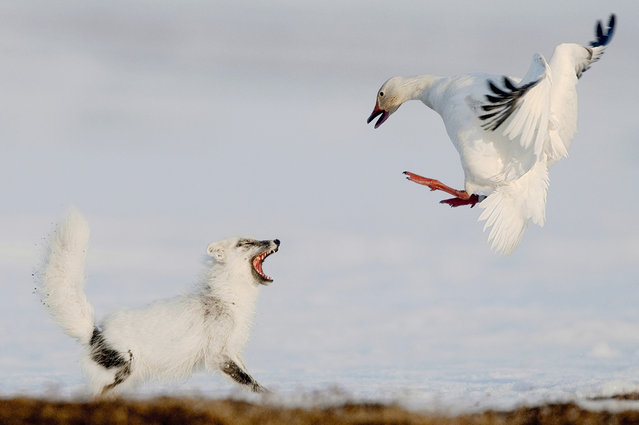
Commended. In late May, about a quarter of a million snow geese arrive from North America to nest on Wrangel Island, in northeastern Russia. They form the world's largest breeding colony of snow geese. Photographer Sergey Gorshkov spent two months on the remote island photographing the unfolding dramas. (Photo by Sergey Gorshkov/Veolia Environnement Wildlife Photographer)

Commended. In late May, about a quarter of a million snow geese arrive from North America to nest on Wrangel Island, in northeastern Russia. They form the world's largest breeding colony of snow geese. Photographer Sergey Gorshkov spent two months on the remote island photographing the unfolding dramas. Arctic foxes take advantage of the abundance of eggs, caching surplus eggs for leaner times. But a goose (here the gander) is easily a match for a fox, which must rely on speed and guile to steal eggs. “The battles were fairly equal”, notes Sergey, “and I only saw a fox succeed in grabbing an egg on a couple of occasions, despite many attempts”. Surprisingly, “the geese lacked any sense of community spirit”, he adds, “and never reacted when a fox harassed a neighboring pair nesting close by”. (Photo by Sergey Gorshkov/Veolia Environnement Wildlife Photographer)
Details
16 Jun 2015 12:30:00
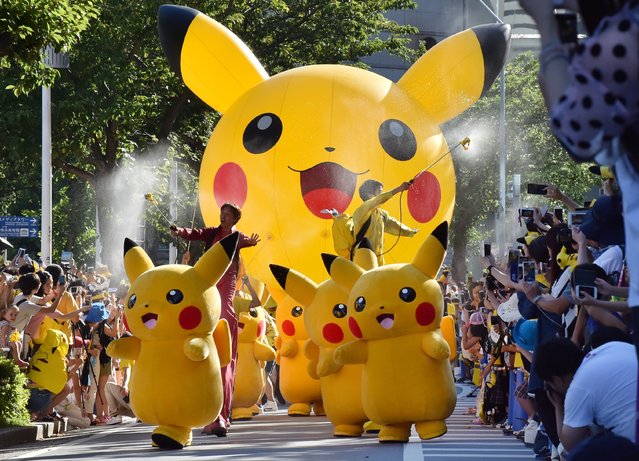
Performers dressed as Pikachu, the popular animation Pokemon series character, perform in the Pikachu parade in Yokohama on August 7, 2016. Some 50 life-size Pikachu characters, the most famous from the Pokemon game, marched along the city’s waterfront street as visitors took mobile phone pictures and videos of them in scorching sunshine. Some participants said they attended the event to search for rare characters of Pokemon – a word short for “pocket monster” – for the megahit smartphone app, which was launched in several countries around the world last month. (Photo by Kazuhiro Nogi/AFP Photo)

Performers dressed as Pikachu, the popular animation Pokemon series character, perform in the Pikachu parade in Yokohama on August 7, 2016. Some 50 life-size Pikachu characters, the most famous from the Pokemon game, marched along the city’s waterfront street as visitors took mobile phone pictures and videos of them in scorching sunshine. Some participants said they attended the event to search for rare characters of Pokemon – a word short for “pocket monster” – for the megahit smartphone app, which was launched in several countries around the world last month. (Photo by Kazuhiro Nogi/AFP Photo)
Details
08 Aug 2016 10:41:00
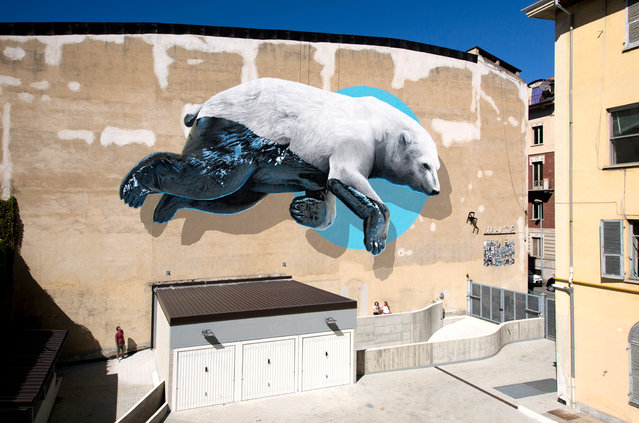
A polar bear whose bottom half is caked in oily black gunk. A whale wrapped in striped fabric: a pseudo straightjacket. These are the messes climate change leaves behind, the things we know are happening but often don’t have the opportunity to see with our own eyes. Swiss street art duo Christian Rebecchi and Pablo Togni, otherwise known as NeverCrew, met in art school when they were 15 and started making work together soon after. As a team, the artists adorn the world with eye-popping and gut-wrenching images depicting the consequences of humanity’s actions on earth. Here: “Black machine” mural painting and installation on the Colosseo theater in Turin, Italy, in September 2015. (Photo by NeverCrew/The Huffington Post)

A polar bear whose bottom half is caked in oily black gunk. A whale wrapped in striped fabric: a pseudo straightjacket. These are the messes climate change leaves behind, the things we know are happening but often don’t have the opportunity to see with our own eyes. Swiss street art duo Christian Rebecchi and Pablo Togni, otherwise known as NeverCrew, met in art school when they were 15 and started making work together soon after. As a team, the artists adorn the world with eye-popping and gut-wrenching images depicting the consequences of humanity’s actions on earth. (Photo by NeverCrew/The Huffington Post)
Details
13 Aug 2016 11:09:00