Loading...
Done
A National Bolivarian Police officer rescues a man who was being attacked by protesters, who then threw rocks at them, during a protest demanding food a few blocks from Miraflores presidential palace in Caracas, Venezuela, Thursday, June 2, 2016. (Photo by Fernando Llano/AP Photo)

A National Bolivarian Police officer rescues a man who was being attacked by protesters, who then threw rocks at them, during a protest demanding food a few blocks from Miraflores presidential palace in Caracas, Venezuela, Thursday, June 2, 2016. Venezuela is seeing rising frustration with widespread food shortages and triple-digit inflation. (Photo by Fernando Llano/AP Photo)
Details
03 Jun 2016 13:01:00
A woman talks to a man as two children play inside a wrecked car at a camp for displaced people in Port-au-Prince, Haiti, March 6, 2016. (Photo by Andres Martinez Casares/Reuters)

A woman talks to a man as two children play inside a wrecked car at a camp for displaced people in Port-au-Prince, Haiti, March 6, 2016. (Photo by Andres Martinez Casares/Reuters)
Details
18 Aug 2016 11:16:00
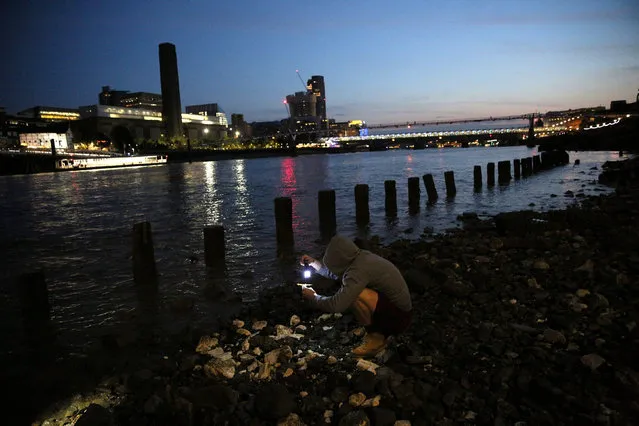
A mudlark uses a torch to look for items on the bank of the River Thames in London, Britain June 06, 2016. Mudlarking is believed to trace its origins to the 18th and 19th century, when scavengers searched the Thames' shores for items to sell. These days, history and archaeology fans are the ones hoping to find old relics such as coins, ceramics, artifacts or everyday items from across centuries. They wait for the low tide and then scour specific areas of exposed shores. "If you're in a field you could be out all day long, with the river you're restricted to about two or three hours," mudlark Nick Stevens said. While many just use the naked eye for their searches, others rely on metal detectors for which a permit from the Port of London Authority is needed. Digging also requires consent. (Photo by Neil Hall/Reuters)

A mudlark uses a torch to look for items on the bank of the River Thames in London, Britain June 06, 2016. Mudlarking is believed to trace its origins to the 18th and 19th century, when scavengers searched the Thames' shores for items to sell. These days, history and archaeology fans are the ones hoping to find old relics such as coins, ceramics, artifacts or everyday items from across centuries. their finds with the Portable Antiquities Scheme. Any item over 300 years old must be recorded. (Photo by Neil Hall/Reuters)
Details
27 Aug 2016 10:43:00
Dressed up as Punxsutawney Phil, Marty Nagy, of Hallandale Beach, Fla., gives thumbs up to passers by before the start of the 12th annual Groundhog Day on Hollywood Beach, Tuesday, February 2, 2016, in Hollywood, Fla. The event, which featured breakfast and an ocean plunge, benefited the Hollywood Beach Lifeguard Competition Team. (Photo by Wilfredo Lee/AP Photo)

Dressed up as Punxsutawney Phil, Marty Nagy, of Hallandale Beach, Fla., gives thumbs up to passers by before the start of the 12th annual Groundhog Day on Hollywood Beach, Tuesday, February 2, 2016, in Hollywood, Fla. The event, which featured breakfast and an ocean plunge, benefited the Hollywood Beach Lifeguard Competition Team. (Photo by Wilfredo Lee/AP Photo)
Details
03 Feb 2016 13:18:00
Boys play with a drainage culvert used for flood control in Las Pinas, Metro Manila February 28, 2016. (Photo by Erik De Castro/Reuters)

Boys play with a drainage culvert used for flood control in Las Pinas, Metro Manila February 28, 2016. (Photo by Erik De Castro/Reuters)
Details
13 Mar 2016 10:41:00
Hucul horses play in the wild meadows and forests near Odrzychowa in southeastern Poland on October 18, 2014. Huculs, a primitive breed of horse, escaped total extinction due to the efforts of scientists and Polish farmers. (Photo by Janek Skarzynski/AFP Photo)

Hucul horses play in the wild meadows and forests near Odrzychowa in southeastern Poland on October 18, 2014. Huculs, a primitive breed of horse, escaped total extinction due to the efforts of scientists and Polish farmers. (Photo by Janek Skarzynski/AFP Photo)
Details
25 Oct 2014 14:08:00
People of pro-government groups, with Russian flags, dance marching through downtown Moscow to mark People s Unity Day, a public holiday, in Russia, on Tuesday, November 4, 2014. (Photo by Ivan Sekretarev/AP Photo)

People of pro-government groups, with Russian flags, dance marching through downtown Moscow to mark People's Unity Day, a public holiday, in Russia, on Tuesday, November 4, 2014. Russia marks National Unity Day on November 4 to celebrate the defeat of Polish invaders in 1612. (Photo by Ivan Sekretarev/AP Photo)
Details
05 Nov 2014 12:19:00
Kawakanih Yawalapiti, 9, Upper Xingu region of Mato Grosso, Brazil, 2018: Kawakanih lives with her tribe, the Yawalapiti, in Xingu national park, a preserve in the Amazon basin of Brazil. The Yawalapiti collect seeds to preserve species unique to their ecosystem, which lies between the rain forest and savannah. Kawakanih’s diet is simple, consisting mainly of fish, cassava, porridge, fruit and nuts. “It takes five minutes to catch dinner”, says Kawakanih. “When you’re hungry, you just go to the river with your net”. (Photo by Gregg Segal/The Guardian)

Photographer Gregg Segal travelled the world to document children and the food they eat in a week. Partly inspired by the increasing problems of childhood obesity, he tracked traditional regional diets as yet unaffected by globalisation, and ironically, found that the healthiest diets were often eaten by the least well off. (Photo by Gregg Segal/The Guardian)
Details
03 Jul 2019 00:03:00