Loading...
Done
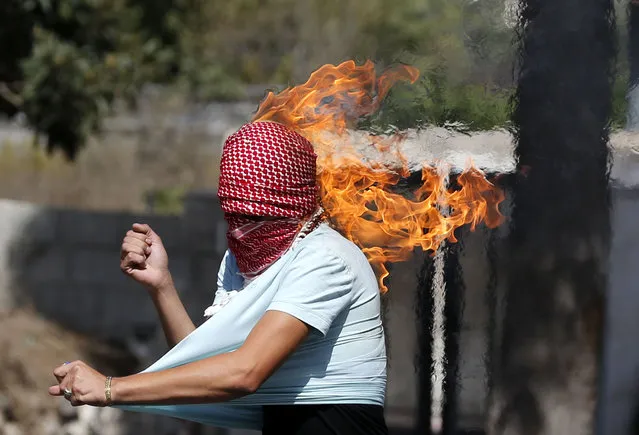
A Palestinian protester sets fire to himself as he throws a molotov cocktail during clashes with the members of the Israeli armed forces in the West Bank city of Hebron, 13 October 2015. The past 12 days have seen the worst spell of street violence in Israel and the Palestinian areas in years, stirred in part by Muslim anger over perceived changes to the status quo observed at a disputed Jerusalem holy site. (Photo by Abed Al Hashlamoun/EPA)

A Palestinian protester sets fire to himself as he throws a molotov cocktail during clashes with the members of the Israeli armed forces in the West Bank city of Hebron, 13 October 2015. The past 12 days have seen the worst spell of street violence in Israel and the Palestinian areas in years, stirred in part by Muslim anger over perceived changes to the status quo observed at a disputed Jerusalem holy site. Sixteen Palestinians from the West Bank and Jerusalem have been killed, but more than half of them have been attackers shot dead after or during attempts to stab Israelis. (Photo by Abed Al Hashlamoun/EPA)
Details
16 Oct 2015 08:06:00
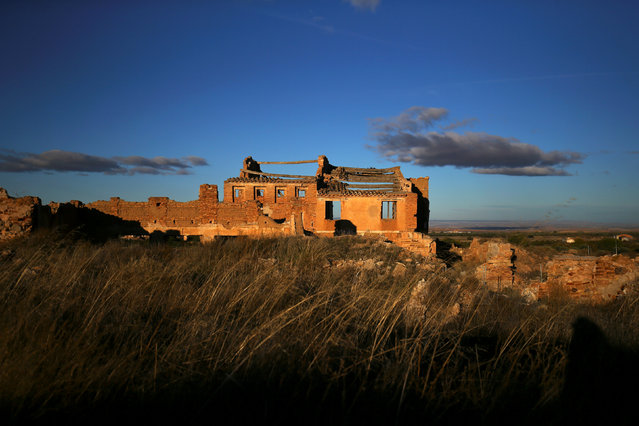
Ruins of a building are seen in the old village of Belchite, in northern Spain, November 13, 2016. (Photo by Andrea Comas/Reuters)

Ruins of a building are seen in the old village of Belchite, in northern Spain, November 13, 2016. Almost 80 years ago Tomas Ortin fled under the cover of night from his home in the small town of Belchite on Spain's northern plains to escape with hundreds of others from one of the bloodiest battles of the country's civil war. At 94 years old, Ortin now lives just across the road from Belchite, which has lain in ruins since Republican forces attacked it, a symbol of the destruction caused by the 1936-1939 war in which an estimated 500,000 people died. (Photo by Andrea Comas/Reuters)
Details
30 Nov 2016 12:31:00
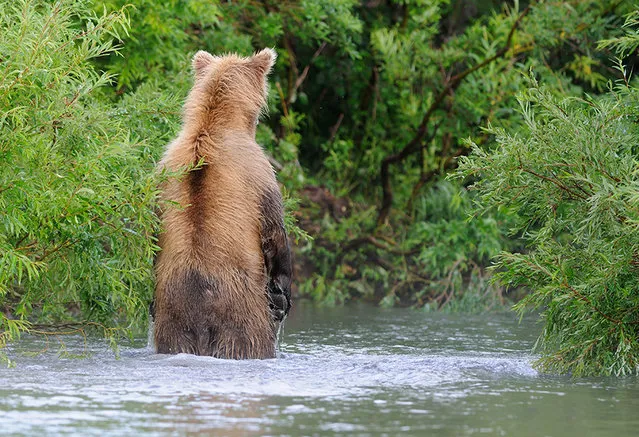
Where's the fish?/n. South Kamchatka Sanctuary<><>South Kamchatka Sanctuary; Kuril Lake; Kamchatka; bear; salmon; spawning

Igor Shpilenok works in the reserve at Kamchatka, Russia. Igor is a fellow of the International League of Conservation Photographers and a winner of the 2006 BBC Wildlife Photographer Competition. Igor’s work has been published in numerous international and Russian magazines, including Smithsonian, National Wildlife, Geo, and BBC Wildlife.

“How does a bear behave when encounter a human? In most cases he runs away. But before running he almost always would rise to stand on his rear feet. And this behavior does not indicate the attack, as many people think...” – Igor Shpilenok. (Photo by Igor Shpilenok via Wildlife Photo Russia)
Details
16 Sep 2012 12:54:00
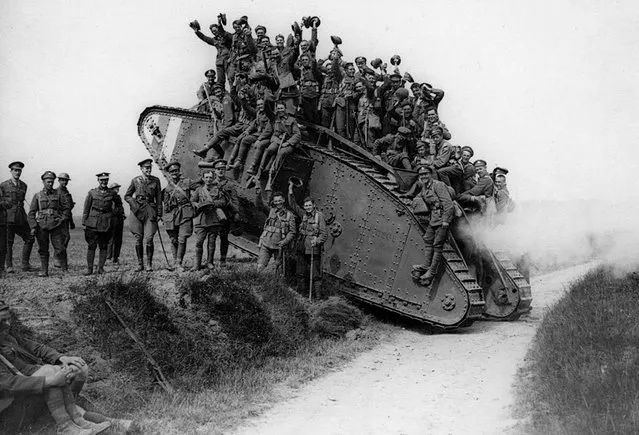
These black-and-white photos are taken from the new book “Armoured Warfare in the First World War 1916 – 1918” by Anthony Tucker-Jones and published by Pen & Sword Military. “Interestingly the British, French and Germans took completely different approaches with varying results”. The British military produced “Little Willie” in Autumn 1915 weighing 18 tonnes, which had a crew of two plus four gunners. “Inspired by a tracked artillery tractor “Little Willie” was referred to as a water tank – hence the name tank – to ensure secrecy”, said Anthony. “This led to the strange looking Mark I with its peculiar rhomboid shape, designed to cross trenches with guns in sponsons on either side. The Germans saw the tank as unchivalrous and were slow to grasp its utility. They favoured the Stormtrooper (specialist soldiers used to infiltrate enemy trenches) and artillery, not the tank”, said Anthony. “However, they didn’t hesitate to make use of captured British tanks. Although the tank helped secure victory and German soldiers dubbed it “Germany’s Downfall” the country was ultimately brought to its knees by the Allies blockade”. Here: British troops hitch a ride on a Mark IV after the massed tank fleet spearheading attack at Cambrai on November 20, 1917. (Photo by Anthony Tucker-Jones/Mediadrumworld.com)

These black-and-white photos are taken from the new book “Armoured Warfare in the First World War 1916 – 1918” by Anthony Tucker-Jones and published by Pen & Sword Military. Here: British troops hitch a ride on a Mark IV after the massed tank fleet spearheading attack at Cambrai on November 20, 1917. (Photo by Anthony Tucker-Jones/Mediadrumworld.com)
Details
23 Feb 2017 00:02:00
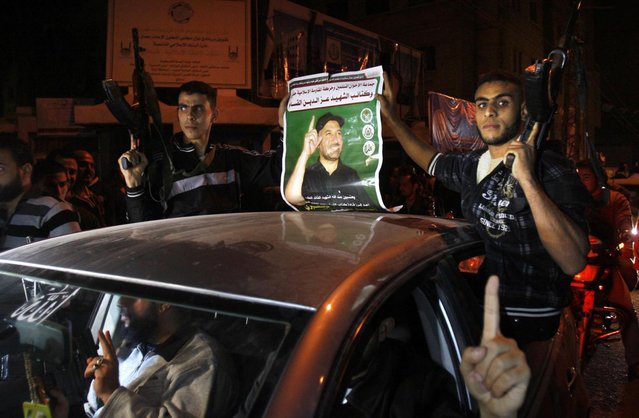
Palestinian gunmen hold a poster of late Ahmed Jabari, head of the Hamas military wing in Gaza City, while they celebrate the cease-fire agreement between Israel and Hamas in Gaza City, Wednesday, November 21, 2012. Israel and the Hamas militant group agreed to a cease-fire Wednesday to end eight days of the fiercest fighting in nearly four years, promising to halt attacks on each other and ease an Israeli blockade constricting the Gaza Strip. (Photo by Adel Hana/AP)

“News of a ceasefire is greeted by wild celebrations on the streets of Gaza, whilst Israeli residents of Jerusalem and Tel Aviv are more cautious in their support for the peace deal”. – Reuters

Photo: Palestinian gunmen hold a poster of late Ahmed Jabari, head of the Hamas military wing in Gaza City, while they celebrate the cease-fire agreement between Israel and Hamas in Gaza City, Wednesday, November 21, 2012. Israel and the Hamas militant group agreed to a cease-fire Wednesday to end eight days of the fiercest fighting in nearly four years, promising to halt attacks on each other and ease an Israeli blockade constricting the Gaza Strip. (Photo by Adel Hana/AP)
Details
22 Nov 2012 10:59:00
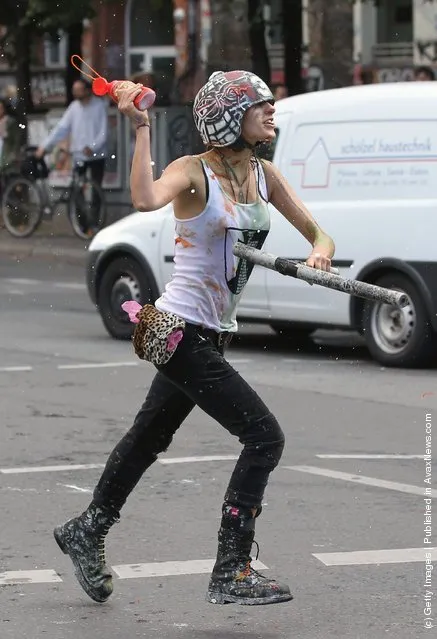
Kreuzberg Vegetable Battle

A female participant armed with a bottle of ketchup attacks in the annual Vegetable Battle in Kreuzberg district near Oberbaumbruecke Bridge on August 28, 2011 in Berlin, Germany. The event pits Kreuzberg district residents againts Friedrichshain district residents for control of the Oberbaumbruecke, and the two sides pelt each other with rotten vegetables, other foods, ketchup, water guns and styrofoam bats until one side has pushed the other from the bridge. The event had originally been cancelled for today, but so many participants showed up anyway and began battling on the Kreuzberg side, where the situation escalated and began to threaten traffic, that police relented and let them later battle it out on the bridge. Kreuzberg claimed victory. (Photo by Sean Gallup/Getty Images)
Details
29 Aug 2011 15:02:00
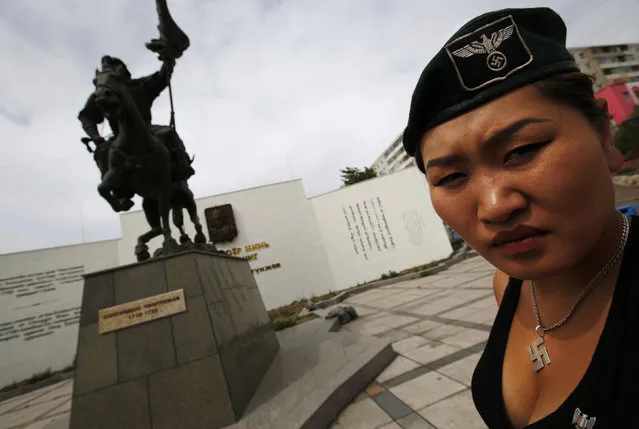
Uranjargal, a leader of the Mongolian neo-Nazi group Tsagaan Khass, stands next to a statue of Chingunjav, a Mongolian national hero, in Ulan Bator June 22, 2013. (Photo by Carlos Barria/Reuters)

Uranjargal, a leader of the Mongolian neo-Nazi group Tsagaan Khass, stands next to a statue of Chingunjav, a Mongolian national hero, in Ulan Bator June 22, 2013. The group has rebranded itself as an environmentalist organisation fighting pollution by foreign-owned mines, seeking legitimacy as it sends Swastika-wearing members to check mining permits. Over the past years, ultra-nationalist groups have expanded in the country and among those garnering attention is Tsagaan Khass, which has recently shifted its focus from activities such as attacks on women it accuses of consorting with foreign men to environmental issues, with the stated goal of protecting Mongolia from foreign mining interests. This ultra-nationalist group was founded in the 1990s and currently has 100-plus members. (Photo by Carlos Barria/Reuters)
Details
09 Jul 2013 07:23:00
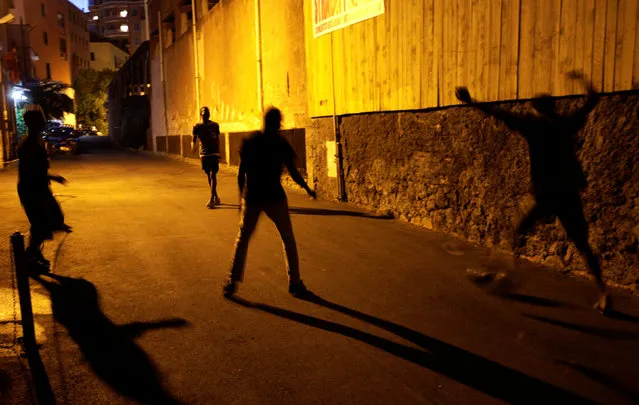
Migrants play soccer at makeshift camp in Via Cupa (Gloomy Street) in downtown Rome, Italy, August 2, 2016. Italy is taking in thousands of boat migrants every week for a third year in a row, and friction is common between them and those who live along the path many take on their journey towards northern Europe. Set up by volunteers, the Baobab centre, by Rome's Tiburtina train station, was shut down by police in December in the wake of the Paris attacks and because the European Union wants Italy to stop migrants from moving on, not help them to do so. B(Photo by Max Rossi/Reuters)

Migrants play soccer at makeshift camp in Via Cupa (Gloomy Street) in downtown Rome, Italy, August 2, 2016. Italy is taking in thousands of boat migrants every week for a third year in a row, and friction is common between them and those who live along the path many take on their journey towards northern Europe. (Photo by Max Rossi/Reuters)
Details
11 Aug 2016 14:31:00