Loading...
Done
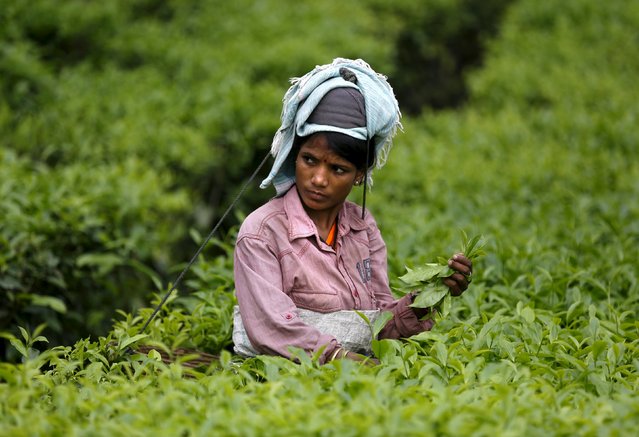
A tea garden worker plucks tea leaves inside Aideobarie Tea Estate in Jorhat in Assam, India, April 21, 2015. (Photo by Ahmad Masood/Reuters)

A tea garden worker plucks tea leaves inside Aideobarie Tea Estate in Jorhat in Assam, India, April 21, 2015. Unrest is brewing among Assam's so-called Tea Tribes as changing weather patterns upset the economics of the industry. Scientists say climate change is to blame for uneven rainfall that is cutting yields and lifting costs for tea firms. (Photo by Ahmad Masood/Reuters)
Details
05 May 2015 11:21:00
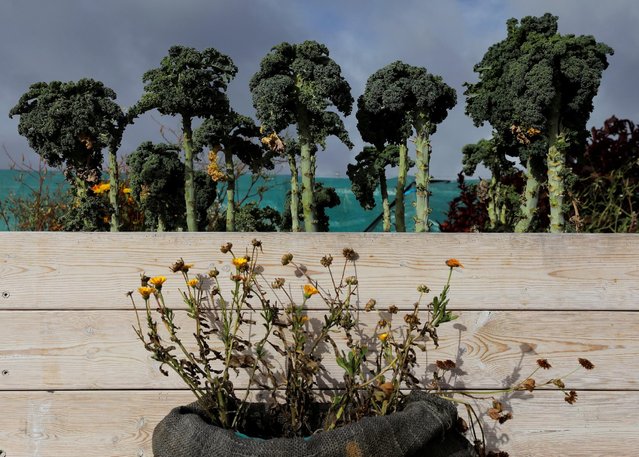
Kale grows at Kajodlingen farm in Gothenburg, Sweden, September 28, 2016. (Photo by Maxim Shemetov/Reuters)

Kale grows at Kajodlingen farm in Gothenburg, Sweden, September 28, 2016. They are doing it on the rooftops, on tower block balconies and even on a disused railway: Swedes have discovered a passion for urban gardening as a way of growing fresh food and getting back in touch with nature. Part of a global movement, an increasing number of Swedish city-dwellers are growing their own in window boxes and allotments or are visiting public gardens built in or on industrial or office spaces. (Photo by Maxim Shemetov/Reuters)
Details
11 Nov 2016 07:58:00
Gemma, right, and Joanne in their home in Angeles City. (Photo by Hannah Reyes Morales/The Washington Post)

Typhoon Yolanda – also known as Haiyan – struck the central part of the country November 8, 2013, leaving at least 6,300 people dead and over four million displaced. A month after Typhoon Haiyan, the United Nations Population Fund estimates that 5,000 women were subjected to sеxual violence. A study by the Health and Human Rights online publication shows the majority of young girls and women in Manila’s sеx industry come from poverty-stricken areas – such as Leyte, Samar, Cebu and southern Mindanao – and enter trafficking through force, deception, economic desperation and psychological manipulation. (Photo by Hannah Reyes Morales/The Washington Post)
Details
01 May 2017 09:59:00
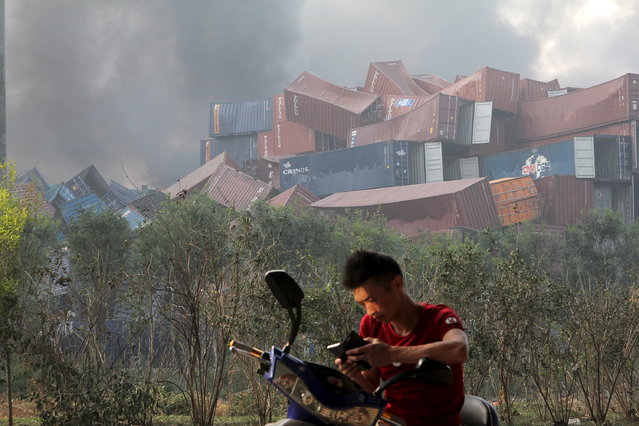
A man checks his mobile phone near overturned shipping containers after explosions hit the Binhai new district, Tianjin, August 13, 2015. (Photo by Reuters/Stringer)

A man checks his mobile phone near overturned shipping containers after explosions hit the Binhai new district, Tianjin, August 13, 2015. A huge explosion hit an industrial area in the northeastern Chinese city of Tianjin late on Wednesday evening, triggering a blast wave felt several kilometres away and injuring at least 50 people, domestic media reported. (Photo by Reuters/Stringer)
Details
13 Aug 2015 11:22:00
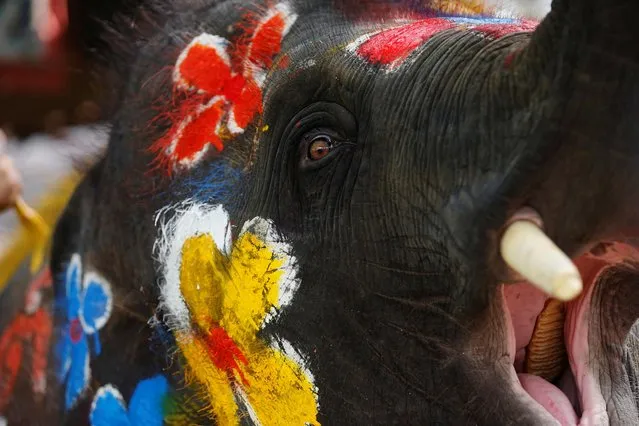
An elephant calf yawns as mahouts paint elephants ahead of celebrations for the water festival of Songkran in Ayutthaya, Thailand on April 11, 2019. (Photo by Soe Zeya Tun/Reuters)

An elephant calf yawns as mahouts paint elephants ahead of celebrations for the water festival of Songkran in Ayutthaya, Thailand on April 11, 2019. The annual elephant Songkran event is held to promote the tourism industry. Songkran Festival is held also to mark the Thai traditional New Year falling annually on 13 April, and it is celebrated with people splashing water and putting powder on each other faces as a symbolic sign of cleansing and washing away the sins from the past year. (Photo by Soe Zeya Tun/Reuters)
Details
13 Apr 2019 00:05:00
Writing about the Ambassador, the art critic Robert Melville said it was “the most daring and enterprising trade journal ever conceived … No other magazine … has so consistently and brilliantly demonstrated the relevance of works of art to the problems of industrial design”. Here: Shelagh Wilson, Copacabana beach, Rio de Janeiro, 1951. (Photo by Elsbeth Juda Archive/Victoria and Albert Museum)

“Grit and Glamour”, a retrospective of the late British photographer Elsbeth Juda, who fled Nazi occupation and came to England in 1933, is at the Jewish Museum, in London, until July 1, 2018. Here: Shelagh Wilson, Copacabana beach, Rio de Janeiro, 1951. (Photo by Elsbeth Juda Archive/Victoria and Albert Museum)
Details
31 Mar 2018 00:05:00
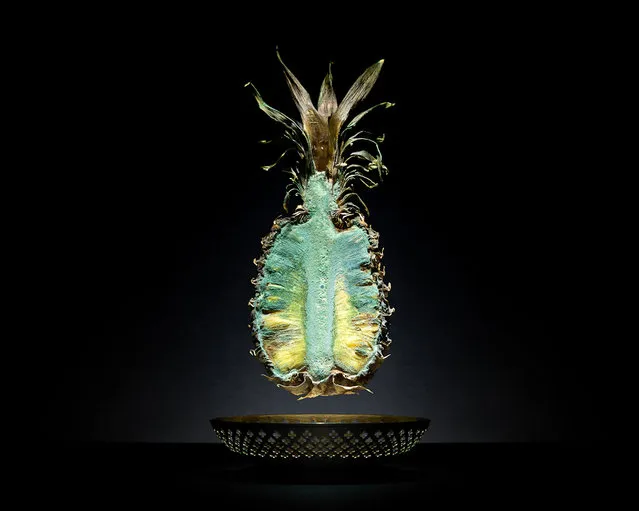
Pineapple

“One Third” – a project on food waste by an Austrian photography Klaus Pichler. According to a UN study one third of the world's food goes to waste – the largest part thereof in the industrialized nations of the global north. Equally, 925 million people around the world are threatened by starvation. The series “One Third” describes the connection between individual wastage of food and globalized food production.

Photo: Pineapple. Place of production: Guayaquil, Ecuador. Cultivation method: Outdoor plantation • Time of harvest: All- season. Transporting distance: 10.666 km (linear distance) • Means of transportation: Aircraft, truck. Carbon footprint (total) per kg: 11,94 kg • Water requirement (total) per kg: 360 l. Price: 2,10 € / kg. (Photo by Klaus Picher)
Details
02 May 2012 11:01:00
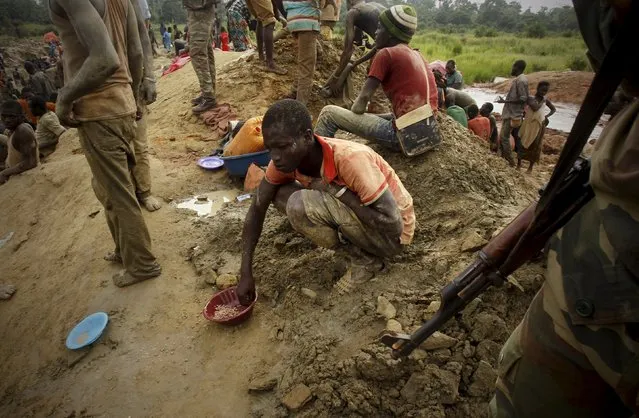
A gold prospector sits and eats close to a soldier at a gold mine near the village of Gamina, in western Ivory Coast, March 18, 2015. (Photo by Luc Gnago/Reuters)

Nestled among the cocoa plantations of western Ivory Coast is a gold mine that does not feature on any official maps. It is not run by an industrial mining company, nor does it pay taxes to the central government. The unlicensed mine is a key part of a lucrative business empire headed by the deputy commander of the West African nation's elite Republican Guard, United Nations investigators allege. Here: A gold prospector sits and eats close to a soldier at a gold mine near the village of Gamina, in western Ivory Coast, March 18, 2015. (Photo by Luc Gnago/Reuters)
Details
08 May 2015 13:54:00