Loading...
Done
A tourist pauses for photos with her mask on at Sensoji Temple Thursday, January 30, 2020, in Tokyo. The country began evacuating Japanese citizens on Wednesday from the Chinese city Wuhan hardest-hit by the virus. (Photo by Jae C. Hong/AP Photo)

A tourist pauses for photos with her mask on at Sensoji Temple Thursday, January 30, 2020, in Tokyo. The country began evacuating Japanese citizens on Wednesday from the Chinese city Wuhan hardest-hit by the virus. (Photo by Jae C. Hong/AP Photo)
Details
27 Feb 2020 00:01:00
Birds behaviour winner: Land of the Eagle by Audun Rikardsen, Norway. High on a ledge, on the coast near his home in northern Norway, Rikardsen carefully positioned an old tree branch that he hoped would make a perfect golden eagle lookout. To this, he bolted a tripod head with a camera, flashes and motion sensor attached, and built himself a hide a short distance away. From time to time, he left road‑kill carrion nearby. Very gradually – over the next three years – a golden eagle got used to the camera and started to use the branch regularly to survey the coast below. (Photo by Audun Rikardsen/2019 Wildlife Photographer of the Year)


Birds behaviour winner: Land of the Eagle by Audun Rikardsen, Norway. High on a ledge, on the coast near his home in northern Norway, Rikardsen carefully positioned an old tree branch that he hoped would make a perfect golden eagle lookout. To this, he bolted a tripod head with a camera, flashes and motion sensor attached, and built himself a hide a short distance away. From time to time, he left road‑kill carrion nearby. Very gradually – over the next three years – a golden eagle got used to the camera and started to use the branch regularly to survey the coast below. (Photo by Audun Rikardsen/2019 Wildlife Photographer of the Year)
Details
17 Oct 2019 00:03:00
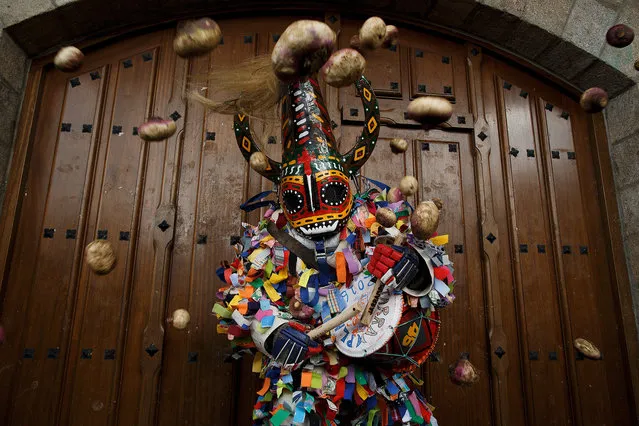
People throw turnips at the Jarramplas as he comes out from the church beating his drum during the Jarramplas Festival on January 20, 2016 in Piornal, Caceres province, Spain. The centuries old Jarramplas festival takes place annually every January 19-20 on Saint Sebastian Day and this year they expect to use more than 20 thousand kilogrames of turnips. Even though the exact origins of the festival are not known, various theories exist including the mythological punishment of Caco by Hercules. (Photo by Pablo Blazquez Dominguez/Getty Images)

People throw turnips at the Jarramplas as he comes out from the church beating his drum during the Jarramplas Festival on January 20, 2016 in Piornal, Caceres province, Spain. The centuries old Jarramplas festival takes place annually every January 19-20 on Saint Sebastian Day and this year they expect to use more than 20 thousand kilogrames of turnips. Even though the exact origins of the festival are not known, various theories exist including the mythological punishment of Caco by Hercules, a relation to ceremonies celebrated by the American Indians that were seen by the first conquerors, to a cattle thief ridiculed and expelled by his village neighbours. It is generally believed to symbolize the expulsion of everything bad. (Photo by Pablo Blazquez Dominguez/Getty Images)
Details
21 Jan 2016 13:21:00
Jack, a Lurcher from Dogs Trust Salisbury, walks past a window display of models in a Dogs Trust shop window in Salisbury, as part of a campaign to discourage the impulse buying of dogs ahead of Valentine's Day, on February 10, 2014. (Photo by Matt Alexander/PA Wire)

Jack, a Lurcher from Dogs Trust Salisbury, walks past a window display of models in a Dogs Trust shop window in Salisbury, as part of a campaign to discourage the impulse buying of dogs ahead of Valentine's Day, on February 10, 2014. (Photo by Matt Alexander/PA Wire)
Details
15 Feb 2014 12:30:00
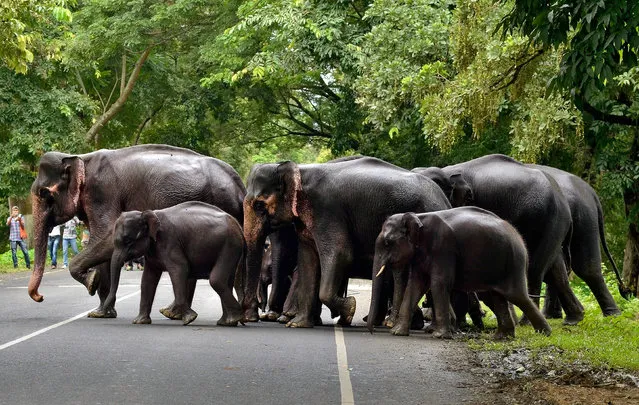
A herd of elephants cross a road that passes through the flooded Kaziranga National Park in the northeastern state of Assam, India, July 12, 2017. (Photo by Anuwar Hazarika/Reuters)

A herd of elephants cross a road that passes through the flooded Kaziranga National Park in the northeastern state of Assam, India, July 12, 2017. (Photo by Anuwar Hazarika/Reuters)
Details
15 Jul 2017 08:26:00
Head coach Kim Mulkey of the LSU Lady Tigers enters the stadium on the red carpet before playing against the Iowa Hawkeyes during the 2023 NCAA Women's Basketball Tournament championship game at American Airlines Center on April 02, 2023 in Dallas, Texas. (Photo by Maddie Meyer/Getty Images)

Head coach Kim Mulkey of the LSU Lady Tigers enters the stadium on the red carpet before playing against the Iowa Hawkeyes during the 2023 NCAA Women's Basketball Tournament championship game at American Airlines Center on April 02, 2023 in Dallas, Texas. (Photo by Maddie Meyer/Getty Images)
Details
13 Apr 2023 03:06:00
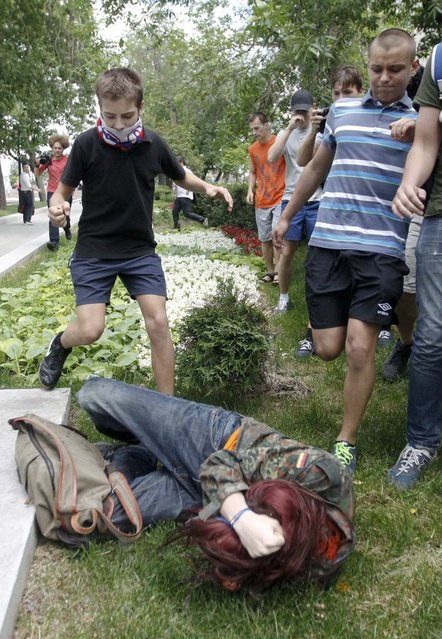
Youths kick a gay rights activist during a protest against a proposed new law termed by the State Duma, the lower house of Parliament, as “against advocating the rejection of traditional family values” in central Moscow June 11, 2013. (Photo by Maxim Shemetov/Reuters)

Youths kick a gay rights activist during a protest against a proposed new law termed by the State Duma, the lower house of Parliament, as “against advocating the rejection of traditional family values” in central Moscow June 11, 2013. (Photo by Maxim Shemetov/Reuters)
Details
12 Jun 2013 08:46:00


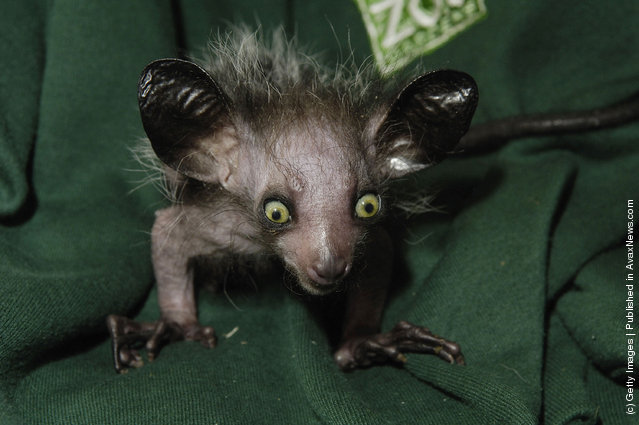
“The aye-aye (Daubentonia madagascariensis) is a lemur, a strepsirrhine primate native to Madagascar that combines rodent-like teeth and a special thin middle finger to fill the same ecological niche as a woodpecker. It is the world's largest nocturnal primate, and is characterized by its unusual method of finding food; it taps on trees to find grubs, then gnaws holes in the wood and inserts its narrow middle finger to pull the grubs out. The only other animal species known to find food in this way is the striped possum. From an ecological point of view the aye-aye fills the niche of a woodpecker as it is capable of penetrating wood to extract the invertebrates within”. – Wikipedia

Photo: In this handout image from Bristol Zoo is seen the first captive bred aye-aye in the UK named “Kintana” (meaning star in Malagasy) April 15, 2005 at Bristol Zoo Gardens, England. The zoo announced today only the second baby aye-aye to be hand-reared in the world (the first was in Jersey Zoo) and has now made his first public appearance since his birth on 11 February 2005. (Photo by Rob Cousins/Bristol Zoo via Getty Images)
Details
13 Apr 2011 13:33:00